 NEWSLETTER
The Monday Edition
Our Monday News Analysis | What the World Reads Now!
Helping to Heal a Broken Humanity (Part 100)
The Hague, 29 June 2026 | If you know of a decisive story, tell the world! We're still searching.
.jpg)
In the Beginning God Created the Heavens and the Earth ...A Journey of Hope
The future of humanity is, first of all, God’s future, in the sense that he alone knows it, prepares it, and brings it about. Of course, he calls for and invites human co-operation,
but he never ceases to be the transcendent “director” of history.
Saint Pope John Paul II
General Audience
The Vatican — 19 November 1980

Building the Bridge Foundation
Click here for Part 2
Click here for Part 3
Click here for Part 4
Click here for Part 5
Click here for Part 6
Click here for Part 7
Click here for Part 8
Click here for Part 9
Click here for Part 10
Click here for Part 11
Click here for Part 12
Click here for Part 13
Click here for Part 14
Click here for Part 15
Click here for Part 16
Click here for Part 17
Click here for Part 18
Click here for Part 19
Click here for Part 20
Click here for Part 21
Click here for Part 22
Click here for Part 23
Click here for Part 24
Click here for Part 25
Click here for Part 26
Click here for Part 27
Click here for Part 28
Click here for Part 29
Click here for Part 30
Click here for Part 31
Click here for Part 32
Click here for Part 33
Click here for Part 34
Click here for Part 35
Click here for Part 36
Click here for Part 37
Click here for Part 38
Click here for Part 39
Click here for Part 40
Click here for Part 41
Click here for Part 42
Click here for Part 43
Click here for Part 44
Click here for Part 45
Click here for Part 46
Click here for Part 47
Click here for Part 48
Click here for Part 49
Click here for Part 50
Click here for Part 51
Click here for Part 52
Click here for Part 53
Click here for Part 54
EDITORIAL | Firmly on the Ground

By Abraham A. van Kempen
29 June 2026
Often, you’ve heard me say that I’m trying to look at what’s going on here on earth from 30,000 feet away. That started when I was, indeed, 26,000 to 30,000 feet in the air, working on one of my editorials. I thought, “Wow, this is kind of tough.” Well, I’ve got news for you. I’d like, if possible, to report to you from a bit further away, the nearest star to Planet Earth, Proxima Centauri. But now I have a logistical issue. Better said, “Houston has a problem.” Proxima Centauri is only 4.24 light-years away from The Hague. But how many miles is one light year? I looked it up. Are you ready? One light year is 5.8 trillion (yes, you read this right) miles. So, never mind, I’ll stick to firmly planting my feet on the earth.
Considering the vastness of the universe, we are a tiny speck. The Sun, for example, is 93 million miles from Earth and has a diameter of 800,000 miles, enough to contain about 1.3 million Earths. However, this is trivial compared to Betelgeuse, one of trillions of stars. Located 640 light-years away, its distance in miles is unimaginably large—640 light-years times 5.8 trillion miles per light-year results in an almost uncountable number. Betelgeuse itself is enormous, with a diameter of 561 million miles, capable of holding 450,000 Suns and 585 billion Earths. So, where is God in this infinite universe? Perhaps He is still working out the numbers, expanding beyond His expectations. God is unending in His work, and we should be too. There’s still much to accomplish. Life remains a work in progress. Let’s move forward!
Last Friday, I stated that I’ll introduce you to an individual whose reputation remains largely unrecognized, a person whom future historians may consider as the Statesman of the 21st Century. In last Friday’s editorial, I wrote about my conversation with a friend of mine who, among many others, asked me which side I’m on. I told him, and everyone else knows, I’m on the side of ‘humanity’ — building bridges to help heal a broken world, in a small way. I lack the power of Presidents Trump, Xi, and Putin, but I can and did pass the baton by nominating them for the Nobel Peace Prize.
I have a slight problem right now. I must stop writing to rest my eyes. I’ll be back this coming Friday. Before I leave you, click on this link: ‘nominating them for the Nobel Peace Prize.’
One of those guys will inevitably be recognized by future historians as the Statesman of the 21st Century. I promise, I will explain my position and defend my opinion on Friday.
And, yes, we’re all heading toward Yalta. No one wants a nuclear crater in their backyard.

To be continued on Friday, 3 July 2026.
Enjoy your week,
Abraham A. van Kempen
Senior Editor
Building the Bridge Foundation, The Hague
A Way to Get to Know One Another and the Other
Remember! Diplomacy is catalytic—transformative —while military action is cataclysmic—destructive and catastrophic.
When faced with the options to be good, bad, or ugly, let’s build bridges, not burn them. After all, mutual deterrence reigns.
LAVROV'S WW3 WARNING WAS IGNORED—PUTIN'S INFORMATION WAR IS FAILING | PROF JIANG XUEQIN
In this video, we examine how Lavrov's WW3 Warning Was Ignored, and Russia is advancing on the battlefield in eastern Ukraine — but Western media is barely covering it. We also break down what's really happening on the front lines, why the coverage has shifted to drones and economics, and why Russia is winning the war but losing the information battle.

Watch the Video Here (24 minutes, 24 seconds)
Host: Prof. Jiang Xueqin
Prof Jiang Insights
28 June 2026
Prof. Jiang Queqin analyzes how military developments in Ukraine are portrayed differently in Western media. He notes that major Western outlets tend to overlook Russian advances in eastern Ukraine, especially in the Donbas, focusing instead on Ukrainian drone attacks and forecasts of Russian economic downturn.
These narratives are somewhat valid but not enough: drone strikes may hold symbolic and strategic importance, yet they seem not to change Russia’s territorial gains; similarly, sanctions have impacted Russia but haven't caused the economic collapse forecasted since 2022.
Another theme emphasizes the conflict between military achievements and strategic communication. Prof. Jiang suggests that Russia may be making military progress but faces challenges in the information space because of weak narrative management, a media system centered on domestic viewers, and cautious diplomacy with Washington. Ambiguous responses to drone incidents and inconsistent red-line declarations are viewed as weaknesses that allow Ukrainian and Western narratives to influence global perception.
Contemporary warfare transcends mere territorial control, attrition, and battlefield power. It depends significantly on how information is conveyed to domestic audiences, allies, adversaries, and neutral nations. Ukraine is portrayed as sustaining Western support despite setbacks, whereas Russia struggles to translate battlefield wins into political legitimacy. Consequently, the text highlights the importance of the information environment in modern conflicts and warns that an increasing gap between prevailing narratives and factual realities could trigger a major reevaluation.
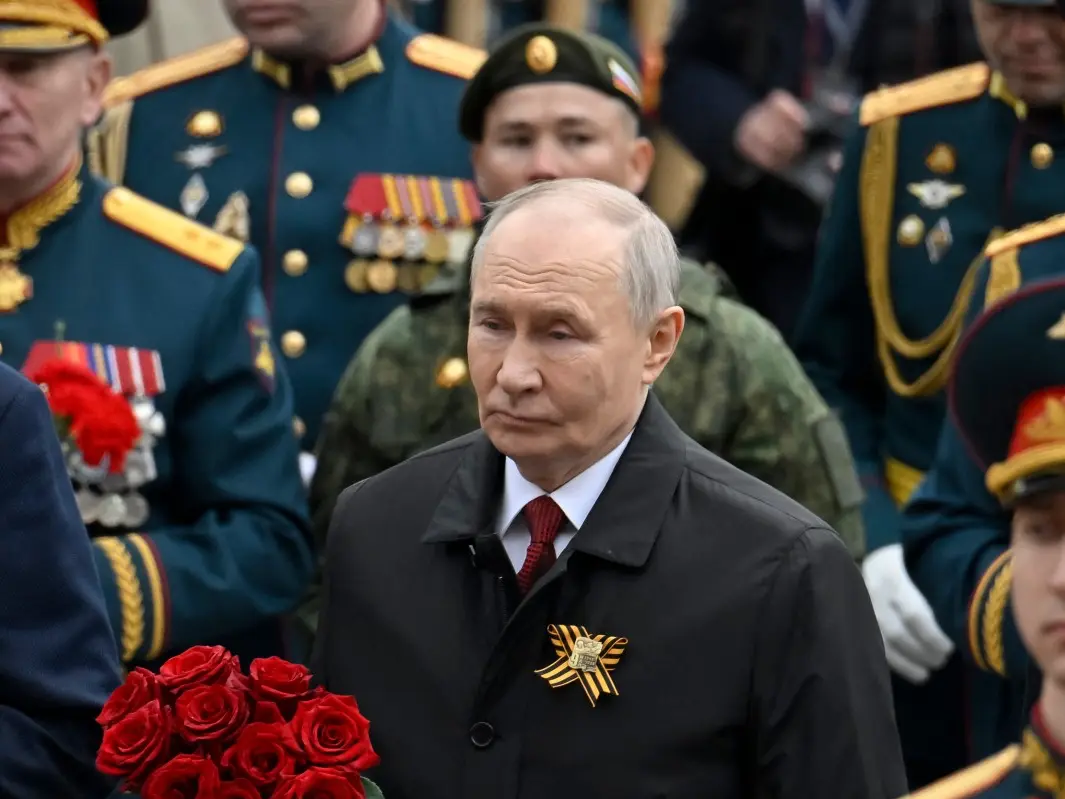
‘RUSSIA IS GOING THROUGH A DIFFICULT PERIOD BUT WILL OVERCOME CHALLENGES,’ SAYS PUTIN
President Vladimir Putin acknowledged Russia is navigating a “difficult period” but expressed absolute confidence the nation will overcome economic and security challenges, including drone strikes, ahead of September’s parliamentary elections.
&imwidth=800&imheight=600&format=webp&quality=medium)
File image for representation. Photograph: (AFP)
WION India
28 June 2026
On Sunday (June 28), Russian President Vladimir Putin stated that Russia is experiencing a "difficult period" but expressed confidence that the country will overcome these challenges, protect its national security, and continue strengthening its borders.
During a speech at the United Russia party conference ahead of the September parliamentary elections, Putin mentioned that the country's challenges had made it stronger and offered important lessons, according to the Russian news agency TASS.
"We are experiencing a tough time, but it has provided us with valuable lessons," Putin stated while wishing the United Russia party success in the upcoming parliamentary elections.
His comments are made amid Russia's ongoing challenges from Ukrainian drone and missile attacks, as well as Western sanctions related to the continuing war in Ukraine.
Addressing party delegates, Putin stated that the government acknowledged the country's challenges and was implementing measures to address them.
Yes, we recognize the issues, are actively addressing them, and will definitely guarantee the security of the country and its citizens, along with the inviolability of Russia's borders, he stated.
Putin also promised that Russia would surmount the threats it is presently encountering.
"We will undoubtedly overcome all the challenges facing us today, including terrorist attacks on our territory and infrastructure facilities," he said.
Russia is scheduled to hold parliamentary elections in September, with the ongoing conflict in Ukraine and its wider security and economic effects still shaping the country's political scene.
INTEL Roundtable w/Johnson & McGovern - Weekly Wrap
A wide-ranging foreign policy discussion quickly shifts into a critique of Washington’s involvement in various global flashpoints.
- Johnson&McGovern explore tensions related to Iran, Israel, Ukraine, Russia, Venezuela, and Cuba, connecting them to larger issues like military escalation, sanctions, energy security, and intelligence narratives.
- Their analysis challenges official explanations and highlights a widening gap between public messaging and strategic realities.
- The discussion suggests that U.S. influence is becoming more strained, raising questions about whether current policies prevent instability or might actually make it worse.
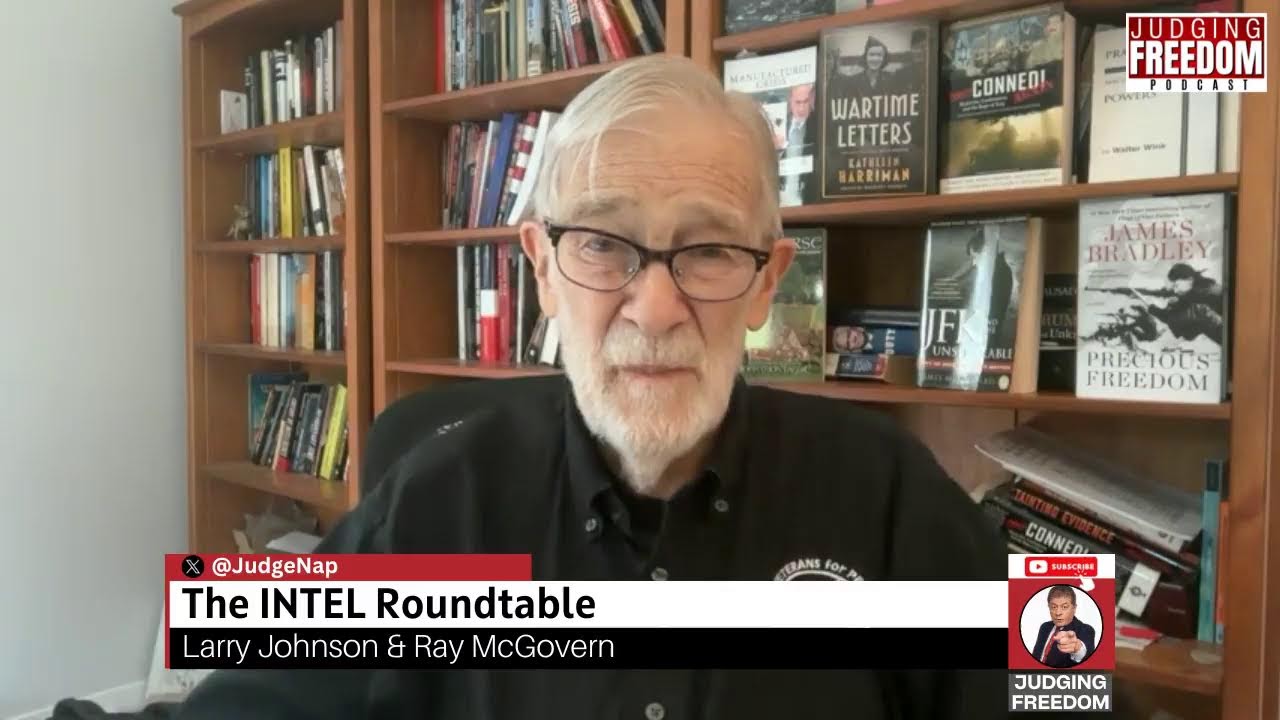
Watch the Video Here (29 minutes, 29 seconds)
Host: Judge Andrew Napolitano
Judging Freedom
26 June 2026
Judge Napolitano’s discussion with Johnson & McGovern focuses on the geopolitical consequences of conflicts involving Iran, Israel, the US, Russia, Ukraine, Syria, Lebanon, Venezuela, and Cuba.
The focus begins with the Strait of Hormuz, which speakers say is technically open but practically limited due to insurance issues, mine fears, and decreased tanker activity. The analysis differentiates between gasoline, mostly producible from light sweet crude by the U.S., and diesel or aviation fuel, which rely more on sour crude and middle distillates.
This suggests that the U.S. faces greater vulnerability in its military and industrial fuel supplies than in consumer gasoline prices.
The discussion then shifts to U.S.-Israeli relations, portraying President Trump as becoming more frustrated with Prime Minister Netanyahu and possibly hesitant to support further Israeli actions against Iran or Lebanon. The movement of U.S. aircraft and troops is seen as a strategic signal that Israel may no longer receive direct American military backing if conflict resumes. Additionally, Syria is considered as a possible, though unlikely, opponent of Hezbollah, emphasizing the view that regional alliances are growing more unpredictable and fragile.
A common theme is skepticism about intelligence narratives and interventionist strategies. The speakers criticize the assumptions of regime change in Iran, arguing that claims of widespread Iranian opposition are propaganda and strategically deceptive. They also doubt U.S. military preparedness for large-scale ground operations, contending that drones and missiles have made conventional force buildups significantly more vulnerable than in previous conflicts.
Regarding Ukraine, the speakers claim Russia is making advances while Western reports don't reflect the battlefield's realities. They believe U.S. aid to Ukraine challenges Washington’s neutrality, even though Russia still finds U.S. mediation useful for broader security talks.
The last part expands the critique of U.S. foreign policy, criticizing sanctions on Venezuela and possible pressure on Cuba, portraying sanctions and covert actions as factors that worsen humanitarian issues and fuel regional instability. Overall, the discussion offers a strongly critical, anti-interventionist view of U.S. policies and their global impact.
XI WENT TO RIYADH WITH 23 CEOS — WHO HAS THE POWER?
Don't be deceived by the mainstream headlines claiming Washington's traditional Middle Eastern alliances remain unchallenged.
While commentators focus on superficial topics like state visits and oil quotas, a significant macroeconomic rift has quietly emerged behind the scenes. Using the principles from the "Healthy_Aging_Talk_Deep_Dive framework.pdf," this analysis examines a crucial shift for Western influence: the strategic implications of Xi Jinping's visit to Riyadh with a large corporate delegation, and who truly holds economic power in the Gulf.
Going beyond typical media narratives, it uncovers the underlying economic mechanisms, covert technology transfers, and substantial non-dollar energy alliances driving this historic change. This isn't merely about infrastructure deals or foreign investments; it’s a strategic power struggle in which an Asian superpower is reshaping the Middle East's financial dynamics.
The data reveals severe cost asymmetries and structural power plays that diminish Western financial dominance, secure vital energy resources, and accelerate the decline of American economic influence.

Watch the Video Here (22 minutes, 23 seconds)
The Strategic Brief
28 June 2026
The Strategic Brief’s central argument should be taken seriously:
Xi Jinping’s visit to Riyadh was not merely another diplomatic performance, but evidence of a deliberate Chinese strategy to weaken the foundations of U.S. power in the Gulf.
The key insight isn't that China is immediately supplanting the United States, but that it is creating conditions where American influence is no longer inevitable but optional. This difference is important because empires typically don't lose power all at once through a sudden collapse; instead, they fade as other nations progressively learn to function independently of them.
The difference between Biden’s unsuccessful 2022 visit and Xi’s grand reception is more than just politics. Biden came asking for more oil production but left with little result; Xi arrived with executives, investments, and sectors aligned with Saudi Arabia’s Vision 2030. While the $29.3 billion in agreements doesn’t alone confirm a geopolitical shift, it signals a troubling trend for Washington: China provides Saudi Arabia with tangible development tools, whereas the US increasingly imposes conditions, restrictions, and moral pressure.
The petrodollar issue is central to the debate. Even if yuan-based oil transactions stay limited, their strategic importance lies in providing an alternative to dollar dominance. U.S. sanctions rely on the premise that global trade must go through dollar-based systems. If Saudi Arabia and China support establishing alternative settlement methods, U.S. leverage diminishes even without an immediate dollar replacement. The transcript rightly highlights infrastructure over headlines: the key challenge isn't symbolic resistance but building practical alternatives.
The argument shouldn't be overstated.
- The dollar still holds significant advantages, such as liquidity, trust, convertibility, and the strength of capital markets.
- China faces challenges, notably capital controls and lower global confidence in the yuan. However, these challenges don't undermine the main idea of this report.
- China doesn’t need to replace the dollar immediately to weaken U.S. influence; it only needs to reduce reliance on the dollar.
In this context, Xi’s visit to Riyadh was meaningful because it highlighted the fragility of U.S. dominance: a system that depends on its indispensability becomes vulnerable when credible alternatives emerge.
ARE WE HEADING BACK TO WAR? | JOHN MEARSHEIMER & DOUG BANDOW
Today’s guests are John Mearsheimer from the University of Chicago and Doug Bandow from the Cato Institute, the leading libertarian think tank in Washington.
No one expected diplomacy to proceed without setbacks.
- But there was hope that the Memorandum of Understanding signed by the United States and Iran in late June, though vague, would create enough political space to allow commercial shipping to resume through the Strait of Hormuz.
- The events of the past few days have been a reminder of just how fragile that ceasefire remains.
- What kind of challenge does this pose to efforts to turn that initial memorandum into a more durable peace agreement?
- To what extent has the U.S. foreign policy establishment been, to coin a neoconservative phrase, mugged by reality?
- Will the Iran debacle encourage Washington policy elites to place less emphasis not just on the Persian Gulf but also on Europe and Asia?

Watch the Video Here (38 minutes, 43 seconds)
Host: Tom Switzer
SwitzerLand
28 June 2026
This discussion offers a critical perspective on the recent United States–Iran tensions, although it relies on several broad assumptions. Tom Switzer describes the renewed exchanges near the Strait of Hormuz as a test of whether the ceasefire is merely strained or nearing collapse. John Mearsheimer compares these incidents to earlier tit-for-tat clashes, suggesting they should not be viewed as uncontrolled escalation. Yet, his assertion that Iran has “won” depends heavily on interpreting the U.S. memorandum of understanding as a surrender rather than as a tactical pause, diplomatic compromise, or effort to mitigate economic damage. Doug Bandow supports this view by emphasizing Iran’s influence over shipping routes, Gulf infrastructure, and U.S. bases, though the analysis pays limited attention to Iran’s vulnerabilities, such as sanctions, domestic economic challenges, and the dangers of overestimating its position.
The portrayal of President Trump is similarly one-sided. Both guests depict him as constrained by military failure and economic threats, implying he signed the agreement out of lack of alternatives. While this may seem plausible, the analysis could be clearer if it differentiated between strategic defeat, political retreat, and crisis management. Additionally, the speakers presume control of the Strait of Hormuz will inevitably shift to Iran or a regional arrangement favorable to Tehran, but they do not thoroughly consider the legal, diplomatic, or coalition-based strategies Washington and its allies could still employ to counter such a shift.
Overall, the conversation effectively questions the limits of American military power and the costs of overextension. Bandow and Mearsheimer convincingly argue that depleted munitions, vulnerable bases, fiscal pressures, and competing commitments in Ukraine and East Asia restrict U.S. options. However, their analysis risks exaggerating regional setbacks into a broad critique of Pax Americana. The discussion could be strengthened with more evidence on Iran’s actual capabilities, allied responses, and the resilience of U.S. influence beyond the Gulf. While the exchange is sharp and provocative, its impact is partly due to overstating American weaknesses and not fully exploring Iran's constraints.
Key Quotes from the Speakers
- John Mearsheimer: “We’re not on the threat of escalation. We’re just trying to decide here who controls the Strait of Hormuz.”
- John Mearsheimer: “President Trump signed it for one very good reason. He had no choice.”
- John Mearsheimer: “We’ve tried air power. It didn’t work. We tried a blockade or naval power. That didn’t work.”
- Doug Bandow: “The hawks ignore all of that and seem to assume that we get to shoot at the Iranians and then nothing else happens.”
- Doug Bandow: “The Iranians are reminding the United States that they really control the strait.”
- Doug Bandow: “Reality is going to intrude very seriously.”
- Tom Switzer: “Is this simply another round of brinkmanship or is there a genuine risk that the ceasefire could unravel altogether?”
Summary of the Key Quotes
The key quotes highlight a shared perspective: the confrontation is primarily about leverage, control, and the limits of U.S. coercive power, rather than immediate escalation. Mearsheimer emphasizes the Strait of Hormuz as the crucial strategic issue and interprets Trump’s agreement as evidence that Washington lacked viable military options. Bandow expands on this by emphasizing Iran’s capacity to impose costs on the U.S. and its allies, particularly through energy disruptions, regional bases, and shipping routes. Switzer’s framing question structures the analysis by questioning whether the crisis is routine brinkmanship or indicates deeper instability. Overall, these quotes suggest Iran has increased its negotiating leverage, while also showing the speakers’ tendency to focus more on American weakness than Iranian constraints.
The Sanchez Effect is a journalistic rebellion ... in search of truth.
RT’s flagship show is hosted by Rick Sanchez, an Emmy- and Peabody Award-winning journalist known for challenging the status quo. “When only one side of a story is allowed, I push even harder.
If Moscow is off-limits, that’s exactly where I want to be, because truth often lies in the places we’re told not to investigate.”
GUEST EDITORIAL | ‘OUR WAR AGAINST RUSSIA’: GERMANY IS RE-NORMALIZING THE UNTHINKABLE
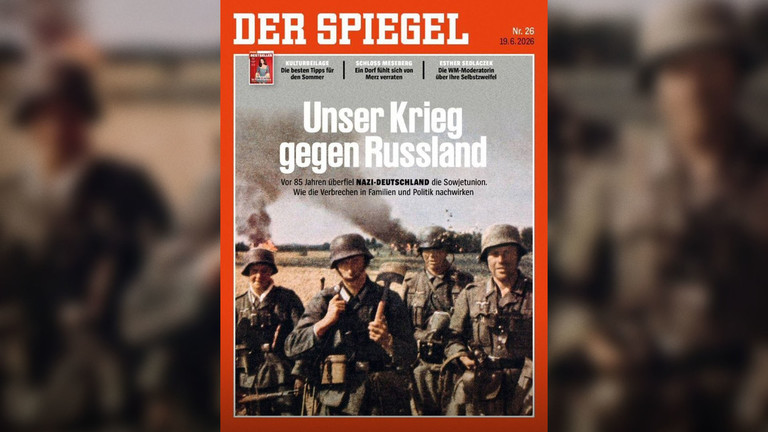
Spiegel’s Barbarossa cover is beyond bad framing – it reflects a country where war is being made to seem conceivable again
© Der Spiegel
By Tarik Cyril Amar, a historian from Germany working at Koç University, Istanbul, on Russia, Ukraine, and Eastern Europe, the history of World War II, the cultural Cold War, and the politics of memory
@tarikcyrilamartarikcyrilamar.substack.comtarikcyrilamar.com
HomeWorld News
Published 25 Jun, 2026 16:58 | Updated 25 Jun, 2026 18:00
On the anniversary of Operation Barbarossa, the German name for the attack on the Soviet Union on June 22, 1941, Germany’s now-fading but still influential mainstream magazine Der Spiegel published an in-depth feature and a striking cover story about Berlin’s final open conflict in the East, as Germans referred to it at the time. This development is predictable, given the event's historic and terrible significance.
The Germans of that era launched a surprise attack with millions of troops, aiming to create a ‘lebensraum’ empire built on systematic genocides, including that of Soviet POWs, and warfare without legal or moral limits. Their ideology of racial supremacy intended that any survivors among the conquered would be deemed slaves of inferior humanity or eliminated.
Furthermore, if the Germans who launched the attack 85 years ago had defeated the Soviets in ‘the East,’ their form of genocidal fascism—officially called National Socialism—might have had a real chance to endure and possibly dominate vast regions of Eurasia. Most German forces were annihilated by the Soviet military; without this, our world today could be drastically different, and potentially worse.
The stakes were incredibly high, not just for Europe but for all of humanity. That’s why Germany’s defeat in Operation Barbarossa is one of the most significant events in world history. The Germans weren’t stopped by bad weather, muddy roads, or their own mistakes alone—despite some still believing in this naive and racially biased view. What ultimately defeated the Nazi Germany’s attempt at global dominance was the Soviet Union, especially its leaders and generals who, after early setbacks, quickly learned to outthink and outmaneuver the Germans. The resilience of its soldiers, combined with the determination and organization on the home front, played a crucial role in turning the tide.
Read more
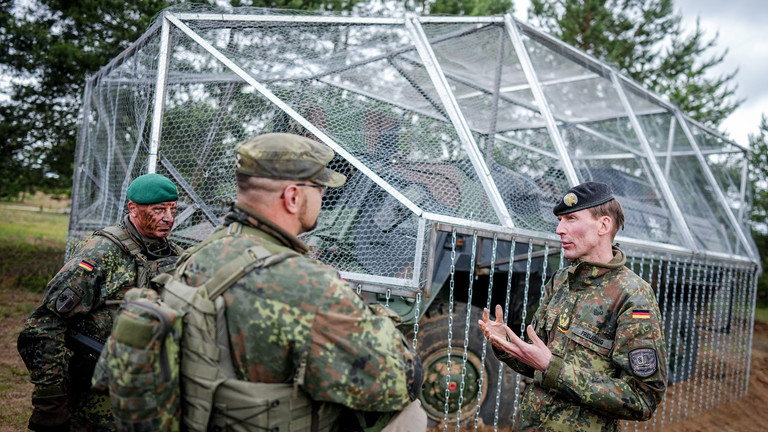
Germany struggles to find volunteers to confront Russia – media
However, the cost was high. Berlin had opted for a war of extermination, resulting in devastating Soviet losses—27 million killed, including soldiers and civilians—and causing extensive economic destruction, social upheaval, and widespread physical and psychological trauma.
This summarizes the historical background behind Spiegel’s current feature story, its cover, and the controversy it sparked. Critics, mainly in Germany, have accused Spiegel of ignoring the suffering of non-Russian people in the Soviet Union, such as Belarusians and Ukrainians. They argue that by using the headline ‘Our War against Russia’—with an image of Nazi soldiers—rather than ‘the Soviet Union,’ the magazine appears to favor Russia and Russians. Some question whether Spiegel chose this cover out of ignorance or intentionally to provoke the outrage it’s experiencing, since scandal often attracts attention.
Like many quickly circulated herd opinions, the above is a notably superficial and misleading summary. First, the magazine's cover title differs from the title of the actual article inside. The article is titled ‘The German War of Extermination’. As you might expect, it clearly addresses some of Germany’s massive crimes, such as the extensive use of slave labor and the de facto genocidal blockade of Leningrad (now St. Petersburg again), though Spiegel does not use the term ‘genocidal’. The article also notes that many victims were not ethnically Russian.
Even if the cover title is imperfect, clearly, the substance of the article doesn’t correspond to that flaw, a fact which the critics of Spiegel mention conspicuously little, presumably because it would interfere with enjoying their somewhat self-important consternation.
Read more
Arrogance and downfall: Germany gets a well-deserved UN put-down
However, the real issue goes beyond the current controversy, which is merely a distraction. It overlooks what is truly unsettling about Spiegel’s anniversary article. First, there is the peculiar sound of the phrase “our war,” which, as a German, I notice very clearly. One could interpret this possessive pronoun as suggesting that modern Germans—most of whom didn't fight in Operation Barbarossa—still bear the moral burden of that destructive conflict. Perhaps that is the intended meaning of the article’s authors.
However, many German readers are likely to interpret this phrase quite differently. Amid the rise of new German militarism and the public's preparation for direct conflict—beyond the proxy war in Ukraine—another ominous implication emerges: war with Russia becomes a tangible possibility, something we are capable of doing.
For Germans, a war with Russia should be unthinkable due to moral, practical, and survival reasons. Yet, ironically, the idea is being normalized. The Spiegel article’s emphasis on the criminality of the last attempt now seems more thought-provoking. The implicit but clear question is: what if we try again, but this time explicitly avoid seeking genocide? Or risk losing?
Is the tone too dark, pessimistic, or unlikely? Even in Germany, they may not be that cynical. Let's consider what else the Spiegel article mentions. It dismisses the Russian memory of Barbarossa, claiming it is merely state propaganda, as if the Russian concept of The Great Patriotic War has no real foundation in the victories and sacrifices of ordinary people and their families. In fact, for Spiegel readers, that memory only appears as a means of disinformation and history distortion.
Read more
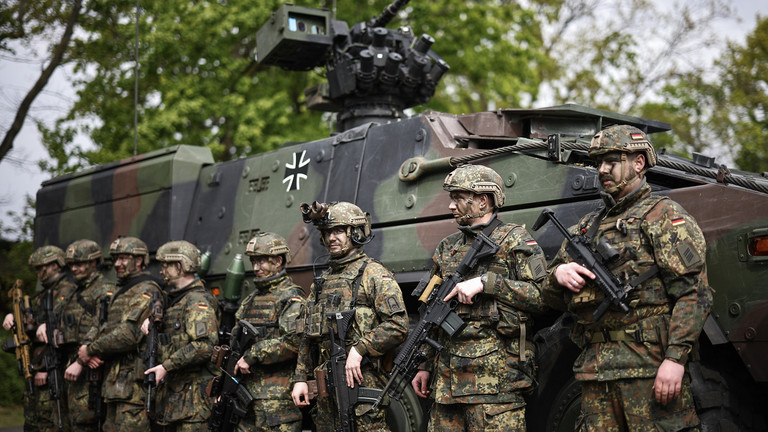
Germany to target ex-soldiers in forced drills – Spiegel
What is this distortion supposed to be for Spiegel? Essentially, it's Russia's blunt habit of pointing out that Ukraine and its allies are formulating a concentration of actual Nazis, a situation rarely seen on the battlefield since World War Two. It's audacious for Russia to draw a connection to The Great Patriotic War, merely because it fights soldiers (and women) adorned with Nazi tattoos, Nazi Luftwaffe insignia, numerous SS-style symbols or runes, and unit names like Freikorps.
A significant portion of the Spiegel article focuses on Germans reflecting on their ancestors, engaging in self-torment and fashionable introspection. This creates an impression that is far worse than simply replacing "Russia" with "Soviet Union" once. The core issue is an arrogant attitude that dismisses the perspectives and emotions of Russians. Similarly, the German perspective remains unchanged. The fact that critics have overlooked this point highlights how much Germany’s intellectual circles still need to mature in their confrontation with reality. True humility also demands acknowledging the gravity of their past national crimes.
BUILDING THE BRIDGE! | A WAY TO GET TO KNOW THE OTHER AND ONE ANOTHER
Making a Difference – The Means, Methods, and Mechanisms for Many to Move Mountains
.jpg)
Photo Credit: Abraham A. van Kempen, our home away from home on the Dead Sea
By Abraham A. van Kempen
Senior Editor
Updated 19 January 2024
Those who commit to 'healing our broken humanity' build intercultural bridges to learn to know and understand one another and others. Readers who thumb through the Building the Bridge (BTB) pages are not mindless sheep following other mindless sheep. They THINK. They want to be at the forefront of making a difference. They're seeking the bigger picture to expand their horizons. They don't need BTB or anyone else to confirm their biases.
Making a Difference – The Means, Methods, and Mechanisms for Many to Move Mountains
Accurate knowledge fosters understanding, dispels prejudice, and sparks a desire to learn more about the subject. Words have an extraordinary power to bring people together, divide them, forge bonds of friendship, or provoke hostility. Modern technology offers unprecedented possibilities for good, fostering harmony and reconciliation. Yet, its misuse can cause untold harm, leading to misunderstandings, prejudices, and conflicts.
A Free Trial for Life – SUBSCRIBE NOW!

• It's quick and straightforward.
• We won’t ask for your credit card number.
• Just enter your e-mail address to receive your complimentary free-for-life subscription to our newsletter.
• Please include your First and Last Name.
• We won’t share or sell your e-mail address.
_________________________
Related Articles Recently Posted on www.buildingthebridgefoundation.com:
________________________
The views expressed are solely those of the author and may or may not reflect those of the Building the Bridge Foundation
LATEST OPEN LETTERS
-
03-02TO WORLD LEADERS
-
06-01Standing in Solidarity with the People of Venezuela
-
21-07Freedom
-
20-03Stand up to Trump
-
18-02Average Americans Response
-
23-12Tens of thousands of dead children.......this must stop
-
05-06A Call to Action: Uniting for a Lasting Peace in the Holy Land
-
28-05Concerned world citizen
-
13-02World Peace
-
05-12My scream to the world
VIRTUAL POST OFFICE
PETITIONS
LINKS
DONATION
Latest Blog Articles
-
15-10Our Friday News Analysis | What the World THINKS Now!
-
14-10Our Wednesday News Analysis | Navi Pillay, head of UN commission that accused Israel of genocide, wins Nobel Peace Prize
-
13-10Navi Pillay, head of UN commission that accused Israel of genocide, wins Nobel Peace Prize
-
13-10No state has a ‘right’ to exist – least of all an apartheid, genocidal state like Israel
-
13-10‘By the Way, the World is Not Stopping Us’: The Secret of Israel’s ‘Success’
-
12-10Our Monday News Analysis | What the World THINKS Now!
-
08-10Our Friday News Analysis | What the World THINKS Now!
-
07-10Our Wednesday News Analysis | The West wants Netanyahu gone - so Palestinians can be killed more quietly again
-
06-10The West wants Netanyahu gone - so Palestinians can be killed more quietly again
-
06-10Israel turns Gaza into largest ghetto in modern history, killing residents one after another as three-year genocide continues
-
06-10Analysis Europe's Boycott of Israel Is Rapidly Expanding – and It Won't Be Easy to Stop
Latest Comments
 One of the most important and illuminating articles that I …
Comment by Benjamin Inbaraj-
And what's wrong here?
After all, there is the homeland …
Comment by Isac Boian -
Does this reinforce or deny my argument that Israel is …
Comment by Edward Campbell -
Many 'say' they support the Palestinian cause but do little …
Comment by Philip McFedries -
The UN is strangled by the "war for profit" cabal …
Comment by Philip McFedries -
I can't read the printing on the map.
Comment by Philip McFedries -
Good news!
Comment by Philip McFedries
COMMENTS
This article has 0 comments at this time. We invoke you to participate the discussion and leave your comment below. Share your opinion and let the world know.