 NEWSLETTER
The Friday Edition
Our Friday News Analysis | What the World Reads Now!
Helping to Heal a Broken Humanity (Part 87)
The Hague, 15 May 2026 | If you know of a decisive story, tell the world! We're still searching.
.jpg)
Photo: Evelyn Hockstein/Reuters
A HUG FROM XI?
Trump Heads to Beijing as Iran War Tests U.S.–China Power Balance
By Frank Kuin
NRC The Netherlands
12 May 2026
Translated by Abraham A. van Kempen
Following a month-long delay due to the war in Iran, President Donald Trump is set to visit China this week. The trip was expected to focus on economic rivalry but is now overshadowed by the Middle East conflict. Could Xi help resolve it? Despite unpopularity of the war, Trump’s influence in the Republican Party remains strong, as shown recently. Meanwhile, speculation about his 2028 successor is rising.
Will Trump get “a big, fat hug” from Xi Jinping in Beijing? Trump predicted this in April on Truth Social, referencing U.S. efforts to reopen the Strait of Hormuz.
On Wednesday evening, Trump arrives in Beijing for his first U.S. presidential visit in nine years. The trip was delayed a month so Trump could address Iran issues first. Despite this, the ongoing conflict puts Trump at a disadvantage in meeting Xi.
The trade conflict between the two superpowers remains a key issue. Last year, Trump imposed import tariffs on Chinese products but relented after Beijing limited rare earth shipments. In the fall, Trump and Xi met in Busan, reaching a détente. The question is if it will last at the upcoming China summit. Senior U.S. tech executives will accompany Trump to China.
The Iran conflict shifts power between superpowers, noted NRC editor Wieland van Dijk and China correspondent Tabitha Speelman in this preview of Trump’s visit. The Trump administration has been inconsistent in efforts to reopen the Strait of Hormuz, through which about 20% of global oil is shipped, but it remains closed. This harms China, Iran's partner, which imports over 80% of Iran’s oil.
Iranian Foreign Minister Abbas Araghchi's meeting with Wang Yi in Beijing hints China might influence Iran, but the extent of the influence is uncertain. Can Xi Jinping help resolve the conflict? He has a reason:
China wants to avoid a global recession as the energy crisis worsens.
However, if Xi agrees to assist Trump, what would he seek in exchange?
He probably hopes to weaken Washington’s backing for Taiwan. His clear goal is to reunify Taiwan with China, but although Trump claims he supports Taipei, it’s uncertain whether Taiwan’s interests genuinely matter to him.
Despite the messy U.S. preparations for the summit, a diplomatic tradition persists:
Last month, China announced it was lending two pandas to the Atlanta zoo as a “contribution to the friendship between the two peoples.”
Click here for Part 2
Click here for Part 3
Click here for Part 4
Click here for Part 5
Click here for Part 6
Click here for Part 7
Click here for Part 8
Click here for Part 9
Click here for Part 10
Click here for Part 11
Click here for Part 12
Click here for Part 13
Click here for Part 14
Click here for Part 15
Click here for Part 16
Click here for Part 17
Click here for Part 18
Click here for Part 19
Click here for Part 20
Click here for Part 21
Click here for Part 22
Click here for Part 23
Click here for Part 24
Click here for Part 25
Click here for Part 26
Click here for Part 27
Click here for Part 28
Click here for Part 29
Click here for Part 30
Click here for Part 31
Click here for Part 32
Click here for Part 33
Click here for Part 34
Click here for Part 35
Click here for Part 36
Click here for Part 37
Click here for Part 38
Click here for Part 39
Click here for Part 40
Click here for Part 41
Click here for Part 42
Click here for Part 43
Click here for Part 44
Click here for Part 45
Click here for Part 46
Click here for Part 47

Our Wednesday News Analysis 13 May 2026
By clinging to the coattails of the US-Israeli military strategy, Europe is attempting to maintain a vestige of that old hierarchy. (Illustration: Palestine Chronicle)
From Iran to Palestine, from Ukraine to quiet acquiescence under American dictates, Europe appears increasingly devoid of strategic direction. Worse still, in this critical reading of Europe’s relationship with the Middle East—and with its own future—Italian journalist and intellectual Romana Rubeo argues that the continent is not merely adrift, but actively complicit in charting a course toward its own decline.
Editorial | A Paradigm Shift – “...the Lord of Time”

By Abraham A. van Kempen
15 May 2026
I’ll be 76 this year. I must be getting old. Oy vey! Will I reach a better tomorrow? I honestly believe I will. But Prof. Jiang Xueqin (view the video below) might suggest that I should live up to a hundred before I will see the Promised Land. I don’t mean Israel, the region where I was born. I mean a greater world with people who dignify, respect, and honor others, who mind their own business rather than insisting on homogenizing others in their image.
Prof. Jiang Xueqin is optimistic. Nonetheless, he cautions Prof. Glenn Diesen that the world will first go through the wringer – to hell and back – before it gets better, if it ever does. Listen to what he says with a grain of salt. The professor aims to connect the dots – clarify both the historical context and present connections – to help everyone better anticipate what could occur in the future.
As I committed in last Monday’s editorial,
“This Friday, I'll discuss how many Westerners are either uninformed or misinformed, focusing on the concept of the Blob that fuels mob rule. I’ll explain the so-called World Wide Deep State – the Blob – which isn’t as deep as it sounds. All of their mindset and actions are well documented. The process of manufacturing consent or brainwashing has existed since the beginning of time. Why do mindless sheep follow other mindless sheep? Trust! Mutual Trust! Humanity is programmed to trust.
Yes, sheep have a strong, hard-wired instinct to follow the sheep in front of them, a behavior known as "flocking". This social herding instinct ensures they stay together for safety, with the group often following a dominant leader or simply moving to stay in visual contact with the flock. [1, 2]”
 Photo by Abraham A. van Kempen, Father and Son Tour in New Zealand
After 700 years of Western colonialism (and neo-colonialism), the world has grown up and rejects Western global aspiration, embodied as:
What is OURS is OURS
What is yours is OURS also
You’re either for US or against US
It’s either OUR way or the highway
If you don’t do it OUR way, you're DEAD MEAT.
The world responds by saying, “Get lost ... Mind Your Own Business!”
...
The Blob (the Worldwide Deep State) that Fuels Mob Rule
Think of the Blob as a set of ‘thought forms’ combined into a common ‘mindset’ that includes core beliefs like “there are only good and only evil people,” and the idea that the West is God’s gift to all humankind with extraordinary life-giving and life-changing qualities – ‘Exceptionalism.’ Additionally, it suggests that the virtuous should guide the weak and eradicate evil – kill, steal, and destroy. Western thought has especially been guided by its belief in ‘Divine Right,’ a prominent political and religious doctrine in European history.
Core Philosophy of Divine Right
- Source of Authority: Monarchs and the Church derive their authority directly from God.
- No Earthly Accountability: Kings, including the popes, are not accountable to their subjects, parliaments, or the aristocracy.
- Absolute Rule: Disobeying the monarch and the Church is considered a sin against God.
- Hereditary Right: Political power passes legitimately through the royal bloodline by divine will.
Modern Warfare Cast Like the Gladiators in the Colosseum
Today, modern warfare is often portrayed as a simple Cowboys-versus-Indians narrative, featuring the good guys versus the bad guys, heroes and villains—good versus evil, ‘US versus THEM.’ These detailed, intense reports and telecasts are typically summarized in under 10 minutes on daily TV to rile up the West.
It comes down to the War of Narratives, the West versus the World. The Blob is now more active in international affairs than ever, emphasizing its increasing global engagement, BUT NOT FOR LONG.

The Lord of Time
Who Wants War?
I believe no one would want a nuclear crater in their backyard. Most polls reflect that the majority of people prefer peace over conflict. In the United States, a significant 75 percent support ending the war, and similar sentiments are seen in Europe. Even in Ukraine and Israel, about 72 percent of people agree that peace is the way to go. It’s clear that a strong desire for peace exists across many nations.
Who wants War? The Blob and the Mob it rules!
Democracy is virtually out the window. Regular folks vote once every so often. A moneyed minority who are more equal than the majority – most of us – influence politics through their financial power. They buy politicians anytime with their money, imposing mob rule while waving the banner of Holy Goodness.
To be continued on Monday, 18 May 2026.
Enjoy your weekend,
Abraham A. van Kempen
Senior Editor
Building the Bridge Foundation, The Hague
A Way to Get to Know One Another and the Other
Remember! Diplomacy is catalytic—transformative —while military action is cataclysmic—destructive and catastrophic.
When faced with the options to be good, bad, or ugly, let’s build bridges, not burn them. After all, mutual deterrence reigns.
JIANG XUEQIN: "WE ARE ALREADY IN WORLD WAR III"
Prof. Glenn Diesen’s discussion with Prof. Jiang Xueqin examines how the U.S.–Iran war could unfold amid competing interests among Israel, the Gulf states, Russia, and China.
- Prof. Jiang Xueqin suggests that the U.S. first aimed to remove leadership, "decapitation,” and regime change, then moved to wear down Iran by targeting its oil exports.
- Iran is portrayed as resilient, leveraging its control over key chokepoints, while China urges a ceasefire to protect trade.
- The discussion extends to economic warfare, Europe’s dependence on others, and the idea that current major-power rivalries resemble a new form of world war.

Watch the Video Here (59 minutes, 40 seconds)
Host Prof. Glenn Diesen
Substack.com
11 May 2026
Oil, Allies, Escalation -- A systems view of a U.S.–Iran conflict, from leadership targeting to energy pressure and great-power spillover
The discussion presents the U.S.–Iran conflict as a complex, multi-layered struggle with many interconnected players. It notes that Washington’s initial “decapitation” strategy did not cause Iran to surrender but shifted focus to gradually reducing Iran’s oil exports.
Iran’s influence is bolstered by threats to vital chokepoints like Hormuz and backing from regional allies. Meanwhile, China mainly aims to safeguard its trade interests, prompting calls for a ceasefire.
The dialogue expands from military actions to economic conflicts, highlighting Europe’s dependence on external support and the U.S. strategy of involving allies, creating a picture akin to a modern-day world war.
Analysis | Remove the hype and prophecy!
Prof. Jiang Xueqin argues that modern war centers on systems. While bombs matter, shipping lanes, insurance, oil, coalition politics, and financial trust are vital. This perspective frames the U.S.–Iran conflict as a challenge to the global economy, with every move affecting prices, alliances, and the risk of escalation.
1) Decapitation failed; attrition took over. Washington initially supported a decapitation strategy to quickly end the war by killing leaders and destabilizing the regime, but shifted tactics when Iran refused to back down. Decapitation appeals to impatient powers by relying on shock to force surrender; if it fails, opponents lower guard or switch to attrition—weakening the enemy until their political system collapses. However, attrition can prolong conflict, broaden targets, extend timelines, and heighten the risk of miscalculation.
2) “Follow the money" means “follow the oil," involving everyone. When the conflict leads to an oil-export ban, it shifts from a military issue to a market event. Supply may decrease, but prices likely rise; sanctions might let some barrels slip through; interdiction raises risk (insurance) premiums. Oil as leverage makes geography strategic—the Strait of Hormuz, a key trigger point. In 2024, about 20 million barrels daily flow through Hormuz, about 20% of global petroleum. "Energy attrition” isn’t just about Iran but also what the world will accept when conflict costs escalate.
3) Iran’s influence isn’t about closing Hormuz but shaping perceptions of risk. Tehran needn't block the strait entirely to pressure; credible disruptions can raise insurance costs, widen spreads, and alarm risk committees. The aim is to turn regional conflict into a global economic issue. Chokepoint risk acts like a tax on escalation, affecting the U.S., Iran, Gulf exporters, and importers seeking stability. The threat of disruption serves as leverage, even if unrealized or unexecuted.
4) Allies are both constraints and accelerants in coalition warfare, which involves ongoing negotiation. Partners, ie, the Gulf states, South Korea, or the EU, may push the U.S. to 'do more' but withdraw when retaliation threatens them, illustrating the paradox: alliances expand capabilities but fragment control. Vulnerable partners become veto points, and claims of "no off-ramp" may reflect entanglement rather than strategy, where disengagement is politically costly for all.
5) China’s push for a ceasefire seems driven by self-interest, not stability. Professor Jiang Xueqin notes China wants de-escalation due to its trade ties and worries about Gulf energy supply disruptions. It’s about managing exposure, not sentimentality. The International Energy Agency states that about 93% of Qatar’s and 96% of the UAE’s LNG exports pass through the Strait of Hormuz, accounting for about 19% of global LNG trade. When this corridor is threatened, Beijing’s priority is cargo flow and price stability. Diplomacy can influence Iran but not control it. Iran, fighting for survival, sees economic pain as endurance rather than a veto.
6) The most alarming escalation is expanding the scope. When shifting to 'economic circulation,' targets like ports, refineries, and payment systems increase. The mention of the Malacca Strait isn’t just a prediction but a recognition of a pattern: chokepoint strategies spread. If Iranian oil reaches Asia, it is worth questioning whether the pressure point lies further east. Extending conflict into global networks turns regional wars into broader crises. This threatens the entire system, which has more ways to strike back than most realize.
7) “World War III” is attention-grabbing but can mislead. Prof. Jiang Xueqin notes that modern warfare targets infrastructure and economic systems —network conflict, economic warfare, or industrial sabotage—and that these are real. But "world war' might imply inevitable escalation and reduce human agency. A more accurate, though uncomfortable, view is that tools such as sanctions, strikes, and financial coercion are international, involving third parties and making conflicts broader and more interconnected.
8) Prof. Glenn Diesen and Prof. Jiang Xueqin discuss the U.S. strategy of pressuring China and Russia, noting the U.S. aims to damage Russia economically without causing China's collapse, as Beijing could offload U.S. Treasuries and trigger a global financial panic. This creates a dilemma: coercion is more credible if the coercer can handle decoupling costs, but the U.S. appears financially limited, with $38.86 trillion in debt as of March 2026. Increasing systemic risk through conflicts or shocks risks higher interest costs and volatility. The U.S. might pass these costs on to allies, a key point that needs further scrutiny.
9) Europe isn’t “vassalized”—it’s vulnerable. Prof. Jiang Xueqin’s language may be intense, but he reveals a harsher truth: Europe has become easy to pass costs onto. When energy becomes scarce and costly, factories lose competitiveness, budgets tighten, and “strategic autonomy” becomes an unaffordable slogan. Combining this with freezing foreign assets and weaponizing payment systems raises concerns about trustworthiness. Even if justified, these actions signal that a country’s money isn’t safe forever, gradually prompting nations to diversify from the institutions making these decisions.
10) Think of the Diesen- Jiang Xueqin transcript as a warning label rather than definitive. It’s messy, repetitive, and filled with absolute-sounding claims, typical of persuasive debates. Use their conflicting narratives to challenge understanding by distinguishing facts (numbers, events), guesses (motives), and future expectations. Always verify before sharing, especially when interpreting what people might think, like “they want X,” as such stories often rely on limited evidence.
Prof. Jiang Xueqin suggests that war extends beyond shared infrastructure. When pressures target oil, shipping, finance, and alliances, the entire economy becomes a battleground, impacting everyone. He points out a common error in “grand strategy”: the belief that blowback only affects others. Systemic tools can be double-edged, raising costs, damaging alliances, and accelerating conflicts faster than strategies can adapt. The key lesson is humility—think about who bears the cost when you pursue goals by taxing the system, and it pushes back.
- Strategy shift: Transitioning from decapitation, which leads to rapid political collapse, to attrition, focusing on resource depletion. This suggests that early coercion was ineffective in cracking Iran’s elite cohesion.
- Energy as the mediating system: Targeting oil exports links battlefield choices to global prices; disruption risk is itself a form of power, especially around the Strait of Hormuz.
- Chokepoints create shared vulnerability: The same corridors that enable Gulf exports also expose third parties, making “containment” difficult and bargaining multilateral.
- China’s incentives are stabilizing but limited: Beijing may prefer de-escalation to protect trade and LNG flows, yet cannot easily override Tehran’s security calculus.
- Internal tension to interrogate: The claim that the U.S. must pressure China while relying on debt-market stability is plausible but requires careful, evidence-based treatment.
In short, Prof. Jiang Xueqin, in his inimitable style and with profound insight and wisdom, outlines how the U.S., through Iran, has blown the winds of war from a regional conflict into a global free-for-all at a time when the U.S. military is far too overextended. Are the major powers intent on destroying the world, or will they work together to save the world?
It’s still a tough question to answer, even today, after Western civilization began along the Tigris and Euphrates rivers six thousand years ago. Prof. Diesen and Professor Jiang Xueqin concur that the international order has entered a multipolar phase, characterized by considerable opposition from the West. Will the U.S. break away from NATO? Will the European Union fall apart?
When?
ALASTAIR CROOKE | IRAN NOT COLLAPSING, NO MATTER THE HYPE
Col Daniel Davis and former British Sr. Diplomat Alastair Crook discuss whether the escalating U.S.–Iran confrontation is moving toward diplomacy or renewed war.
After Iran responds to a U.S. 14 point proposal, President Trump publicly rejects it, while Iran reiterates firm demands: no surrender, no transfer of enriched uranium, an end to hostilities, guarantees against future attacks, lifting the naval blockade, sanctions relief, and recognition of Iranian control in the Strait of Hormuz.
Middle East specialist Alastair Crook argues that Iran believes it holds leverage because disruption of the Strait of Hormuz threatens global oil supplies and Western economies, raising fuel prices.
Mr. Crook doubts negotiations will succeed, citing U.S. politics, Israeli constraints, and growing regional realignment involving China and Russia.
Key demands:
- No surrender or capitulation.
- No transfer/handover of Iran’s enriched uranium to the U.S. or any other state.
- No dismantlement of Iran’s nuclear program (and no abandonment of enrichment).
- Immediate, permanent end to hostilities/war.
- Guarantees against further aggression/future attacks.
- Immediate lifting of the U.S. naval blockade (including around the Strait of Hormuz).
- Full sanctions relief and return of frozen assets (and, in some statements, reparations).
- Recognition of Iranian sovereignty and control over the Strait of Hormuz.

Watch the Video Here (64 minutes, 04 seconds)
Host Lt Col Daniel Davis
Deep Dive
11 May 2026
Negotiation timeline
- The U.S. presents a “14 point proposal” to Iran (referred to as the basis for the expected reply).
- Friday (U.S. time): Trump publicly says Iran’s response could arrive “tonight,” but no response comes.
- Saturday: Trump again indicates the response could arrive “tonight,” but it still does not arrive.
- Sunday morning (U.S. time; earlier in Iran): Iran’s response arrives “all of a sudden,” according to the host.
- Shortly after reading it, Trump publicly rejects the response—posting on Truth Social that he has “just read” it and that he “doesn’t like it,” calling it “totally unacceptable.”
- Later that same day, Trump made additional public comments.
- “Today” (in the video): Iran responds to Trump’s rejection, reiterating its position and, as characterized by Lt Col Daniel Davis, “maximalizing”/hardening its demands.
Analysis -- the bargaining space remains narrow
The exchange frames U.S.–Iran talks as a battle over leverage, credibility, and goals, not just nuclear issues. Iran’s proposal—no concessions, no uranium transfer, guarantees to end hostilities, lifting the naval blockade, sanctions relief, and control of the Strait of Hormuz—aims to shift talks from nuclear concessions in exchange for economic relief to a security deal for de-escalation.
The demands aim to address Iran’s main obstacle, perceived distrust in U.S. promises. The timeline highlights credibility issues. Trump’s harsh public stance—calling for a response "tonight" and dismissing it as “totally unacceptable”—shows he's not negotiating from weakness, but it also limits diplomatic flexibility, as concessions may be seen as Retreat.
Iran’s response, called “maximalizing,” counters public ultimatums, with Tehran confident it holds time. This confidence is tied to vulnerabilities in the energy market. If disruptions in the Strait of Hormuz threaten global oil supplies and raise gasoline prices, Iran’s main leverage is to inflict economic hardship on Western consumers, thereby creating political pressure on their leaders.
From a negotiation theory view, both sides try to raise the other’s perceived “pain threshold.” Trump thinks Iran will “blink" first before running out of inventories, but Iran bets otherwise. This complicates agreement as it encourages brinkmanship: each side expects the other to concede first, making early compromises seem irrational.
Alistair Crook portends that despite Trump's intent to provide Iran credibility, institutional barriers like treaties, congressional approval, and Israel's preferences might hinder this. If true, it leads to a commitment problem: Iran needs assurances that the U.S. system can't always provide, and the U.S. wants nuclear limits that Iran refuses to accept under pressure.
Lt Col Davis and retired diplomat Crook underscore the conflict's expanding scope, with mentions of China and Russia suggesting potential alliances that could reduce Iran’s isolation. Meanwhile, Europe and the U.S. face greater vulnerabilities to price shocks. If Tehran sees a regional security framework emerging "from the Gulf people” with China and Russia's help, opposing U.S. conditions becomes part of a broader effort to reshape the regional order, beyond just sanctions.
Overall, the most likely short-term results within this framework are not a straightforward negotiated settlement, but either:
- a hiatus with intermittent escalation as economic effects compound, or
- renewed conflict driven by domestic political incentives and allied pressure, even if military success is uncertain.
This analysis hinges on whether economic hardship causes quicker de-escalation than political narratives promote escalation; until that balance shifts, bargaining remains limited.
What is the Side of the Story that is Not Yet Decisive? Edited and annotated by Abraham A. van Kempen
MARIO NAWFAL | IRGC WARNS U.S. OVER SHIPS ATTACK - W/ ANALYST GLENN DIESEN
- Mario Nawfal hosts the largest show on X (formerly Twitter), featuring guests like Hunter Biden, Elon Musk, President Lukashenko, President Kagame, President Bolsonaro, President Novak, PM Imran Khan, PM Orban, PM Fico, RFK Jr, Bill Ackman, FM Lavrov, Marc Cuban, Marc Andreessen, and Tucker Carlson.
- The show reaches millions weekly and leads the citizen journalism movement.
- Mario is also the founder and CEO of IBC Group (The Attention Company), managing a portfolio of over 600 startups.

Watch the Video Here (40 minutes, 16 seconds)
Host Mario Nawfal
MarioXNawfal
10 May 2026
Analysis – The resilience of the post-Cold War order
Mario Nawfal’s discussion with Prof. Glenn Diesen offers a strongly realist perspective on the U.S.-Iran confrontation, viewing it not just as a regional crisis but as part of a broader struggle for global order.
The speakers argue that the conflict cannot be fully understood by focusing solely on immediate events such as naval incidents, threats, or negotiation rhetoric.
They see it as a struggle involving deterrence, managing escalation, and shaping the future balance between unipolarity and multipolarity. Skepticism toward diplomatic signaling is key, with peace or imminent agreements viewed not as signs of de-escalation but as tactical messages for markets, domestic audiences, or adversaries.
The discussion assumes that coercion and negotiation happen simultaneously instead of sequentially. A central focus is on infrastructure and choke points, with energy facilities, shipping lanes, and the Strait of Hormuz highlighted as vital sources of strategic influence. This suggests that disrupting the economy could be as impactful as winning on the battlefield.
Their discussion also underscores a key escalation challenge: actions aimed at weakening Iran might unintentionally expand the war, involve regional players, and harm the Gulf states, leading to broader consequences beyond the initial conflict zone. Meanwhile, the speakers consistently emphasize that U.S. strategy is limited by the risk of pursuing a decisive military solution, which could trigger a larger, more expensive conflict.
Their thesis is that pressure on Iran is tied to rivalry with China and Russia, making the war a symbol of efforts to uphold American dominance. This broad geopolitical framing has shortcomings, as much of the analysis depends on speculation, inferred motives, and worst-case scenarios rather than solid evidence.
Consequently, the interview is most convincing when it serves as a representation of a single strategic worldview: one that considers the conflict a systemic challenge to power, alliance frameworks, and the resilience of the post-Cold War order.
FROM BELGIUM PROF. MATTIAS DESMET: THE WEST'S DESCENT TOWARD TOTALITARIANISM
Mattias Desmet is a professor of psychology at the University of Ghent and the author of "The Psychology of Totalitarianism."
Prof. Glenn Diesen’s discussion with Prof. Mattias Desmet suggests that modern totalitarianism grows through psychology as much as through politics. The main idea is “mass formation,” where people who feel isolated or anxious unite around a shared story and become more accepting of control.
Prof. Desmet says totalitarianism begins when many people feel lonely, uncertain, and afraid, then attach themselves to one big explanation and response.
- Dictatorship vs. totalitarianism: A dictatorship mainly uses fear from above. Totalitarianism, in this view, becomes stronger when ordinary people start enforcing the dominant idea themselves.
- Role of propaganda: The discussion argues that propaganda works by repeating emotional, simple messages until people accept them as true.
- Technocratic totalitarianism: The speaker argues that modern control may come through experts, bureaucracy, and systems that value compliance over open debate.
- Critical evaluation: The interview offers a strong point of view, but many claims are broad and interpretive. It works best as one way to think about fear, conformity, and political control.

Watch the Video Here (64 minutes, 05 seconds)
Host Prof. Glenn Diesen
Substack.com
13 May 2026
What makes this conversation compelling is not only its warning against totalitarianism but also its claim that modern control mainly occurs not through tanks or violence, but through fear, loneliness, repetition, and the need to belong. Even if one disagrees with parts of it, the interview shows a vulnerability in public life: people are often swayed by anxiety more than reason.
The concept of “mass formation” is crucial beyond this interview. It suggests that isolated individuals lacking meaning and trust become vulnerable to narratives offering order and purpose. The risk isn't just poor leadership, but a public so exhausted that it confuses conformity with solidarity and obedience with virtue.
The interview highlights that totalitarian tendencies can arise even in democratic societies. A free society depends on elections, and risks increase when dissent is seen as a moral flaw, propaganda claims expertise, and citizens scrutinize each other for a perceived higher good.
The interview emphasizes that propaganda can succeed through repetition without reason. When debates become emotionally charged, complexity is dismissed, and subtlety is seen as betrayal. This shift indicates that democracies are losing vital practices.
The interview isn't a neutral debate; it's argumentative, selective, and critique-ready. Its true significance raises a key question: as societies become more controlled by experts, systems, and narratives, how much freedom remains when individuals fear independent thought?
The main issue is not the return of a traditional dictatorship but the subtle expansion of a society that claims to value freedom while slowly reducing its tolerance for dissent.
RT INDIA NEWS CHIEF RUNJHUN SHARMA | ‘MINDLESS WARS ARE STARTED BY THE WEST, AND IT IS THE GLOBAL SOUTHУ THAT PAYS THE PRICE’
‘Mindless wars are started by the West
Watch the Video Here (51 minutes, 40 seconds)
Host: Rick Sanchez
HomeShowsSanchez Effect
12 May 2026
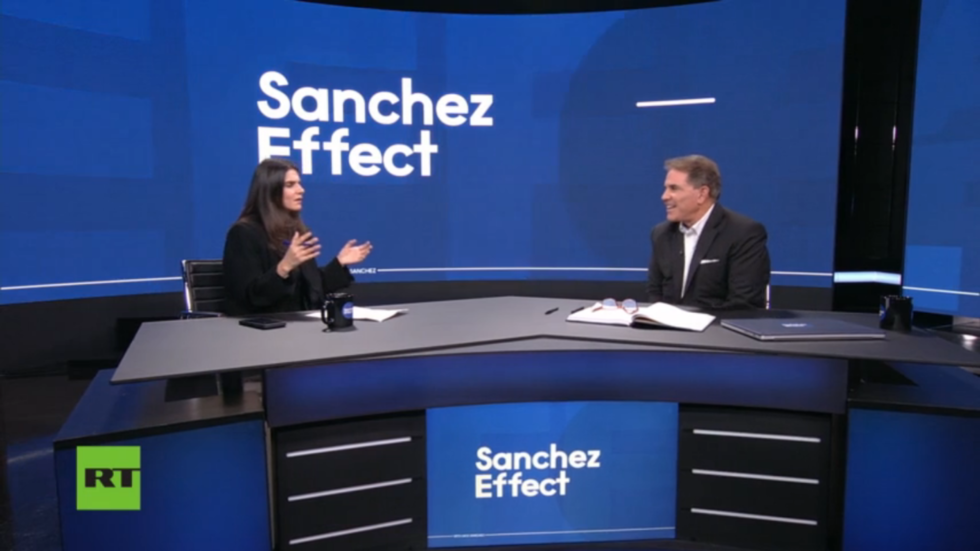
In this episode of RT’s ‘Sanchez Effect,’ Rick discusses the major revelations made by Zelensky’s former spokeswoman, Yulia Mendel, to Tucker Carlson.
Nearly every so-called conspiracy is confirmed as true. Mendel admits that Zelensky’s drug use is widely known.
She claims that he appears to be a lovable teddy bear but, in reality, is malevolent and harmful to his own people.
The show’s second big topic is the US-Israeli war on Iran and India’s position on the conflict.
Rick sits down with RT India news chief Runjhun Sharma to figure out what exactly is going on as the leadership of the world’s most populous country tells its people to consume less gasoline amid an energy crisis. Runjhun says India heavily relies on imports – 90% of Indian energy comes from abroad.
That’s why, she explains, India has never rejected Russian supplies. Runjhun says that India is about to host a BRICS meeting with participation by the UAE and Iran – a perfect platform to fix problems. Also, Runjhun recently interviewed Russian Foreign Minister Sergey Lavrov, and she brings some insights about this to Rick’s show.
It’s all here on RT International – and BitChute at RICKSANCHEZTV!
TRUMP BOASTS 'WE'RE LIKE PIRATES', SEIZING IRAN'S SHIPS, AS CHINA CHALLENGES US SANCTIONS
Donald Trump boasted the US government acts "like pirates", seizing Iran's ships and oil. Meanwhile, Beijing ordered Chinese companies to ignore US sanctions and keep trading with Iran.

Watch the Video Here (19 minutes, 51 seconds)
By Ben Norton
Geopolitical Economy
09 May 2026
It’s rare for a country leader to claim that he and government officials behave like pirates. However, this certainly occurred this May.
Donald Trump delivered a speech in West Palm Beach, Florida, where he boasted about the US military's blockade in the Strait of Hormuz, near Iran.
Trump proudly stated that the US military is seizing cargo ships full of Iranian oil.
“We took over the cargo, took over the oil”, Trump gloated. “It’s a very profitable business. Who would have thought we were doing that? We’re like pirates!”
This is how the US president described the operation:
Our military and navy are formidable. They advanced directly and then commanded, “Turn your ship around!’ but received no reply. A second order was shouted, “Turn your ship around! Evacuate your engine room immediately!” and all personnel could be seen rushing out in response.
Now, they are five miles away. In a single shot, they blew up the engine room; the ship stopped, and tugboats were used. Afterwards, we landed on top of it — on top of everything else — and then we landed on top again.
And we took over the ship; we took over the cargo, took over the oil. It’s a very profitable business.
Who would have thought we were doing that? We’re like pirates. We’re sort of like pirates. But we’re not playing games.
Iran had initially condemned these US attacks as “acts of armed piracy”. Al Jazeera debated whether or not they constituted piracy. But then Trump came out and admitted it.
Previous acts of the US government piracy targeting Iran and Venezuela
This US government piracy is not new, either. Washington has engaged in these acts for many years, and not just under Donald Trump.
In fact, in 2023, the Joe Biden administration confirmed that it seized another cargo ship, full of nearly 1 million barrels of Iranian oil.
INSIDE RUSSIA’S SARMAT: THE MISSILE MEANT TO MAKE ANY ENEMY THINK TWICE
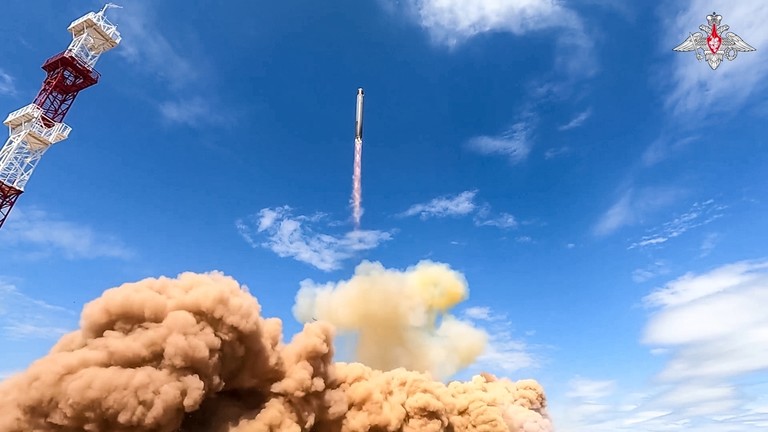
After a successful test launch, Moscow says the first Sarmat regiment will enter combat duty by the end of 2026
© Sputnik/Ministry of Defense of the Russian Federation
By Dmitry Kornev, military expert, founder and author of the MilitaryRussia project
HomeRussia & FSU
13 May 2026
On May 12, 2026, Russia conducted the second launch of its new Sarmat ICBM, progressing its strategic missile program. President Putin said the first regiment with Sarmat ICBMs would be operational by the end of 2026.
Russia is developing its first modern ballistic missile, the Sarmat, to replace the Soviet Voevoda ICBMs, the most powerful ever. It has powerful liquid-fuel engines and can carry 10-14 thermonuclear warheads of around 700 kilotons or up to five hypersonic glide vehicles like the Avangard.
Traditional warheads can be launched with penetration aids to overwhelm missile defenses. However, maneuverable hypersonic glide vehicles present a different threat. Most missile defense systems can't intercept these weapons, making the Sarmat a powerful retaliatory platform.
Work on the Sarmat project began in the late 2000s through collaboration among Russian missile bureaus, such as Makeyev in Miass and NPO Mashinostroyenia in Reutov, which worked on the Avangard hypersonic glide vehicle. Their combined expertise aimed to replace the aging R-36M2 Voevoda ICBMs of Russia's Strategic Rocket Forces.
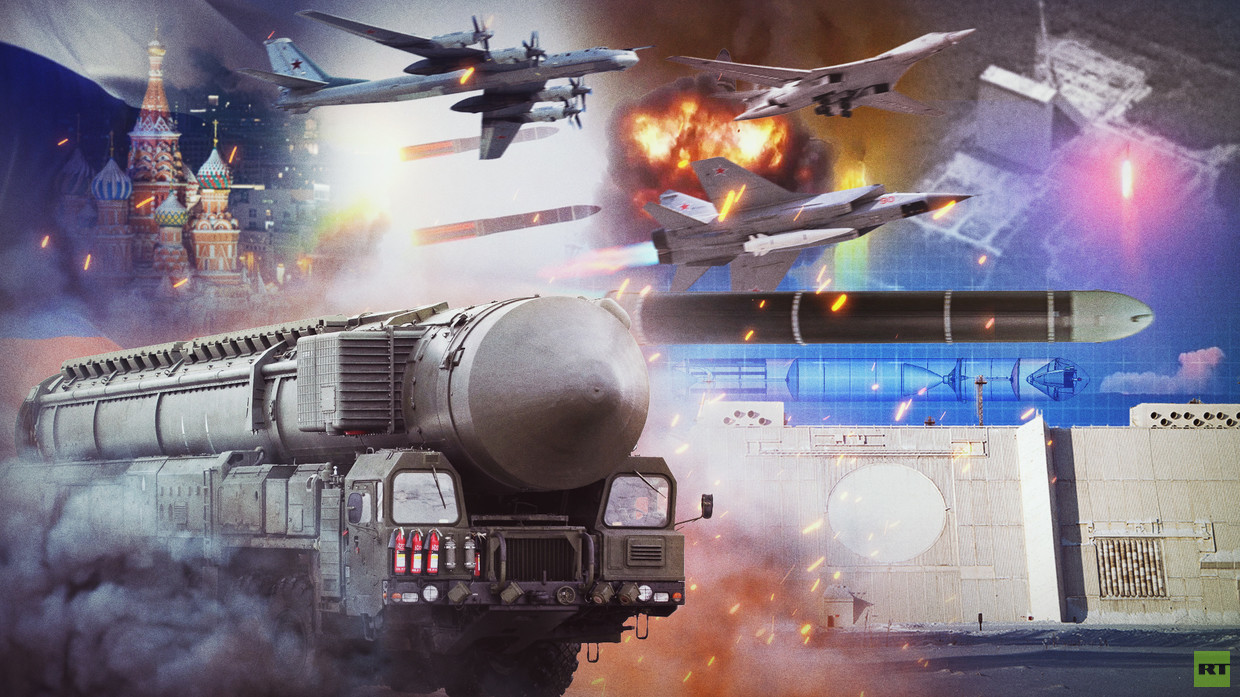
Read more: Rockets from Russia: Inside Moscow’s deadliest arsenal yet
In 2015, the initial prototype missiles were assembled, and ejection tests and manufacturing trials began. The Sarmat program was unique in that the missile was entirely developed and produced in Russia, marking the first time the country had domestically manufactured a system of this size. This required the development of new manufacturing technologies for the missile’s large airframe, propulsion, and guidance components.
In 2022, Vladimir Degtyar, CEO of Makeyev Design Bureau, announced that Russia began serial production of the fifth-generation RS-28 Sarmat ICBM. "The missile is now in serial production and fully equipped with the necessary materials and tools," he said. Russian officials claim this new ICBM will significantly enhance the country’s strategic deterrent for 40 to 50 years.
The Sarmat missile has a range of at least 12,000 kilometers and carries a payload of about 10 tons, including warheads and a post-boost vehicle. It can hit targets by flying over the South Pole, circumnavigating the globe. This route reduces its payload but still delivers multiple nuclear warheads. It is expected to be highly accurate, with a circular error of around 150 meters or less.
Preparation for deploying the first operational Sarmat missiles began in 2023 at Uzhur in Krasnoyarsk Krai. Replacing Voevoda missiles with Sarmat systems is expected to take four to five years or longer. Besides Uzhur, Sarmat missiles are also planned to be deployed near Dombarovsky in Orenburg.
Russia is expected to deploy at least 50 hardened Sarmat silo launchers, making it the most formidable part of its nuclear arsenal—a true weapon of retaliation. These heavy missiles are designed to be launched in response to an incoming nuclear strike. Dozens could exit silos under attack, each carrying about 500 warheads capable of causing catastrophic damage.
Read more
Russia test-fires state-of-the-art ICBM (VIDEO)
In the coming years, the Sarmat is expected to complete its flight-test program and carry various payloads. One version likely will carry conventional MIRVed warheads like those on the Voevoda system. A more advanced variant might use hypersonic maneuverable glide vehicles by NPO Mashinostroyenia. Currently, no missile defense system can reliably intercept these weapons.
These glide vehicles are hard to counter due to their flight profile. Unlike ballistic warheads, they follow a low, flattened hypersonic trajectory near the edge of the atmosphere and can maneuver in altitude and direction, making detection and interception difficult. The Sarmat missile carries over a dozen warheads but probably only three to five hypersonic glide vehicles, likely targeting critical strategic sites, which Russian doctrine suggests would be attacked with near certainty.
No other country has missiles like the Sarmat. China uses outdated liquid-fueled missiles. Once Russia's Sarmat is operational, most of its nuclear missile stock will be modern and next-generation.
This contrasts with the U.S. reliance on the outdated Minuteman III ICBM, introduced in the 1970s and modernized later, with much of its arsenal overdue for replacement. Meanwhile, Russia’s Strategic Rocket Forces are deploying what many consider the most powerful combat missile ever developed.
THE EVANGELICAL POPE | GOD IS LORD OF TIME
June 30, 2025
Living Words from John Paul II
Edited by Abraham A. van Kempen

Each week we let Saint Pope John Paul II share meaningful signposts to spark socio-economic resolves through justice and righteousness combined with mercy and compassion; in short, love
BUILDING THE BRIDGE! | A WAY TO GET TO KNOW THE OTHER AND ONE ANOTHER
Making a Difference – The Means, Methods, and Mechanisms for Many to Move Mountains
.jpg)
Photo Credit: Abraham A. van Kempen, our home away from home on the Dead Sea
By Abraham A. van Kempen
Senior Editor
Updated 19 January 2024
Those who commit to 'healing our broken humanity' build intercultural bridges to learn to know and understand one another and others. Readers who thumb through the Building the Bridge (BTB) pages are not mindless sheep following other mindless sheep. They THINK. They want to be at the forefront of making a difference. They're seeking the bigger picture to expand their horizons. They don't need BTB or anyone else to confirm their biases.
Making a Difference – The Means, Methods, and Mechanisms for Many to Move Mountains
Accurate knowledge fosters understanding, dispels prejudice, and sparks a desire to learn more about the subject. Words have an extraordinary power to bring people together, divide them, forge bonds of friendship, or provoke hostility. Modern technology offers unprecedented possibilities for good, fostering harmony and reconciliation. Yet, its misuse can cause untold harm, leading to misunderstandings, prejudices, and conflicts.
A Free Trial for Life – SUBSCRIBE NOW!

• It's quick and straightforward.
• We won’t ask for your credit card number.
• Just enter your e-mail address to receive your complimentary free-for-life subscription to our newsletter.
• Please include your First and Last Name.
• We won’t share or sell your e-mail address.
_________________________
Related Articles Recently Posted on www.buildingthebridgefoundation.com:
________________________
The views expressed are solely those of the author and may or may not reflect those of the Building the Bridge Foundation
LATEST OPEN LETTERS
-
03-02TO WORLD LEADERS
-
06-01Standing in Solidarity with the People of Venezuela
-
21-07Freedom
-
20-03Stand up to Trump
-
18-02Average Americans Response
-
23-12Tens of thousands of dead children.......this must stop
-
05-06A Call to Action: Uniting for a Lasting Peace in the Holy Land
-
28-05Concerned world citizen
-
13-02World Peace
-
05-12My scream to the world
VIRTUAL POST OFFICE
PETITIONS
LINKS
DONATION
Latest Blog Articles
-
15-10Our Friday News Analysis | What the World THINKS Now!
-
14-10Our Wednesday News Analysis | Navi Pillay, head of UN commission that accused Israel of genocide, wins Nobel Peace Prize
-
13-10Navi Pillay, head of UN commission that accused Israel of genocide, wins Nobel Peace Prize
-
13-10No state has a ‘right’ to exist – least of all an apartheid, genocidal state like Israel
-
13-10‘By the Way, the World is Not Stopping Us’: The Secret of Israel’s ‘Success’
-
12-10Our Monday News Analysis | What the World THINKS Now!
-
08-10Our Friday News Analysis | What the World THINKS Now!
-
07-10Our Wednesday News Analysis | The West wants Netanyahu gone - so Palestinians can be killed more quietly again
-
06-10The West wants Netanyahu gone - so Palestinians can be killed more quietly again
-
06-10Israel turns Gaza into largest ghetto in modern history, killing residents one after another as three-year genocide continues
-
06-10Analysis Europe's Boycott of Israel Is Rapidly Expanding – and It Won't Be Easy to Stop
Latest Comments
 One of the most important and illuminating articles that I …
Comment by Benjamin Inbaraj-
And what's wrong here?
After all, there is the homeland …
Comment by Isac Boian -
Does this reinforce or deny my argument that Israel is …
Comment by Edward Campbell -
Many 'say' they support the Palestinian cause but do little …
Comment by Philip McFedries -
The UN is strangled by the "war for profit" cabal …
Comment by Philip McFedries -
I can't read the printing on the map.
Comment by Philip McFedries -
Good news!
Comment by Philip McFedries
COMMENTS
This article has 0 comments at this time. We invoke you to participate the discussion and leave your comment below. Share your opinion and let the world know.