 NEWSLETTER
The Friday Edition
Our Friday News Analysis | What the World Reads Now!
Helping to Heal a Broken Humanity (Part 111)
The Hague, 7 August 2026 | If you know of a decisive story, tell the world! We're still searching.
.jpg)
Living Words of Saint Pope John Paul II | “East Versus West”
It is timely to mention - with no exaggeration – that a leadership role among nations can only be justified by the possibility and willingness to contribute widely and generously to the common good.
When the West gives the impression of abandoning itself to forms of growing
and selfish isolation, the East, in its turn, seems to ignore, for questionable reasons,
its duty to cooperate in alleviating human misery (1987).
We are up against not only a betrayal of humanity’s legitimate expectations - a betrayal that is a harbinger of unforeseeable consequences - but also an absolute desertion of a moral obligation.
We are thus confronted with a strange phenomenon: while economic aid and development plans meet with the obstacle of insuperable ideological barriers and with tariff and trade barriers, arms of whatever origin circulate with almost total freedom worldwide.
... everyone knows that in some instances, the capital lent by the developed world
has been used in the underdeveloped world to buy weapons.
“What Christianity forbids is to seek solutions...by the ways of hatred, by the murdering of defenseless people, by the methods of terrorism.”
Saint Pope John Paul II
Saint Peter’s Basilica, The Vatican
30 December 1987
This week’s reflection: “East Versus West”

Building the Bridge Foundation
Click here for Part 71
Click here for Part 70
OUR WEDNESDAY NEWS ANALYSIS
THE WEST BANK ON THE BRINK: ISRAEL’S FAR RIGHT, U.S. SUPPORT, AND A REGION IN CRISIS

While global attention is on US-Iran tensions, a separate crisis worsens in Palestinian territories. In the West Bank, Israeli raids, arrests, settlement expansion, and attacks by extremists heighten instability and risk of conflict.
The key issue is whether the escalation continues Israel’s long-standing settlement policy or if Netanyahu’s far-right government is exploiting regional unrest to boost support from nationalist voters.
The answer may be a combination of both.
Editorial | Who Can Afford Wars? No one!
By Abraham A. van Kempen
07 August 2026
No one, not one country, can really afford wars. Wars cost a fortune. They’re almost always financed to be repaid by future generations who had no voice in waging wars. If it weren’t so easy to print money – it’s called ‘Quantitative easing’ – diplomacy would supersede wars. Yesterday, I picked up some groceries at the local supermarket. Shocking! I bought a few donuts ($5.00), coffee ($15.00), crackers ($4.30), mayonnaise ($5.25), bananas ($2.00), and green onions ($1.50); total, $33.05.
What’s going on? INFLATION! Future Generations Pay for Wars Through Inflation!
America and Americans can’t afford wars, but most Americans believe what they’re told: “We can’t NOT afford to wage wars. “We appoint ourselves as the leaders of the free world, anointed to spread liberal democracy whether the world wants it, likes it, or not.” The cost of wars is charged on the US Inflationary Credit Card, better known as the National Debt.
Currently, the national debt has increased, in round figures and who is counting, to $40 trillion. Add to that another $20 trillion of household or consumer debt, plus $30 trillion of unfunded government liabilities, i.e., Social Security and other social entitlement programs, and we’re facing a collective debt of $90 trillion. This means that every man, woman, and child living legally in the United States owes $300,000 each. For a family of four, this sums up to $1.2 million per family owed to the collective national debt.
Future generations will naturally settle the collective debts owed to lending institutions and their shareholders, perpetuating a cycle that makes the rich richer and the poor poorer. This is why you might notice that a bag of groceries that cost $10 ten years ago now costs $33, or why a house built in 1926 for $82,000 recently sold for $12 million. To retire our national debt obligations, the annual minimum wage must – artificially, in real terms, so to speak – increase to $1 million a year. OK, I’m being cynical, even a bit sarcastic, but not all that facetious.
Let’s fast-forward to a glorious future without wars. Which of the two photos is appropriate for this moment? One depicts war; the other, peace. You’ve seen it before in another editorial published a week or two ago.
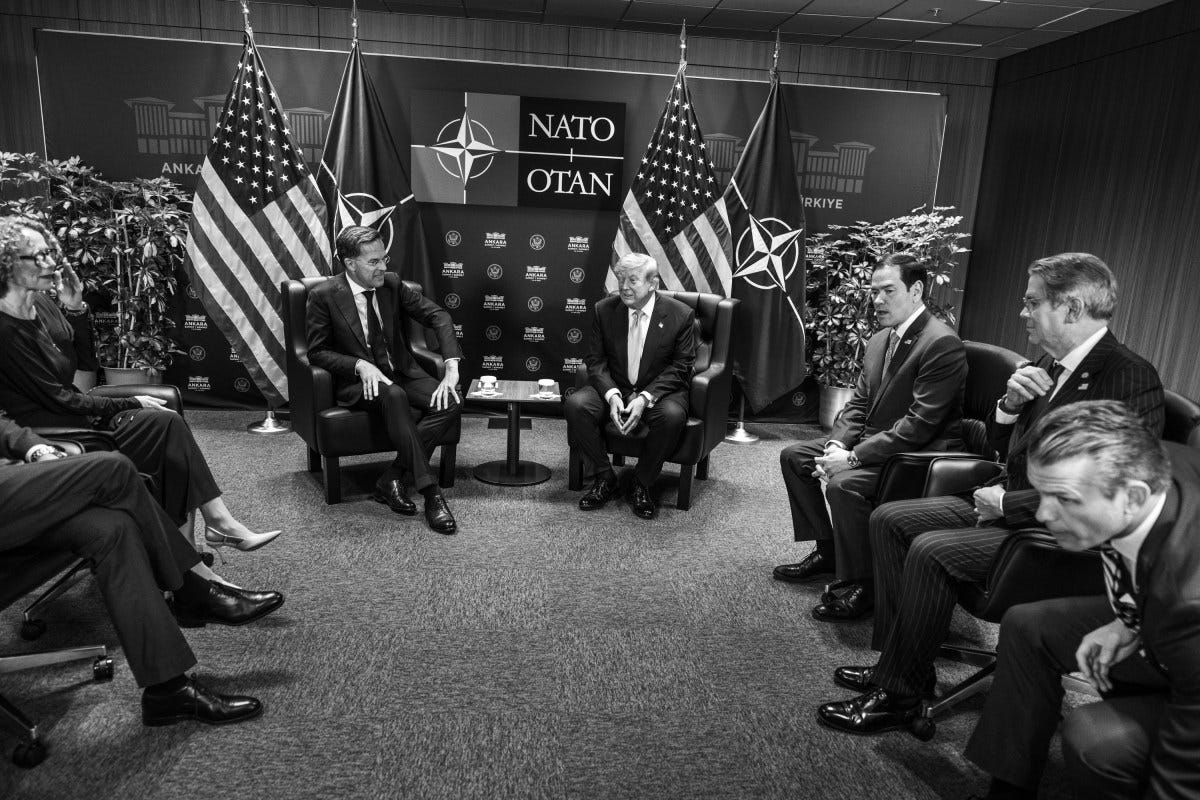
President Donald J. Trump meets NATO Secretary General Mark Rutte at the 2026 NATO Summit in Ankara, 8 July 2026. Official White House Photo by Daniel Torok.

Churchill, Roosevelt, and Stalin at Yalta brokering peace that turned out to be make-believe
Please review my analysis below:
“Analysis | A Heart-to-Heart on a World Running Out of Illusions – Richard Wolff views Europe’s anti-Russian fervor as the politics of imperial decline; Jennifer Kavanaugh sees the West’s military promises colliding with hard limits. Together, they issue a warning we ignore at our peril.
The Eurocentric paradigm of Unipolar Autocracy will gradually have to adapt to the evolving world of multipolar autonomy, shifting away from its long-standing focus of the past six centuries that has profoundly shaped humanity:
What is mine is mine.
What is yours is mine also.
It’s either my way or the highway.
If you’re not for us, you’re against us.
If you don’t do it our way, you’re dead meat.
To be continued on Monday, 10 August 2026.
With Every Good Wish to You, I am,
Sincerely yours,
Abraham A. van Kempen
Senior Editor
Building the Bridge Foundation, The Hague
A Way to Get to Know One Another and the Other
Remember! Diplomacy is catalytic—transformative —while military action is cataclysmic—destructive and catastrophic.
When faced with the options to be good, bad, or ugly, let’s build bridges, not burn them. After all, mutual deterrence reigns.
THE OCCULT OLIGARCHY IN THE WEST HATES EVERYONE WHO PUSHES AGAINST THEM – AUTHOR AND ‘KRAINER ANALYTICS’ FOUNDER ALEX KRAINER
Alex Krainer, born in Croatia, is a market analyst, author, and ex-hedge fund manager.
- Western power claims to defend democracy, human rights, sovereignty, and free markets, but often acts like a neo-colonial system that keeps resource-rich, formerly colonized nations reliant on Western influence.
- Energy resources like oil and gas are main goals, while the dollar-driven financial system transfers wealth from the Global South to Western banks and corporations.
- We are moving from a declining unipolar system to an emerging multipolar world. Former colonies and non-Western nations are no longer vulnerable or isolated.
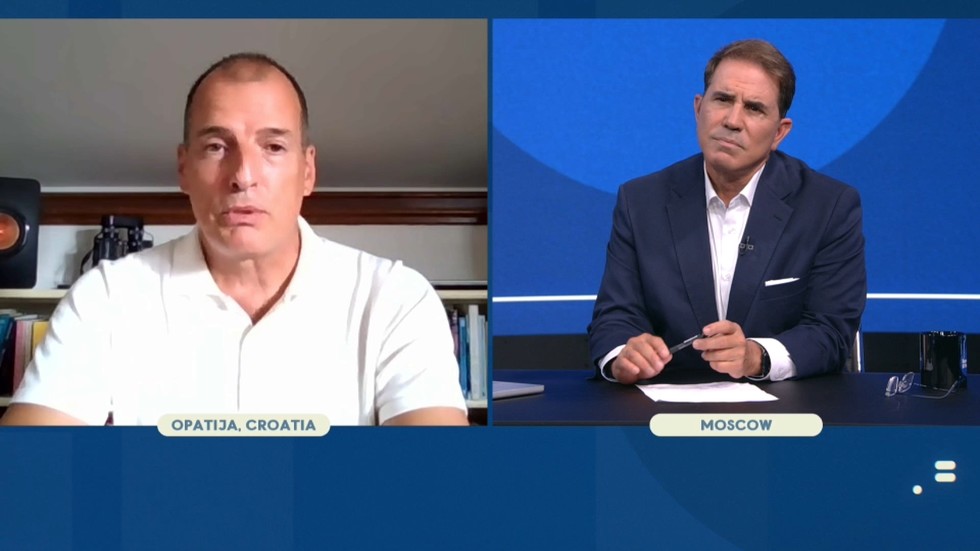
Watch the Video Here (50 minutes, 07 seconds)
Host Rick Sanchez
HomeShowsSanchez Effect
28 July 2026
In the latest episode of the Sanchez Effect, Alex Krainer discusses Western attitudes—despising those who oppose them and mistreating and exploiting those who submit. It’s a no-win situation. He also explains how Moscow has effectively resisted pressure to restore its superpower status.
Mr. Krainer discusses the reasons behind Israel's current complete isolation and impending collapse. Warning signs are everywhere: the Gulf States are cornered, the Houthis and Iran hold the advantage, and longtime Western puppet rulers are losing influence in the region.
Watch the full episode now to find out who will endure this major shift in global power.
GUEST EDITORIAL | THE EU HAS NO PLAN IF PEACE BREAKS OUT IN UKRAINE
Recently, NATO held "peace summits" without Russia, where European leaders, including former Polish President Duda, discussed peace by sanctioning the breakup of Russia.
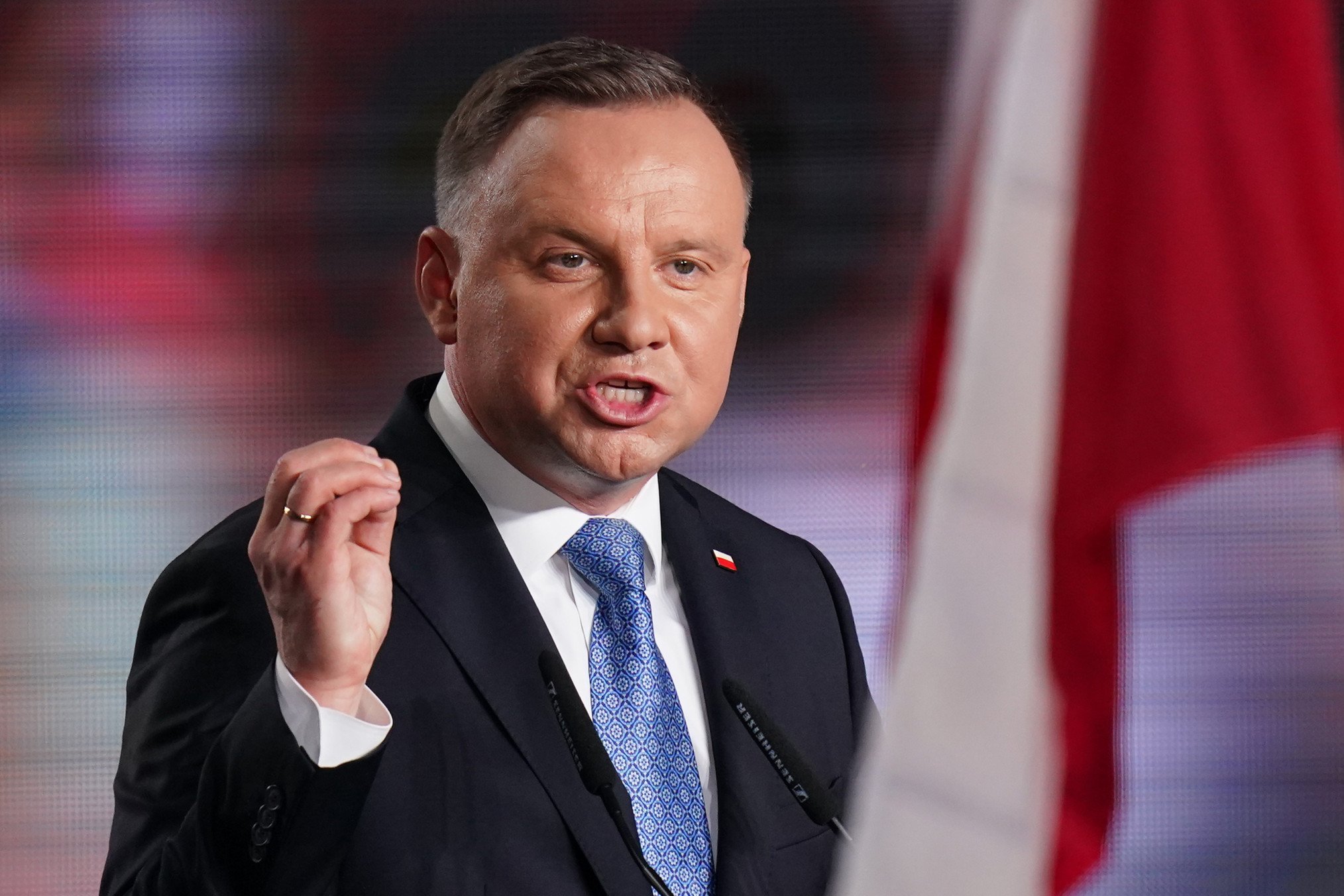
Andrzej Sebastian Duda (born 16 May 1972) is a Polish lawyer and politician who served as the 6th president of Poland from 2015 to 2025. Source: Euractiv
By Prof. Glenn Diesen
GLENN DIESEN
4 AUGUST 2026
In recent years, NATO has organized "peace summits" to which Russia was not invited, where European leaders, including President Duda, advocated peace by breaking up Russia into smaller states.
Now that NATO is clearly losing its proxy war, the EU demands an "unconditional ceasefire". This is not a peace proposal but an effort to prolong the war. An “unconditional ceasefire” is a condition for starting negotiations, intended to freeze a conflict that NATO is losing, giving it time to rearm, regroup, and even send in NATO troops as “peacekeepers”.
- Why has the EU boycotted diplomacy for 4.5 years and continues to do so?
- Why doesn't NATO consider removing expansion from the table as part of a ceasefire?
- Would it be prudent to discuss with the other side how our failure to create a mutually acceptable pan-European security framework after the Cold War has contributed to this terrible war?
The EU uses smear campaigns and censorship to prevent its public from discussing this issue, and it will certainly not raise it with Russia.
The EU cannot allow this war to end, as there is no plan for peace.
- Supporting Ukraine keeps the U.S. engaged in Europe, temporarily maintains European unity, shields an unpopular political elite from rising opposition demanding change, presents military Keynesianism as an economic strategy for a de-industrializing Europe, diminishes Russia's strategic threat, and gives European leaders time to prepare for a direct conflict with Russia.
- A peace treaty would require European leaders to reimburse the funds they have seized and partially stolen from Russia, which were also used as collateral for loans to Ukraine.
- Victory would strengthen Europe's alliance with the U.S. and consolidate Ukraine's resilience, whereas defeat would strip Europe of a clear role or influence in a multipolar world.
Currently, there is no plan for what happens when peace is achieved.
When the Trump administration chose not to follow the NATO consensus by boycotting diplomatic efforts and trying to end the war in Ukraine, European leaders mainly focused on halting the negotiations.
- They hurried to Washington, demanding an “unconditional ceasefire” without considering a political resolution.
- Simultaneously, they escalated deep strikes into Russia to promote the false notion that Russia could be defeated.
- European leaders achieved their goal, leading the Trump administration to embrace the misleading narrative that Ukraine had “turned the tide."
Initially, Trump aimed to either stop the Ukraine War or delegate it to European powers, but now the proxy conflict in Ukraine has become Trump’s own war.
If the goal was truly to "help Ukraine:
- NATO wouldn't have destabilized the Ukrainian government in 2014 to push Ukraine into NATO, which only a small minority of Ukrainians supported.
- It also wouldn't have undermined the Minsk Agreement between 2015 and 2022, nor pressured Zelensky to reverse the peace platform that won him the 2019 election.
- Additionally, it wouldn't have sabotaged the Istanbul agreement in 2022, or at least,
- It would have ended the war in November 2022 based on General Mark Milley's advice when Ukraine was strongest.
- Today, "standing with Ukraine" seems to mean deporting Ukrainian refugees and funding military recruiters to hunt Ukrainian men for a war Ukraine can't win.
Proxy wars are brutal and exploit civilians as cannon fodder. This cruel practice is often portrayed publicly as a deed of compassion and support, despite requiring unconscionable sacrifices from the people.
PROF. RICHARD WOLFF: WHY EUROPE'S LEADERS PROVOKE WAR WITH RUSSIA
Europe’s Strategic Dead End
- Europe’s relationship with Russia seems more like a sign of strategic exhaustion than a clear security plan. Without colonial privileges, steady industrial confidence, and strong American support, European leaders have started to view their geopolitical concerns through a moral lens.
- While it’s easier to portray Russia as the main problem, this doesn't really solve Europe’s main issue: the lack of an independent economic and diplomatic system.
- While increasing military efforts might please Washington and reduce domestic opposition, it could also cause more social divisions and speed up deindustrialization.
- The best way forward for Europe is not endless confrontation but sensible independence—by building stronger economic ties, establishing security agreements, and embracing a multipolar world before decline becomes unavoidable.

Watch the Video Here (52 minutes, 52 seconds)
Host Prof. Glenn Diesen
Substack.com
4 August 2026
Analysis | A Heart-to-Heart on a World Running Out of Illusions
Richard Wolff views Europe’s anti-Russian fervor as the politics of imperial decline; Jennifer Kavanaugh sees the West’s military promises colliding with hard limits. Together, they issue a warning we ignore at our peril.
By Abraham A. van Kempen
7 August 2026
Listen closely, and you can hear the old order creaking.
You can feel it in the quiet tension of European capitals, in the dim factory floors where energy once seemed abundant and security felt everlasting, in the Ukrainian winter inching closer to families who have learned to sleep through sirens, and in the uncertain smiles of Asian allies wondering if the American shield is still as strong as before — or if it merely exists in memory. Professor Richard Wolff and Professor Jennifer E. Kavanaugh look at this moment from different perspectives: he from the passionate world of political economy, she from the pragmatic map room of military realism. Still, both highlight, with remarkable clarity, the same truth: the West’s illusions are disappearing faster than it can develop a new strategy.
Wolff’s central thesis is clear and impactful: Europe’s face-off with Russia isn’t just a noble stand for Ukraine, but rather a reflection of a continent that’s gradually fading—having lost its empire, industrial edge, and the comforting illusion that America would always look after Europe’s interests. Kavanaugh’s perspective is more reserved but equally powerful: she points out that our military commitments are now surpassing our actual capacity, and the old habit of promising security everywhere is clashing with real-world limits in missiles, manpower, logistics, and potential escalation. Wolff highlights the economic and political fears driving panic, while Kavanaugh warns that spreading ourselves too thin could lead to dangerous overreach.
Think of the hardworking German factory worker who once believed that affordable energy, export markets, and skilled labor were a kind of unspoken promise. He wasn't thinking about grand strategies or attending global forums like Davos; he just knew that keeping the furnace burning, the order books full, and ensuring a brighter future for his children beyond insecure, part-time jobs mattered most. But then, energy prices went up, Chinese competition grew fiercer, American priorities shifted, and suddenly the language of sacrifice became familiar again. Rearmament was framed as a matter of destiny, while social spending became more flexible. Russia was blamed for almost everything. Wolff sees this worker and says: this is what decline looks like, turning economic anxieties into global political drama.
Picture a Ukrainian mother listening for air raid sirens, while officials far away debate the next aid package, missile, or red line. She’s not caught up in abstract thinking; her life is filled with outages, funerals, conscription notices, and interrupted childhoods. Kavanaugh’s realism is important because it doesn’t flatter her with false hopes. She wonders if Ukraine can get enough air defenses, trained personnel, industrial support, and diplomatic influence to turn the tide of the war. Her answer isn’t sentimental but based on reality: courage alone can’t stop ballistic missiles, and slogans can’t create people.
Here is where Wolff and Kavanaugh belong in the same conversation. Wolff asks why European leaders need Russia to be more than an adversary—why Russia must become a civilizational demon, a screen onto which Europe projects its own terror of irrelevance. Kavanaugh asks what happens when that demonization becomes policy—when pressure replaces diplomacy, alliance expansion replaces settlement design, and military integration makes neutrality harder to imagine. Wolff gives us the wound beneath the speech. Kavanaugh gives us the battlefield report showing that the speech cannot deliver what it promises.
Listen to the testimonials hidden in plain sight. A European retiree says her heating bill has become a political education. A small manufacturer says he can survive competition, but not policy crafted by leaders who pretend cost does not matter. A young Ukrainian soldier says drones have changed the battlefield, but someone still has to hold the trench. An Asian ally says American protection is welcome, but American distraction is now a fact of life. None of these voices needs to cite theory. They are theory, spoken in rent, fuel, fear, and fatigue.
Wolff’s emotional temperature is volcanic. He speaks like a man who has watched capitalism evade accountability by inventing enemies. His Europe is not a confident fortress of democracy but an aging aristocrat muttering about moral purpose while the roof leaks. He remembers colonial privilege, the extraction that made small countries feel large, the long postwar shelter under American power, and the terrifying moment when that shelter becomes a leash. In his telling, Europe’s leaders provoke conflict because peace would force them to answer the question they fear most: what is Europe for if it is no longer an empire, no longer a workshop, no longer America’s favorite child?
Kavanaugh’s emotional temperature is disciplined, but do not mistake restraint for softness. Her work is compassionate precisely because it is unseduced. She does not wave flags at empty warehouses. She does not confuse alliance rhetoric with replenished stockpiles. She knows that a security guarantee is not a poem; it is a chain of capabilities, production lines, political will, and credible limits. When she warns that pressure can harden Russia’s position rather than soften it, she is not excusing Moscow. She is reminding us that adversaries have agency, memories, fears, and their own escalation ladders.
The contrast is striking. Wolff starts with class and empire; Kavanaugh starts with force posture and credible commitments. Wolff argues that Europe’s crisis is rooted in a political economy that can no longer reproduce its old comforts. Kavanaugh argues that the West’s crisis is rooted in strategic habits that no longer match its resources. Wolff fears a social explosion from austerity, rearmament, and managed decline. Kavanaugh fears miscalculation from overpromising, underproducing, and treating diplomacy as a weakness. He is the fire alarm in the basement. She is the engineer tapping the bridge and saying, “This span will not hold.”
And you and I, are the ones being asked to cross that bridge. We're told that escalation equals seriousness, that more weapons mean more leverage, that diplomacy favors aggression, that doubt equals disloyalty, and that every opponent is Hitler with every compromise Munich. However, history isn't a vending machine for analogies. Sometimes, the bravest choice isn't to shout louder from the balcony, but to acknowledge when a policy has reached its limit before the costs—bodies, budgets, and political stability—become too high.
This is not an argument for surrender. It is an argument against delusion. Europe needs a future that does not depend on permanent hostility toward the largest country on its continent. Ukraine needs a settlement framework that addresses security without pretending that battlefield arithmetic can be wished away. Asia needs regional arrangements that include diplomacy with China rather than mimicking bloc confrontation. America needs to stop confusing global management with national strength. Multipolarity is not a slogan; it is the weather. You can curse the rain, or you can build a roof.
So let us say the unsayable with moral clarity: the old order is not coming back. Wolff explains why the West is grieving its loss. Kavanaugh explains why the West cannot resurrect it militarily. One speaks of decline; the other of limits. Together, they offer a mercy disguised as a warning. They ask us to leave the theater before the exits close. To choose production over posturing, diplomacy over intoxication, autonomy over dependency, and truth over the narcotic of righteous denial. The age of illusions is ending. The question is whether we will end it like adults—or be ended by it like fools.
Abraham van Kempen writes on geopolitics, political economy, and the hard truths hiding beneath comfortable Western myths.
PROF. JENNIFER KAVANAGH: A HISTORIC SHIFT IN ASIA AND UKRAINE’S DEFEAT
- Prof. Jennifer Kavanagh discusses the weakening position of the U.S. in East Asia and why it does not seem possible for Ukraine to "turn the tide.”
- Kavanagh is a Senior Fellow and Director of Military Analysis at Defense Priorities and an Adjunct Professor at Georgetown University’s Center for Security Studies.
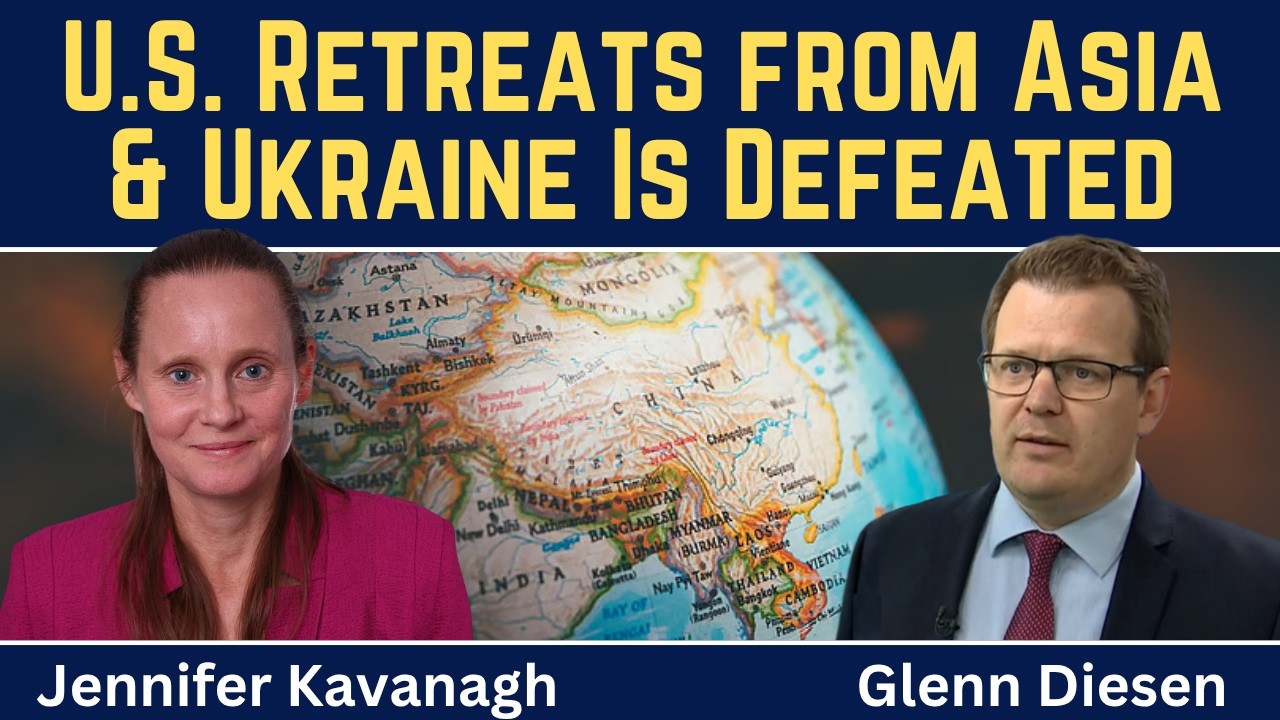
Watch the Video Here (54 minutes, 24 seconds)
Host Prof. Glenn Diesen
Substack.com
2 August 2026
Washington’s shrinking ability to police multiple regions simultaneously is exposing the central illusion of the post-Cold War order: that U.S. primacy could be global, permanent, and cost-free.
From East Asia to Ukraine, allies are discovering that American guarantees no longer match the U.S.’s unlimited capacity, while rivals are learning that pressure can reshape facts on the ground.
The result is not simple abandonment but a harsher transition to multipolarity, in which smaller powers must rethink security beyond dependence on Washington.
The urgent question is whether they will build diplomacy alongside defense—or stumble into blocs that make war more likely.
CHAS FREEMAN: MIDDLE EAST IN TRANSITION & A NEW WORLD ORDER
- Ambassador Freeman, a former Assistant Secretary of Defense, received the Department of Defense's top public service awards for his work in developing a NATO-focused European security system after the Cold War and for rebuilding defense ties with China.
- He also served as U.S. Ambassador to Saudi Arabia during Operations Desert Shield and Desert Storm. In his discussion, Ambassador Freeman emphasizes the importance of reconnecting the West to diplomacy and adapting to a vastly changed global landscape.
Something dark is crossing the horizon, and we can feel its shadow before it arrives. The world trembles in the blue glow of burning skylines, sealed borders, broken promises, and leaders standing among the ashes, calling ruin resolve. Diplomacy is not merely fading; it is being buried like a lantern under cold earth while ordinary people wait beneath the falling sparks of pride, fear, hunger, grief, and graves. This is why we cannot look away.
Peace begins when enemies are seen as human beings before the night turns them into targets.

Watch the Video Here (57 minutes, 03 seconds)
Host Prof. Glenn Diesen
Substack.com
01 August 2026
ESSAY | Amb. Chas Freeman and Zev Jabotinsky: Two Roads at the Edge of the Storm – How Their Central Points Differ
By Abraham A. van Kempen
7 August 2026
Retired U.S. Amb. Chas Freeman and Zev Jabotinsky (1840-1920), the architect of Israel’s Likud Party, both understand power, fear, and interests, but they choose different moral and political paths. Freeman notes that diplomacy has failed because Western leaders ignore others’ security concerns and identities. His approach is realistic, emphasizing negotiation, sovereignty, and restraint. He argues that in a multipolar world, more diplomacy, not less, is needed to prevent any single power from controlling outcomes indefinitely.
Jabotinsky is recognized as the founding father of the Haganah, the precursor to Israel's army. He was a pioneer of Revisionist Zionism, elaborated in his 1923 book, ‘The Iron Wall: We and the Arabs.’ Some poetically call it ‘My Community’ or ‘Mein Kampf’ in German. Zionism often emphasizes lebensraum, which can involve attacking, invading, expelling, and displacing indigenous populations from their lands, claiming their possessions as part of the struggle. It presents a choice: engage in conflict or face the implications of inaction, fostering an ‘us versus them’ outlook.
Jabotinsky argues Palestinian Arab resistance to Zionism was natural, rational, and unavoidable. Zionism could not rely solely on persuasion or voluntary agreement. His “Iron Wall” concept suggests Jewish settlement and statehood require overwhelming force until resistance becomes futile, after which negotiations can occur from strength. While Freeman sees diplomacy as vital to prevent disaster, Jabotinsky considers force a necessary precondition for diplomacy.
The core distinction isn't just "peace versus war," but also how each side views the crucial turning point. Freeman emphasizes valuing the other's dignity and interests first for lasting order. Conversely, Jabotinsky suggests recognition follows once one side shows strong resolve. Freeman’s approach feels like a calm negotiation, while Jabotinsky’s is like building a fortress first, opening talks only once secured.
Key arguments at a glance:
- Freeman’s starting point: diplomacy must begin by recognizing the fears, interests, sovereignty, and agency of other peoples.
- Jabotinsky’s starting point: resistance by the native population is natural and unavoidable, so force must come before negotiation.
- Freeman’s method: restraint, negotiation, balance, and strategic listening to prevent conflict from becoming catastrophe.
- Jabotinsky’s method: an “Iron Wall” of overwhelming strength that makes resistance futile before talks can occur.
- The moral divide: Freeman treats the other side as an interlocutor; Jabotinsky treats the other side as an obstacle to be overcome.
- The essay’s conclusion: security matters, but lasting peace requires diplomacy before humiliation hardens into permanent rage.
The Table or the Wall: What Freeman and Jabotinsky Still Teach Us
When leaders choose walls over tables, they should be honest about the cost: the bill is usually paid by the next generation.
The difference between Ambassador Chas Freeman and Zev Jabotinsky extends beyond diplomacy versus coercion. It reflects a core ideological divide: recognition or submission. Freeman emphasizes starting at the negotiation table, focusing on understanding others’ concerns to prevent conflict. Jabotinsky, however, begins with barriers, asserting force creates realities that must be acknowledged before dialogue.
Freeman’s argument criticizes an era that confuses punishment with strategic thinking. He advocates disciplined realism—listening, calculating, negotiating, respecting other countries' histories, fears, and priorities. Diplomacy isn’t just formalities after violence; it’s crucial to prevent conflicts from escalating.
Jabotinsky’s view is clear and firm. He acknowledged Palestinians might oppose changes and believed native populations resist colonization. His “Iron Wall” strategy used overwhelming force to break resistance, aiming to ease negotiations. Its strength is in honesty, but it also raises moral questions.
Freeman sees the opposing side as a political actor whose interests should be addressed early to prevent disasters, emphasizing understanding power dynamics and diplomacy. Jabotinsky sees it as an obstacle to be broken down before negotiations, prioritizing strengthening power first and using diplomacy only after the situation is settled.
Understanding why this distinction matters shows how walls—physical, ideological, diplomatic, or psychological—offer an illusion of safety. They provide short-term security but create communities based on fear. A wall might delay violence temporarily, but can't erase shared memories or true feelings. It can quiet dissent but can't foster true agreement. While a border wall may protect territory, it isn't enough for real legitimacy.
Freeman warns that when diplomacy fails, the strong often equate action with planning and weapons with wisdom. Jabotinsky states that defenseless people risk being swept away by history. These warnings are important, but fear shouldn't lead us to treat barriers as inviolable. Security aids defense but shouldn't justify policies that surrender others, especially in the pursuit of true peace.
The decision is clear: adopt politics that see enemies as potential allies through dialogue, or one that views interlocutors as defeated enemies-in-waiting. Freeman highlights diplomacy's courage—imperfect, frustrating, slow—but always respectful of dignity and independence. Jabotinsky emphasizes coercion—gaining strength first, then negotiating, regardless of morals.
Policymakers have an urgent role: protect people and secure borders, but coercion isn't a real agreement, and silence isn't approval. True leadership involves reopening talks before walls become the only way to communicate.
It's wise to choose diplomacy early to prevent embarrassment from turning into anger. In fleeting romances, gentle boundaries keep things respectful. Be cautious of political issues asking future generations to face fears their ancestors hesitated to confront. Approaching these carefully fosters understanding and progress.
LAURA LOOMER VS. MULTIPOLARITY
Constantin von Hoffmeister carefully analyzes Laura Loomer’s critique of multipolarity, addressing each point and arguing that her claims mistake an unchangeable geopolitical reality for a hostile ideological agenda.
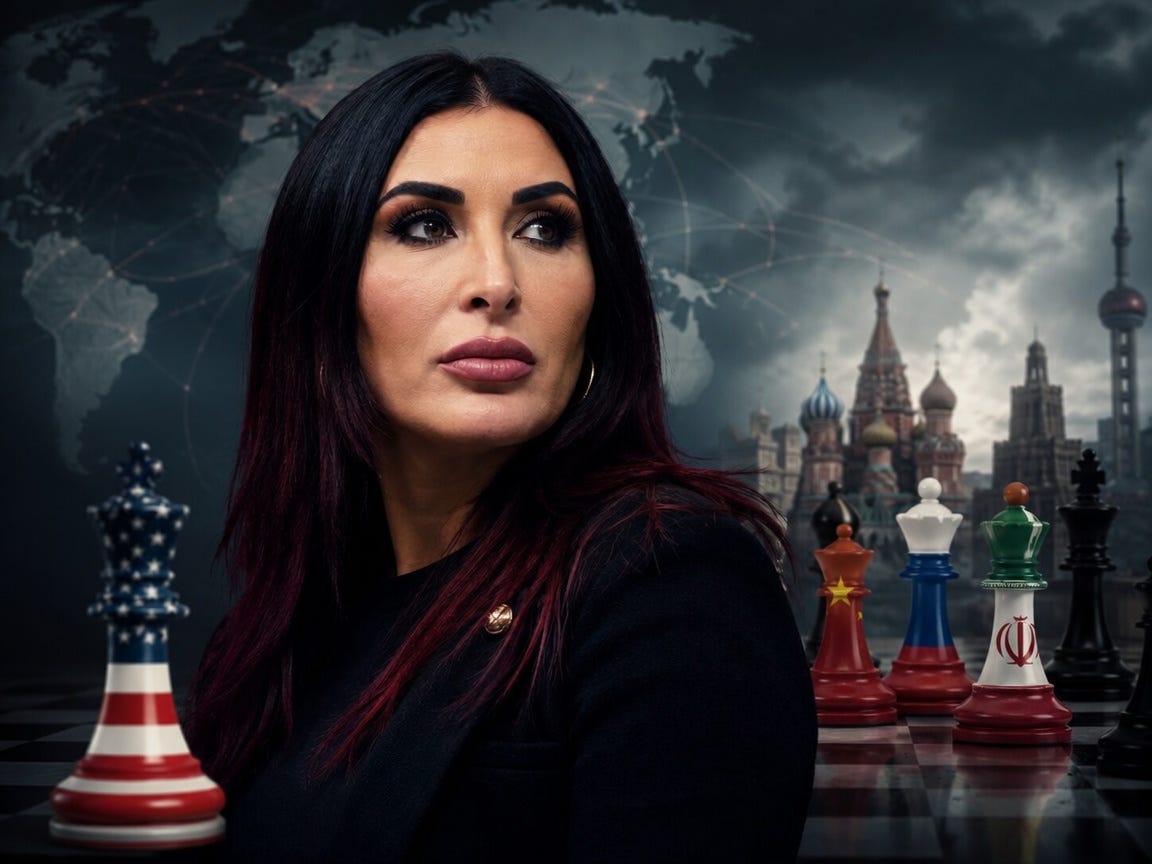
By Constantin Von Hoffmeister
Multipolar Press
31 July 2026
American supremacy attacks civilizational diversity.
Laura Loomer's recent condemnation of multipolarity marks one of the clearest attempts on the American Right to frame the emerging international order as an existential threat rather than an inevitable transformation. Her arguments merit careful examination, not because they are unique, but because they reflect assumptions that have become increasingly common in debates about the future of global power.
Loomer presents her first argument in the simplest possible terms. She claims that multipolarity exists to destroy American supremacy. According to her, Russia promotes the doctrine because it seeks the United States' decline, while China, Iran, and other governments adopt the same language for the same reason. In her account, multipolarity is not a description of the international system but a political weapon aimed directly at Washington. The disappearance of American predominance therefore becomes the central objective of every state that speaks of a multipolar world.
This argument confuses consequence with intention. Multipolarity does not begin with hostility toward America. It begins with the recognition that the distribution of power has already shifted. China possesses industrial capacity on a scale unseen in modern history. India has become a continental power with global ambitions. Russia remains one of the world’s foremost military powers despite unprecedented sanctions. Regional actors such as Turkey, Saudi Arabia, Brazil, Indonesia, and others increasingly pursue independent policies rather than automatic alignment with Washington. These developments did not arise because someone wrote books about multipolarity. The books appeared because the balance of power was already shifting. The decline of unipolarity is therefore not a revolutionary program but a recognition of political reality. No empire has remained permanently dominant. History moves through shifting distributions of power, and every generation mistakes its own arrangements for permanent truths until events prove otherwise.
Loomer’s second argument casts multipolarity as an alliance among Russia, China, Iran, Islamist movements, and other governments united by hatred of the West. She portrays these actors as part of a single ideological front whose shared purpose is the destruction of Western civilization. Under this interpretation, every state that speaks of multipolarity belongs to the same hostile camp, regardless of its own interests or historical experience.
This confuses coincidence with unity. The countries commonly associated with multipolarity frequently disagree on territory, economics, religion, and regional influence. India maintains a strategic rivalry with China while participating in organizations that include Beijing. Turkey remains a NATO member while purchasing Russian military equipment. Saudi Arabia cooperates with Washington while expanding relations with Moscow and Beijing. Iran and Russia share interests in some regions but not in every sphere. Brazil follows its own priorities, while Indonesia pursues a different course entirely. There is no single ideological headquarters directing these governments toward one objective. What unites them is not identical beliefs but the desire to preserve greater freedom of action. Multipolarity does not require permanent friendship among its participants. It merely assumes that several independent centers of power exist simultaneously.
Loomer’s third argument claims that multipolarity functions primarily as Russian propaganda. According to her, Moscow uses information campaigns, media personalities, and sympathetic commentators to persuade Western audiences that American leadership should end. The doctrine therefore appears to be little more than a sophisticated psychological operation.
Propaganda cannot manufacture geopolitical reality. It may exaggerate events or shape perceptions, but it cannot create factories, armies, populations, technological industries, or national interests. The rise of several major powers has measurable economic and military foundations independent of any Russian information campaign. China did not become an industrial giant because of Russian messaging. India did not become the world’s most populous country through propaganda. American debt, political polarization, and industrial decline cannot be explained by foreign influence alone. Every great power produces narratives that support its own interests. Washington has done so for generations, just as London, Paris, Moscow, and Beijing have done before it. Reducing structural transformation to propaganda mistakes symptoms for causes.
Loomer’s fourth argument identifies multipolarity as the greatest threat to Western civilization. She presents American predominance as the final guarantee of Western survival. Once that predominance disappears, she argues, the civilization that produced Europe and North America will inevitably collapse under hostile external forces.
This assumes that civilization depends on imperial management from a single capital. Yet Western civilization existed for centuries before the United States emerged as the world’s leading power. Classical Greece, Republican Rome, medieval Christendom, Renaissance Italy, imperial Spain, Bourbon France, Victorian Britain, and many other historical forms flourished under very different political arrangements. Civilizations possess cultural continuity independent of whichever state temporarily holds first place. Indeed, empires often weaken the societies they lead by drawing them into endless military commitments, financial burdens, and ideological universalism. A civilization survives through confidence in its own traditions, institutions, and people rather than through permanent global supremacy.
Loomer’s fifth argument focuses on thinkers linked to multipolarity, notably Alexander Dugin. She claims they openly seek the destruction of the United States, exposing the doctrine’s real aims. Since some supporters favor ending American dominance, she infers that multipolarity is inherently aimed at combating America as a nation.
BUILDING THE BRIDGE! | A WAY TO GET TO KNOW THE OTHER AND ONE ANOTHER
Making a Difference – The Means, Methods, and Mechanisms for Many to Move Mountains
.jpg)
Photo Credit: Abraham A. van Kempen, our home away from home on the Dead Sea
By Abraham A. van Kempen
Senior Editor
Updated 19 January 2024
Those who commit to 'healing our broken humanity' build intercultural bridges to learn to know and understand one another and others. Readers who thumb through the Building the Bridge (BTB) pages are not mindless sheep following other mindless sheep. They THINK. They want to be at the forefront of making a difference. They're seeking the bigger picture to expand their horizons. They don't need BTB or anyone else to confirm their biases.
Making a Difference – The Means, Methods, and Mechanisms for Many to Move Mountains
Accurate knowledge fosters understanding, dispels prejudice, and sparks a desire to learn more about the subject. Words have an extraordinary power to bring people together, divide them, forge bonds of friendship, or provoke hostility. Modern technology offers unprecedented possibilities for good, fostering harmony and reconciliation. Yet, its misuse can cause untold harm, leading to misunderstandings, prejudices, and conflicts.
A Free Trial for Life – SUBSCRIBE NOW!

• It's quick and straightforward.
• We won’t ask for your credit card number.
• Just enter your e-mail address to receive your complimentary free-for-life subscription to our newsletter.
• Please include your First and Last Name.
• We won’t share or sell your e-mail address.
_________________________
Related Articles Recently Posted on www.buildingthebridgefoundation.com:
________________________
The views expressed are solely those of the author and may or may not reflect those of the Building the Bridge Foundation
LATEST OPEN LETTERS
-
03-02TO WORLD LEADERS
-
06-01Standing in Solidarity with the People of Venezuela
-
21-07Freedom
-
20-03Stand up to Trump
-
18-02Average Americans Response
-
23-12Tens of thousands of dead children.......this must stop
-
05-06A Call to Action: Uniting for a Lasting Peace in the Holy Land
-
28-05Concerned world citizen
-
13-02World Peace
-
05-12My scream to the world
VIRTUAL POST OFFICE
PETITIONS
LINKS
DONATION
Latest Blog Articles
-
15-10Our Friday News Analysis | What the World THINKS Now!
-
14-10Our Wednesday News Analysis | Navi Pillay, head of UN commission that accused Israel of genocide, wins Nobel Peace Prize
-
13-10Navi Pillay, head of UN commission that accused Israel of genocide, wins Nobel Peace Prize
-
13-10No state has a ‘right’ to exist – least of all an apartheid, genocidal state like Israel
-
13-10‘By the Way, the World is Not Stopping Us’: The Secret of Israel’s ‘Success’
-
12-10Our Monday News Analysis | What the World THINKS Now!
-
08-10Our Friday News Analysis | What the World THINKS Now!
-
07-10Our Wednesday News Analysis | The West wants Netanyahu gone - so Palestinians can be killed more quietly again
-
06-10The West wants Netanyahu gone - so Palestinians can be killed more quietly again
-
06-10Israel turns Gaza into largest ghetto in modern history, killing residents one after another as three-year genocide continues
-
06-10Analysis Europe's Boycott of Israel Is Rapidly Expanding – and It Won't Be Easy to Stop
Latest Comments
 One of the most important and illuminating articles that I …
Comment by Benjamin Inbaraj-
And what's wrong here?
After all, there is the homeland …
Comment by Isac Boian -
Does this reinforce or deny my argument that Israel is …
Comment by Edward Campbell -
Many 'say' they support the Palestinian cause but do little …
Comment by Philip McFedries -
The UN is strangled by the "war for profit" cabal …
Comment by Philip McFedries -
I can't read the printing on the map.
Comment by Philip McFedries -
Good news!
Comment by Philip McFedries
COMMENTS
This article has 0 comments at this time. We invoke you to participate the discussion and leave your comment below. Share your opinion and let the world know.