 NEWSLETTER
The Monday Edition
Our Monday News Analysis | What the World Reads Now!
Helping to Heal a Broken Humanity (Part 82)
The Hague, 27 April 2026 | If you know of a decisive story, tell the world! We're still searching
We’ve moved the Evangelical Pope to https://evangelicalpope.substack.com/
The Evangelical Pope is a space dedicated to sharing enduring spiritual and moral insights inspired by the life and teachings of Saint Pope John Paul II, as he connects as the pastor of billions, a theologian and philosopher, and a poet and world statesman, perhaps the Statesman of the 20th Century.
Born as Karol Józef Wojtyła, Saint Pope John Paul II became the most beloved pope in history. He was a man for all seasons, revered on every continent, proclaiming his universal faith in the One engraved on the face of all humanity.
In a world screeching with noise—sensory overload amid clashing encounters—we aim to provide solitude, back to basics, serenity, quality time, another alternative—one of clarity, depth, and reflection, grounded in faith.
Every message connects timeless truths to the realities of our time, encouraging readers to ponder more deeply, live more intentionally, and remain rooted in what genuinely matters.
The Evangelical Pope is part of the Building the Bridge Foundation’s broader vision—an initiative committed to fostering understanding, dialogue, and unity across cultures, perspectives, and beliefs. Through reflection and thoughtful engagement, we aim to build bridges where there is distance and to bring clarity where there is confusion.
Our Mission
To communicate enduring truths with sincerity and depth, and to contribute—however modestly—to a world that values understanding over division, and reflection over noise.
What You’ll Find Here
- Reflections inspired by Saint Pope John Paul II
- Faith-centered perspectives on modern life
- Thoughtful and accessible spiritual insights
- A space for quiet reflection in a noisy world
Why This Matters
We believe meaningful change begins with understanding—ourselves, the other, and one another.
Through words, ideas, and shared reflection, we hope to advance that understanding.
A Shared Journey
This is not merely a publication but a space that grows alongside its readers—those who seek depth, truth, and a more reflective way to engage with the world.
If these reflections resonate with you over time, welcome to this journey.
Click here for Part 2
Click here for Part 3
Click here for Part 4
Click here for Part 5
Click here for Part 6
Click here for Part 7
Click here for Part 8
Click here for Part 9
Click here for Part 10
Click here for Part 11
Click here for Part 12
Click here for Part 13
Click here for Part 14
Click here for Part 15
Click here for Part 16
Click here for Part 17
Click here for Part 18
Click here for Part 19
Click here for Part 20
Click here for Part 21
Click here for Part 22
Click here for Part 23
Click here for Part 24
Click here for Part 25
Click here for Part 26
Click here for Part 27
Click here for Part 28
Click here for Part 29
Click here for Part 30
Click here for Part 31
Click here for Part 32
Click here for Part 33
Click here for Part 34
Click here for Part 35
Click here for Part 36
Click here for Part 37
Click here for Part 38
Click here for Part 39
Click here for Part 40
Click here for Part 41
Click here for Part 42
Click here for Part 43
Click here for Part 44
Editorial | Manufacturing and Manipulating Consent
By Abraham A. van Kempen
27 April 2026
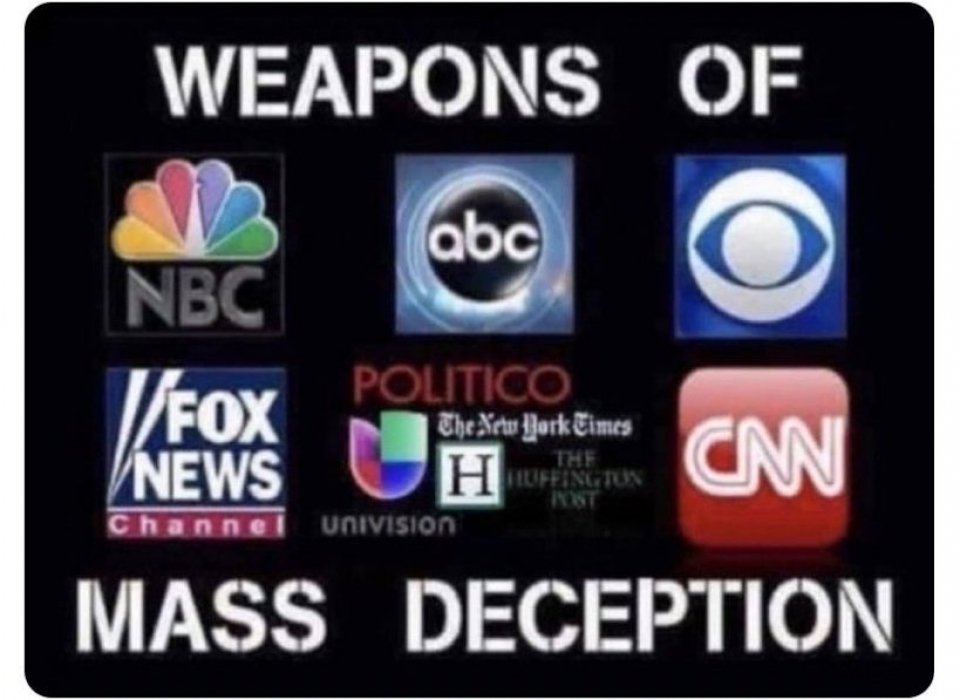
When you consider the Worldwide Deep State, think of it as a blob—a mindset of influential opinion leaders who rule a mob of mindless sheep that follow other mindless sheep.
Last Friday, I committed to explaining how the Blob manufactures consent. Due to family commitments, I didn't meet our initial Monday News Analysis deadline. Please review this edition, which is an eye-opener—more insights will follow. I will detail how ‘they’ manipulate consent and why about 80 percent of us tend to believe in fairy tales most of the time. I will also identify their foot soldiers and operatives by role rather than by name. Stay tuned!
To be continued on Friday, 1 May 2026.
Have a great week,
Abraham A. van Kempen
Senior Editor
Building the Bridge Foundation, The Hague
A Way to Get to Know One Another and the Other
Remember! Diplomacy is catalytic—transformative —while military action is cataclysmic—destructive and catastrophic.
When faced with the options to be good, bad, or ugly, let’s build bridges, not burn them. After all, mutual deterrence reigns.
A WATERSHED MOMENT? | PROF. JOHN MEARSHEIMER AND SIR MAX HASTINGS
Prof. John Mearsheimer:
On 23 April 2026, I was on “Switzerland,” Tom Switzer’s new podcast, with the distinguished British historian and journalist, Max Hastings.
- It was a sobering conversation because Max is deeply concerned about President Trump’s state of mind and where he is taking not just the United States but the rest of the world as well.
- Listening to Max, who is judicious, highly knowledgeable about international politics, very smart, and deeply committed to the trans-Atlantic relationship, you realize how much damage President Trump has done to America’s standing around the world.
- And you realize we are living in dangerous times as both Israel and the US are forced to face up to the fact that they picked a fight with Iran they cannot win...

Watch the Video Here (58 minutes, 25 seconds)
Host Tom Switzer
Switzerland
23 April 2026
Historians reserve the term “watershed” for those rare moments when events do not merely shock the established order but upend it. Think of the fall of the Berlin Wall in 1989, which hastened the end of the Cold War and ushered in an era of American unipolarity. Or the September 11, 2001, attacks in the US, which ignited the global war on terror and culminated in the long, costly entanglements of the so-called forever wars.
In each case, those living through the moment could sense they were witnessing events whose consequences would extend far beyond the immediate crisis. The question now is whether the war in Iran belongs in that category. On the world stage, many allies and partners increasingly worry that the United States as a friend is shrinking with extraordinary rapidity. If this is true, what does this mean for international affairs after the Iran war?
Guests are Sir Max Hastings, the British military historian, columnist, and former newspaper editor, and John Mearsheimer, professor of political science from the University of Chicago.
Join Tom's Exclusive Newsletter: https://mailchi.mp/cff5e11f69a3/switz... Read Tom's Substack: https://substack.com/@tomswitzer
Tom Switzer is a journalist and broadcaster who has been a prolific commentator on politics and international affairs. His writing and commentary have appeared in outlets including The Wall Street Journal, The New York Times (international), The Australian, and across ABC and Sky News, where he has been a regular presenter and panelist.
For 30 years, since 1995, he has worked at the Washington-based American Enterprise Institute, the Australian Financial Review, The Australian, the London-based Spectator magazine, and the Sydney-based Center for Independent Studies, which he headed from 2017 to 2025.
He is the host of Switzerland, a long-form interview series exploring global politics, modern history, and the ideas shaping the world.
MEIN AI – PALANTIR’S ALEX KARP WANTS US TO KNOW HE HAS BIG PLANS
The surveillance giant is not even hiding its truly evil plans for humanity anymore, and its only downfall might be its hubris
Substack.com
24 April 2026
By Tarik Cyril Amar, a historian from Germany working at Koç University, Istanbul, on Russia, Ukraine, and Eastern Europe, the history of World War II, the cultural Cold War, and the politics of memory
@tarikcyrilamartarikcyrilamar.substack.comtarikcyrilamar.com
Once the Nazis were done, quite a few people started scratching their heads. Obviously, one thing to baffle any sane observer was the sheer enormity of their crimes, accomplished, moreover, with frenetic, really start-upish drive and ambition in a mere 12 years: World War? Check. Genocides? Check. Bad hairstyle? Check.
But then, there also was another puzzle: How could their self-besotted visionary-in-chief, hobby philosopher (with a bent to sinister German stuff), and obviously mentally less-than-stable wannabe genius of a leader have gotten a whole nation of, apparently, reasonably educated people to go along? And not just go along, but go along to the very, very bitter end.
That question was all the more disturbing in view of the fact that Adolf Hitler had not been shy about displaying his insanity and extremely bad intentions well before conservative elites installed him in power in 1933. Hitler’s book-length, indeed two-volume, manifesto of German fascism (AKA Nazism), Mein Kampf, was published in 1925 and 1926, sold more than 12 million copies, and was translated into over a dozen languages.
Those ready to brave its pathological me-me-me-and-HISTORY narcissism, daft hodge-podge ramblings about the better and the lesser parts of humanity, and brownshirt-bro bombast could not say that the future Leader had been concealing where he intended to lead Germany and, really, the world.
Indeed, Hitler’s manifesto could have served as an all-alarms-howling, bright-red-lights-flashing-everywhere, get-the-straitjackets-now warning. The main points of Nazi Germany’s evil to come were all there, laid out in general but with stunning honesty: empire building with industrial-strength brutality, extermination or at least slavery for those considered inferior and superfluous, and last but not least, eternal primacy of one master country, to be achieved and maintained by all and any means, because that country – in Hitler’s case Germany – was defined as superior to all others and called upon to lead the world, forever.

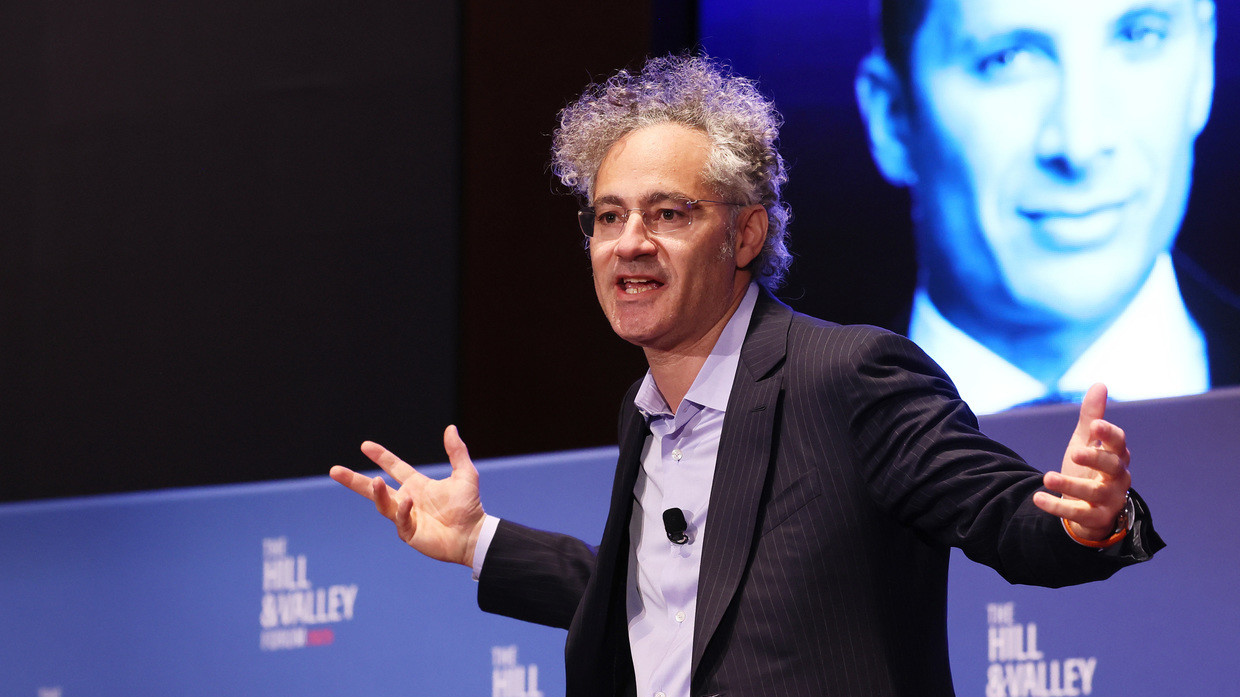
Alex Karp, CEO of Palantir Technologies, speaks on a panel titled Power, Purpose, and the New American Century at the Hill and Valley Forum at the U.S. Capitol on April 30, 2025 in Washington, DC. © Getty Images / Kevin Dietsch
It is one of those bitter ironies of history that Alex Karp, CEO of the very peculiar software company Palantir, who regularly refers to his Jewish family background and what it would have meant for him under the Nazis, has recently released a manifesto that also should serve as a warning to the rest of us. A summary of his longer tract ‘The Technological Republic’ (co-authored with Nicholas Zamiska) the 22-point X post has provoked a great backlash.
Read more
Wired for War: What’s in Palantir’s ‘Technofascist’ manifesto?
Cas Mudde, well-known expert on the far right, has called it “Technofascism pure!” (with an exclamation mark in the original). Yanis Varoufakis feels that “if Evil could tweet, this is what it would!” (with another exclamation mark). Mudde has also called for a full stop to all cooperation with Palantir by European companies and government agencies. Even Eliot Higgins, founder of Cold War re-enactment tool and Western information war front Bellingcat has been moved to mild irony. How daring! (Exclamation mark mine.)
These are not overreactions. Karp’s Palantir Manifesto really is an astonishingly open exploration of a very sick mind’s vision for the future of humanity, arguing, in effect, for an open-ended AI arms race, bringing back German and Japanese militarism, racism masked as realism about cultural backwardness (as it happens, also a Nazi “Kulturträger” move, which Karp should have heard about in his German years), and, last but not least, letting our brilliant billionaires and new elites in general off the hook when they mess up. How unselfish.
It is also painfully, criminally badly written in a style that combines mock-Oswald Spengler Götterdämmerung kitsch (“The decadence of a culture or civilization, and indeed its ruling class, will be forgiven only if that culture is capable of delivering economic growth and security for the public.”) with sheer non-sequitur inanity (Why, again, can’t we have economic growth and security without any of that “ruling class decadence”?).
There are passages that read like young Jordan Peterson – age 15 and on too much Diet Coke – trying to be deep, really, really deep for the first time: “Those who look to the political arena to nourish their soul and sense of self, who rely too heavily on their internal life finding expression in people they may never meet, will be left disappointed” and “our society has grown too eager to hasten, and is often gleeful at, the demise of its enemies. The vanquishing of an opponent is a moment to pause, not rejoice.”
After the inimitable practice of America’s war idiot-in-chief Don Tzu of Hormuz, Alex and his Palantir friends are giving us their I Ching of the tech dim. Lucky us: So much American primacy and then we get Silicon Valley meta, too!
Yet farcical as Karp’s manifesto is, it is, of course, a deadly serious matter. After all, we live in a world where Palantir has already risen to far too much power. Founded as a CIA spin-off after the terror attacks of September 11, 2001, and backed by totally normal “transhumanist” and Antichrist-obsessive Peter Thiel, Palantir has grown into a bloody monster, combining, in true fascist style, the logics of efficiency and extermination with its software tools, such as Gotham, Foundry, or Maven, while mass-spying on everything and everyone it can, and systematically embedding itself in international business and government to become – or appear – indispensable.
Read more
Palantir’s Technological Republic is a blueprint for digital tyranny
Palantir – named after all-seeing magic stones used by the villains of Tolkien’s Lord of the Rings (again: don’t say you weren’t warned) has already produced so much evil that a short worst-of-the-worst sample must do: The company has officially denied being involved in genocidal Israel’s use of AI to mass-murder Palestinians faster. Curiously enough, Alex Karp has, however, smirkingly admitted the fact in public. Regarding the deployment of Palantir’s targeting software in the American-Israeli war of aggression against Iran, the company is not even denying it.
But Palantir never rests. While deeply and proudly involved in genocidal slaughters and imperialist warfare, it also subverts peacetime societies pervasively. In Britain, for instance, a backlash has set in against the state’s reckless handing over of police powers and extremely sensitive data (for instance, in the spheres of finance and health) to the American CIA-offshoot gone rogue. In Germany, Palantir systems are used for policing in at least three federal states: Hesse, North Rhine-Westphalia, and Bavaria. In the US, Palantir has, of course, already so deeply invaded the state that it not only helps it fight its criminal wars abroad but also, for instance, terrorizes its migrants and some non-migrants, too, at home.
Indeed, Palantir is so evil that even its own employees are beginning to wonder if they might, actually, be the bad guys. Hint: Yes, you are.
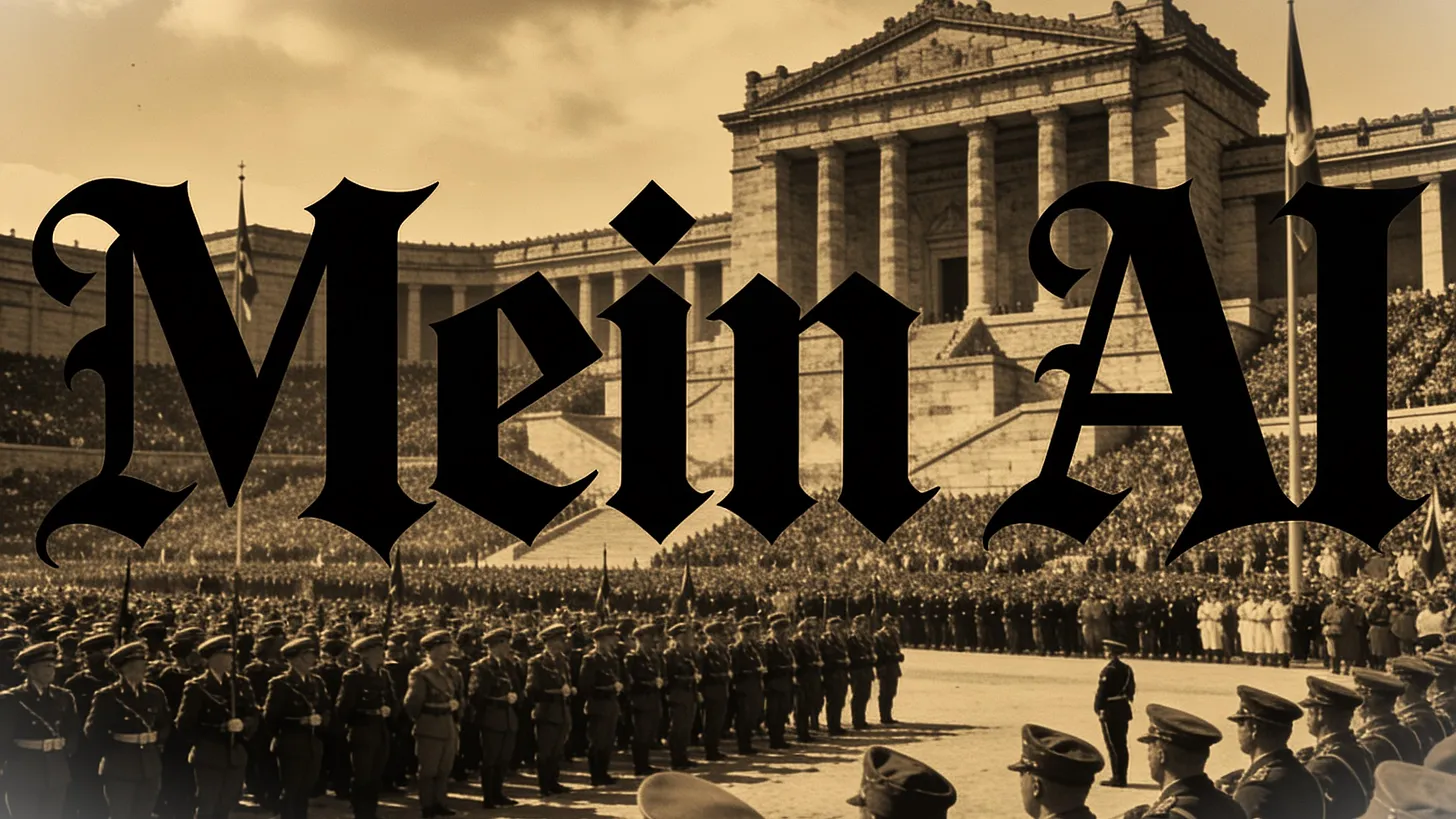
For the rest of us, that is, almost all of us on this planet afflicted by Silicon Valley: It’s time to believe them when they tell us to our faces that they are coming for us. Palantir is a clear and present danger. Its CEO is an extremely dangerous maniac, its mission is subversion, surveillance, and violence, and its only Achilles heel may be that old nemesis of the wicked: hubris. The sort of hubris that makes you announce your horrible aims in a manifesto we should call Alex Karp’s Mein AI.
What is the Side of the Story that is Not Yet Decisive? Edited and annotated by Abraham A. van Kempen
‘EITHER YOU RUN THE SHOW, OR THE SHOW RUNS YOU, AND TRUMP DOESN’T RUN THE SHOW. HE HAS BEEN COMPLETELY CHECKMATED.’ – STEVE HANKE
In this episode of RT’s Sanchez Effect, we analyze the Iranian conflict purely from an economic perspective.

Watch the Video Here (54 minutes, 38 seconds)
Host Rick Sanchez
RT’s Sanchez Effect
23 April 2026
Our guest, a professor of applied economics at Johns Hopkins University, brings valuable insights to this intriguing discussion. He argues that Iran is winning geographically, especially while controlling the crucial Strait of Hormuz.
He also criticizes US President Donald Trump’s decision to block Iranian ports, warning that this could trigger a global economic crisis. The professor describes the embargo as a ‘stupid thing to do,’ emphasizing that it is causing countries to turn away from the US and could lead to a major worldwide recession.
Mr. Hanke notes that Trump has trapped himself with no clear exit and predicts that, amid the chaos, BRICS will emerge as a winner.
Watch the whole episode here on RT International, or on BitChute ‘ricksancheztv’.
THE NEOCON UPGRADE AND THE NEW TOTALITARIANISM
Decoding the Palantir Manifesto
The transcript below is from Prof. Alexander Dugin’s latest episode of the Radio Sputnik Escalation Show.
Arktos Journal and Alexander Dugin
Substack.com
23 April 2026
Radio Sputnik, Escalation Show Host: Let’s start with a rather unusual topic concerning the West’s new ideology—or, to be precise, how to interpret it, which is something we still need to figure out. Let’s analyze the Palantir Manifesto released by the United States. What kind of document is this, what are its goals, and what does it actually promise the world?
Here are the summary excerpts of the Manifesto published in The New York Times:
1. Silicon Valley owes a moral debt to the country that made its rise possible. The engineering elite of Silicon Valley has an affirmative obligation to participate in the nation's defense.
2. We must rebel against the tyranny of the apps. Is the iPhone our greatest creative, if not crowning, achievement as a civilization? The object has changed our lives, but it may also now be limiting and constraining our sense of the possible.
3. Free email is not enough. The decadence of a culture or civilization, and indeed its ruling class, will be forgiven only if that culture is capable of delivering economic growth and security for the public.
4. The limits of soft power, of soaring rhetoric alone, have been exposed. The ability of free and democratic societies to prevail requires something more than moral appeal. It requires hard power, and in this century, hard power will be built on software.
5. The question is not whether A.I. weapons will be built; it is who will build them and for what purpose. Our adversaries will not pause to indulge in theatrical debates about the merits of developing technologies with critical military and national security applications. They will proceed.
6. National service should be a universal duty. We should, as a society, seriously consider moving away from an all-volunteer force and fighting the next war only if everyone shares in the risk and the cost.
7. If a U.S. Marine asks for a better rifle, we should build it, and the same goes for software. We should, as a country, be capable of continuing a debate about the appropriateness of military action abroad while remaining unflinching in our commitment to those we have asked to step into harm's way.
8. Public servants need not be our priests. Any business that compensated its employees as the federal government compensates public servants would struggle to survive.
9. We should show far more grace towards those who have subjected themselves to public life. The eradication of any space for forgiveness—a jettisoning of any tolerance for the complexities and contradictions of the human psyche—may leave us with a cast of characters at the helm we will grow to regret.
10. The psychologization of modern politics is leading us astray. Those who look to the political arena to nourish their souls and sense of self, who rely too heavily on their inner life, finding expression in people they may never meet, will be left disappointed.
11. Our society has grown too eager to hasten and is often gleeful at the demise of its enemies. The vanquishing of an opponent is a moment to pause, not rejoice.
12. The atomic age is ending. One age of deterrence, the atomic age, is ending, and a new era of deterrence built on A.I. is set to begin.
13. No other country in the history of the world has advanced progressive values more than this one. The United States is far from perfect. But it is easy to forget how much more opportunity this country offers those who are not hereditary elites than any other nation on the planet.
14. American power has made possible an extraordinarily long peace. Too many have forgotten, or perhaps take for granted, that nearly a century of some form of peace has prevailed in the world without a great-power military conflict. At least three generations — billions of people and their children and now grandchildren — have never known a world war.
15. The postwar neutering of Germany and Japan must be undone. The defanging of Germany was an overcorrection for which Europe is now paying a heavy price. A similar and highly theatrical commitment to Japanese pacifism will, if maintained, also threaten to shift the balance of power in Asia.
16. We should applaud those who attempt to build where the market has failed to act. The culture almost snickers at Musk's interest in grand narrative, as if billionaires ought to simply stay in their lane of enriching themselves… Any curiosity or genuine interest in the value of what he has created is essentially dismissed, or perhaps lurks from beneath a thinly veiled scorn.
17. Silicon Valley must play a role in addressing violent crime. Many politicians across the United States have essentially shrugged when it comes to violent crime, abandoning any serious efforts to address the problem or take on any risk with their constituencies or donors in coming up with solutions and experiments in what should be a desperate bid to save lives.
18. The ruthless exposure of the private lives of public figures drives far too much talent away from government service. The public arena—and the shallow and petty assaults against those who dare to do something other than enrich themselves—has become so unforgiving that the republic is left with a significant roster of ineffectual, empty vessels whose ambition one would forgive if there were any genuine belief structure lurking within.
19. The caution in public life that we unwittingly encourage is corrosive. Those who say nothing wrong often say nothing much at all.
20. The pervasive intolerance of religious belief in certain circles must be resisted. The elite's intolerance of religious belief is perhaps one of the most telling signs that its political project constitutes a less open intellectual movement than many within it would claim.
21. Some cultures have produced vital advances; others remain dysfunctional and regressive. All cultures are now equal. Criticism and value judgments are forbidden. Yet this new dogma glosses over the fact that certain cultures and indeed subcultures... have produced wonders. Others have proven middling, and worse, regressive and harmful.
22. We must resist the shallow temptation of a vacant and hollow pluralism. We, in America and, more broadly, in the West, have for the past half-century resisted defining national cultures in the name of inclusivity. But inclusion into what?
Alexander Dugin: Let’s remind our listeners what Palantir is. It is one of the key startups created by Peter Thiel and Alex Karp in Silicon Valley. They are developing a system for global surveillance of everything happening on the planet: in space, in the civil society of Western countries, and far beyond their borders. All these databases converge into unified hubs, into centers which, despite their formal “private” status, are deeply integrated into the system of intelligence agencies and political decision-making.
In fact, we are witnessing the construction of an Orwellian world in which absolutely all sensors, satellites, phones, and any devices capable of transmitting a signal are connected to a single network. The line between online and offline is blurring, becoming seamless. Huge arrays of artificial intelligence decode, catalog, and accumulate all of this in one place in real time. We find ourselves in a society of total control, the kind George Orwell wrote about in his dystopian 1984: “eyes” everywhere, devices everywhere, and Big Brother relentlessly watching everyone.
Palantir is the Big Brother today. It is no longer just a company with a multibillion-dollar turnover—it is the embodiment of the West itself and its technological superiority. As soon as we come into contact with anything digital—and we do this constantly—we instantly fall within its sphere of influence. Everything we say, write, and do near even a turned-off gadget instantly becomes the property of this surveillance system.
And Palantir is, in essence, a Matrix that has already been created and launched, putting humanity on the path toward total, meticulous control. Consider what we have encountered during the Special Military Operation: this is not merely a new war; it is a new way of life. Drones, tracking systems, satellites, secure communication channels, and high-precision guidance are virtually eliminating the advantages that underpinned traditional battles. Tanks, ships, infantry, and even individual soldiers are losing their former significance right before our eyes.
Today, robots, artificial intelligence, and instant data transmission rule the roost, hacking information and immediately triggering political and informational processes. Statements by politicians around the world, combined with these technologies, create a wall that is extremely difficult to break through.
BUILDING THE BRIDGE! | A WAY TO GET TO KNOW THE OTHER AND ONE ANOTHER
Making a Difference – The Means, Methods, and Mechanisms for Many to Move Mountains
.jpg)
Photo Credit: Abraham A. van Kempen, our home away from home on the Dead Sea
By Abraham A. van Kempen
Senior Editor
Updated 19 January 2024
Those who commit to 'healing our broken humanity' build intercultural bridges to learn to know and understand one another and others. Readers who thumb through the Building the Bridge (BTB) pages are not mindless sheep following other mindless sheep. They THINK. They want to be at the forefront of making a difference. They're seeking the bigger picture to expand their horizons. They don't need BTB or anyone else to confirm their biases.
Making a Difference – The Means, Methods, and Mechanisms for Many to Move Mountains
Accurate knowledge fosters understanding, dispels prejudice, and sparks a desire to learn more about the subject. Words have an extraordinary power to bring people together, divide them, forge bonds of friendship, or provoke hostility. Modern technology offers unprecedented possibilities for good, fostering harmony and reconciliation. Yet, its misuse can cause untold harm, leading to misunderstandings, prejudices, and conflicts.
A Free Trial for Life – SUBSCRIBE NOW!

• It's quick and straightforward.
• We won’t ask for your credit card number.
• Just enter your e-mail address to receive your complimentary free-for-life subscription to our newsletter.
• Please include your First and Last Name.
• We won’t share or sell your e-mail address.
_________________________
Related Articles Recently Posted on www.buildingthebridgefoundation.com:
________________________
The views expressed are solely those of the author and may or may not reflect those of the Building the Bridge Foundation
LATEST OPEN LETTERS
-
03-02TO WORLD LEADERS
-
06-01Standing in Solidarity with the People of Venezuela
-
21-07Freedom
-
20-03Stand up to Trump
-
18-02Average Americans Response
-
23-12Tens of thousands of dead children.......this must stop
-
05-06A Call to Action: Uniting for a Lasting Peace in the Holy Land
-
28-05Concerned world citizen
-
13-02World Peace
-
05-12My scream to the world
VIRTUAL POST OFFICE
PETITIONS
LINKS
DONATION
Latest Blog Articles
-
15-10Our Friday News Analysis | What the World THINKS Now!
-
14-10Our Wednesday News Analysis | Navi Pillay, head of UN commission that accused Israel of genocide, wins Nobel Peace Prize
-
13-10Navi Pillay, head of UN commission that accused Israel of genocide, wins Nobel Peace Prize
-
13-10No state has a ‘right’ to exist – least of all an apartheid, genocidal state like Israel
-
13-10‘By the Way, the World is Not Stopping Us’: The Secret of Israel’s ‘Success’
-
12-10Our Monday News Analysis | What the World THINKS Now!
-
08-10Our Friday News Analysis | What the World THINKS Now!
-
07-10Our Wednesday News Analysis | The West wants Netanyahu gone - so Palestinians can be killed more quietly again
-
06-10The West wants Netanyahu gone - so Palestinians can be killed more quietly again
-
06-10Israel turns Gaza into largest ghetto in modern history, killing residents one after another as three-year genocide continues
-
06-10Analysis Europe's Boycott of Israel Is Rapidly Expanding – and It Won't Be Easy to Stop
Latest Comments
 One of the most important and illuminating articles that I …
Comment by Benjamin Inbaraj-
And what's wrong here?
After all, there is the homeland …
Comment by Isac Boian -
Does this reinforce or deny my argument that Israel is …
Comment by Edward Campbell -
Many 'say' they support the Palestinian cause but do little …
Comment by Philip McFedries -
The UN is strangled by the "war for profit" cabal …
Comment by Philip McFedries -
I can't read the printing on the map.
Comment by Philip McFedries -
Good news!
Comment by Philip McFedries
COMMENTS
This article has 0 comments at this time. We invoke you to participate the discussion and leave your comment below. Share your opinion and let the world know.