 NEWSLETTER
The Monday Edition
Our Monday News Analysis | What the World Reads Now!
Helping to Heal a Broken Humanity (Part 92)
The Hague, 1 June 2026 | If you know of a decisive story, tell the world! We're still searching.
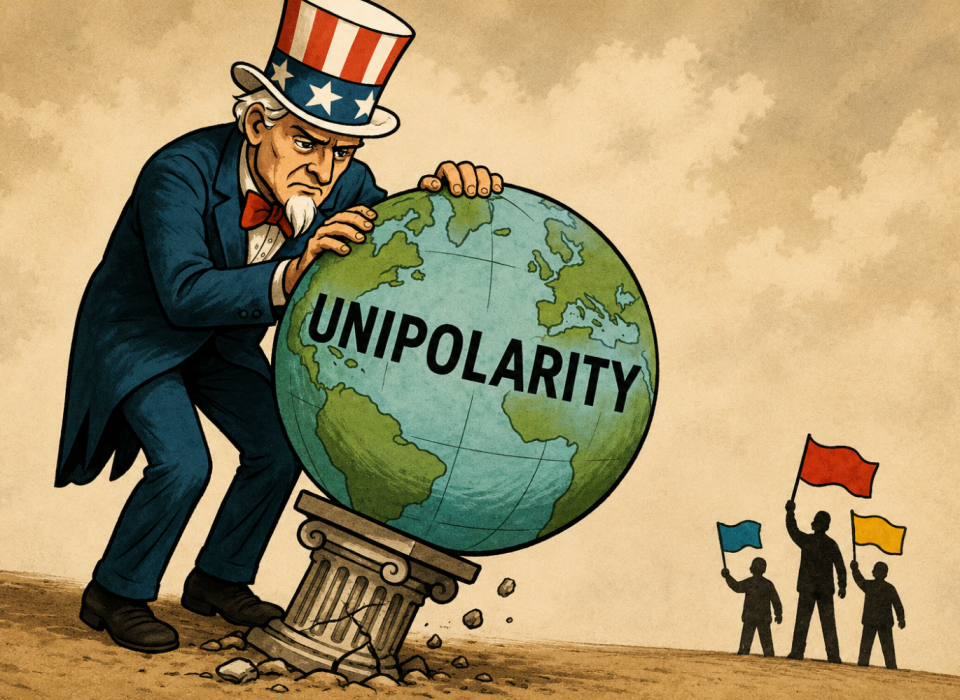
Between Hegemony and Pluralism: Rethinking Unipolar Autocracy Versus Multipolar Autonomy – A More-or-Less Western Perspective

Building the Bridge Foundation
Click here for Part 1
Click here for Part 2
Click here for Part 3
Click here for Part 4
Click here for Part 5
Click here for Part 6
Click here for Part 7
Click here for Part 8
Click here for Part 9
Click here for Part 10
Click here for Part 11
Click here for Part 12
Click here for Part 13
Click here for Part 14
Click here for Part 15
Click here for Part 16
Click here for Part 17
Click here for Part 18
Click here for Part 19
Click here for Part 20
Click here for Part 21
Click here for Part 22
Click here for Part 23
Click here for Part 24
Click here for Part 25
Click here for Part 26
Click here for Part 27
Click here for Part 28
Click here for Part 29
Click here for Part 30
Click here for Part 31
Click here for Part 32
Click here for Part 33
Click here for Part 34
Click here for Part 35
Click here for Part 36
Click here for Part 37
Click here for Part 38
Click here for Part 39
Click here for Part 40
Click here for Part 41
Click here for Part 42
Click here for Part 43
Click here for Part 44
Click here for Part 45
Click here for Part 46
Click here for Part 47
Click here for Part 48
Click here for Part 49
EDITORIAL | Between Hegemony and Pluralism: Rethinking Unipolar Autocracy Versus Multipolar Autonomy – A More-or-Less Western Perspective
By Abraham A. van Kempen
1 June 2026
Why today’s contest is less a moral showdown than a struggle over power, legitimacy, and the shape of global order
A common perspective on today's geopolitics views it as a struggle between Western efforts to maintain dominance in a unipolar world (Unipolar Autocracy) and non-Western nations seeking greater independence in a multipolar world (Multipolar Autonomy). This perspective emphasizes two main issues: the critique that the liberal order often pushes Western values without a sufficiently fair assessment, and the demands from emerging powers and postcolonial states for a more equitable share of sovereignty, representation, and influence in global institutions. This explanation highlights real tensions. Though it addresses major conflicts, it downplays significant differences in power and legitimacy, coercion and consent, and reform and revolution.
Why the thesis is persuasive
The argument resonates because the post-Cold War order has never been just a neutral, rules-based system. It has offered real public goods like open trade routes, financial ties, alliance guarantees, and institutional coordination. At the same time, it has relied on differences in enforcement.
Western powers promoted international law but faced criticism for selectively interpreting it, imposing sanctions, intervening, and promoting norms in a hierarchical manner. Iraq's memory influences views of universal legality, and disputes over Kosovo, Libya, and Gaza deepen the perception that principles are applied variably based on the violator and the protected. This creates a paradox: an international order that is liberal in rhetoric but punitive in practice.
Why “unipolar autocracy” overstates the case
Describing Western dominance as a “unipolar autocracy” may be exaggerated. While hegemony implies total control, the reality is complex. The US and its allies influence through alliances, institutions, markets, consent, and shared narratives—reinforced with military force when deemed necessary. Western influence depends on partnerships: sanctions involve the EU, the US, NATO, and about 50 countries in the Coalition of the Willing; export controls include nations such as the Netherlands, Japan, Taiwan, and South Korea, which benefit financially as obedient members of the Coalition of the Willing. Strategies like “friend-shoring” show influence through networks, not commands from one city. Smaller countries oppose, negotiate, or seek deals, making this hegemonic if not imperial.
The phrase 'Unipolar Autocracy versus Multipolar Autonomy' pinpoints a contradiction: a country can be democratic internally but act asymmetrically externally. This is a legitimacy crisis for Western liberal hegemony, seen not as a shared constitutional system but as rules shaped by Atlantic powers, with moral language that does not reflect equal influence. This appears in military interventions, sanctions, and dissatisfaction with IMF and World Bank representation, where emerging economies argue that their economic power isn't matched by their institutional influence. The issue is less about Westerners creating a global autocracy and more about its tendency to equate primacy with universality.
Why “multipolar autonomy” also needs scrutiny
The thesis also highlights that “the rest" seeks a more just, diverse, and independent order. Many countries in Asia, Africa, Latin America, and the Middle East aim to expand options rather than follow Western dominance. They pursue different trade partnerships, reduce reliance on the dollar and Western finance, increase influence in global institutions, and avoid strict binary alignments. Initiatives like BRICS expansion, the use of local currencies, alternative payment systems, and calls for reform of the governance of the IMF and the World Bank are politically important, even if not yet fully economic. Multipolarity thus often signals strategic autonomy rather than expansionist aims.
China plays a crucial role amid global uncertainties. It promotes a multipolar world, moving away from Western dominance through initiatives such as the Belt and Road Initiative, BRICS, and support for alternative payment systems. Beijing shows its commitment to a diverse, interconnected world beyond Western-led institutions. China isn’t just advocating for shared independence; it positions itself as a civilization-scale power prioritizing hierarchy, respect, and strategic autonomy. This is seen in actions in the South China Sea, pressure on Taiwan, and efforts to develop its own standards and infrastructure to reduce reliance on the West. Does challenging a single dominant power automatically lead to a more balanced global landscape?
The Global South's voting at the UN extends beyond East–West divides. Many countries in Africa, Asia, Latin America, and the Middle East support sovereignty and territorial integrity. However, fewer endorse Western expectations that these votes should result in sanctions or alliances. By 2025, resolutions reflected ongoing concerns about aggression, with more abstentions and issue-specific stances. Countries seek diplomatic flexibility, acting independently of Western pressure. This pattern shows that the Global South adopts a procedural, transactional, and selective approach, upholding principles without using them as bloc tools.
Russia has become a significant global player, contesting the Western-led order through energy exports, military deterrence, and diplomatic tactics. It seeks to counter the Atlantic alliance, as evidenced by the proxy war involving Ukrainians as NATO’s pawns and its moves to de-dollarize within BRICS, indicating its goal to reshape global trade. Russia is committed to reshaping the Atlantic Autocracy to align with the values of Multipolar Autonomy, even in the face of challenges such as EU-US/NATO sanctions against Russia related to export controls, ongoing conflicts, and the economy's reliance on hydrocarbons. Its strategic choices include discounted energy sales, repudiation of sanctions, and alliances with 150 non-Western nations. Russia’s growing capacity depends on convincing like-minded nations to help build a new, more appealing world order.
“The rest of the world” isn't a single entity but a range of governments and nations, from democracies and autocracies to resource-rich states, each with their own policies. India buys discounted Russian energy while strengthening U.S. ties. Saudi Arabia manages relations with Washington, Beijing, and others. Turkey, part of NATO, pursues an independent course. These examples show that strategic independence involves balancing interests, not strict ideology. Some countries invoke multipolarity to justify repression or to defend their influence, which isn't always about promoting freedom. A multipolar world can encourage diversity but also lead to shifting alliances, rivalries, and complex power structures influenced by new global players.
What is happening
Our findings show that transitioning from unipolarity to multipolarity is gradual, marked by realignment and competition among nations. Western dominance remains strong in finance, technology, the military, and institutions, but faces increasing challenges. During the Ukraine crisis, some non-Atlantic countries condemned sovereignty breaches and remained neutral instead of supporting sanctions or Western actions.
Challenger groups like BRICS coordinate symbols and test financial tactics but do not resolve conflicts among China, India, Gulf monarchies, African borrowers, and commodity exporters. The global landscape is more complex: major powers clash more, US–China tech restrictions disrupt supply chains, middle powers act cautiously, and many Global South nations negotiate across multiple platforms rather than forming a unified anti-Western bloc. This new order is neither like historic empires nor a hierarchy of equals; it is a crowded, negotiable, and unstable environment where legitimacy, connectivity, resistance to sanctions, and economic diversity are as vital as military strength.
Failed sanctions and the paradox of hegemonic power
Western sanctions show that global dominance relies on infrastructure as much as territory. The measures against Russia reveal the failure of U.S. and allied control over critical points in finance, shipping, insurance, currencies, and technology. These restrictions on banking, reserves, energy revenue, and dual-use exports highlight Western influence in the world economy. Sanctions reinforce Western leadership by ensuring access to dollar liquidity, Western markets, SWIFT, and advanced semiconductors, all of which depend on waning Atlantic-based institutions.
Sanctions reveal the limits of authority. Though often costly and less effective than compliance, they prompt searches for alternatives. Russia uses shadow shipping, third-country intermediaries, and wartime fiscal mobilization. China and others are developing new payment systems, local-currency deals, and supply protections. Many Global South governments see economic ties as political risks, creating a dilemma: sanctions can boost Western influence in the short term but may weaken their legitimacy in the long term. Sanctions don't end Western power but drive others to operate beyond its control.
Conclusion
Think of the thesis as a thought-provoking starting point rather than the final word. It shows how claims to universality have weakened due to hierarchical structures and selective enforcement, reflecting calls for sovereignty, reforms, and a move away from Western dominance. However, it can be inaccurate when framing these tensions as a moral struggle between democratic autocracy and emancipatory multipolarity.
For example, China shows that resisting Western dominance can go hand in hand with trying to build new hierarchies. Likewise, votes from the Global South at the United Nations indicate that many countries support universal principles but resist strict bloc discipline. The main question is not just whether the West will step back or whether others will take the lead, but whether a more equitable distribution of power can be realized through more legitimate rules. Without this, the world risks moving from a single unstable hierarchy to multiple competing ones.
I’m a bit under the weather. To be continued on Friday, 5 June 2026.
Enjoy your week,
Abraham A. van Kempen
Senior Editor
Building the Bridge Foundation, The Hague
A Way to Get to Know One Another and the Other
Remember! Diplomacy is catalytic—transformative —while military action is cataclysmic—destructive and catastrophic.
When faced with the options to be good, bad, or ugly, let’s build bridges, not burn them. After all, mutual deterrence reigns.
BUILDING THE BRIDGE! | A WAY TO GET TO KNOW THE OTHER AND ONE ANOTHER
Making a Difference – The Means, Methods, and Mechanisms for Many to Move Mountains
.jpg)
Photo Credit: Abraham A. van Kempen, our home away from home on the Dead Sea
By Abraham A. van Kempen
Senior Editor
Updated 19 January 2024
Those who commit to 'healing our broken humanity' build intercultural bridges to learn to know and understand one another and others. Readers who thumb through the Building the Bridge (BTB) pages are not mindless sheep following other mindless sheep. They THINK. They want to be at the forefront of making a difference. They're seeking the bigger picture to expand their horizons. They don't need BTB or anyone else to confirm their biases.
Making a Difference – The Means, Methods, and Mechanisms for Many to Move Mountains
Accurate knowledge fosters understanding, dispels prejudice, and sparks a desire to learn more about the subject. Words have an extraordinary power to bring people together, divide them, forge bonds of friendship, or provoke hostility. Modern technology offers unprecedented possibilities for good, fostering harmony and reconciliation. Yet, its misuse can cause untold harm, leading to misunderstandings, prejudices, and conflicts.
A Free Trial for Life – SUBSCRIBE NOW!

• It's quick and straightforward.
• We won’t ask for your credit card number.
• Just enter your e-mail address to receive your complimentary free-for-life subscription to our newsletter.
• Please include your First and Last Name.
• We won’t share or sell your e-mail address.
_________________________
Related Articles Recently Posted on www.buildingthebridgefoundation.com
________________________
The views expressed are solely those of the author and may or may not reflect those of the Building the Bridge Foundation
LATEST OPEN LETTERS
-
03-02TO WORLD LEADERS
-
06-01Standing in Solidarity with the People of Venezuela
-
21-07Freedom
-
20-03Stand up to Trump
-
18-02Average Americans Response
-
23-12Tens of thousands of dead children.......this must stop
-
05-06A Call to Action: Uniting for a Lasting Peace in the Holy Land
-
28-05Concerned world citizen
-
13-02World Peace
-
05-12My scream to the world
VIRTUAL POST OFFICE
PETITIONS
LINKS
DONATION
Latest Blog Articles
-
15-10Our Friday News Analysis | What the World THINKS Now!
-
14-10Our Wednesday News Analysis | Navi Pillay, head of UN commission that accused Israel of genocide, wins Nobel Peace Prize
-
13-10Navi Pillay, head of UN commission that accused Israel of genocide, wins Nobel Peace Prize
-
13-10No state has a ‘right’ to exist – least of all an apartheid, genocidal state like Israel
-
13-10‘By the Way, the World is Not Stopping Us’: The Secret of Israel’s ‘Success’
-
12-10Our Monday News Analysis | What the World THINKS Now!
-
08-10Our Friday News Analysis | What the World THINKS Now!
-
07-10Our Wednesday News Analysis | The West wants Netanyahu gone - so Palestinians can be killed more quietly again
-
06-10The West wants Netanyahu gone - so Palestinians can be killed more quietly again
-
06-10Israel turns Gaza into largest ghetto in modern history, killing residents one after another as three-year genocide continues
-
06-10Analysis Europe's Boycott of Israel Is Rapidly Expanding – and It Won't Be Easy to Stop
Latest Comments
 One of the most important and illuminating articles that I …
Comment by Benjamin Inbaraj-
And what's wrong here?
After all, there is the homeland …
Comment by Isac Boian -
Does this reinforce or deny my argument that Israel is …
Comment by Edward Campbell -
Many 'say' they support the Palestinian cause but do little …
Comment by Philip McFedries -
The UN is strangled by the "war for profit" cabal …
Comment by Philip McFedries -
I can't read the printing on the map.
Comment by Philip McFedries -
Good news!
Comment by Philip McFedries
COMMENTS
This article has 0 comments at this time. We invoke you to participate the discussion and leave your comment below. Share your opinion and let the world know.