 NEWSLETTER
Common Grounds
You Can't Integrate Israel Into the Middle East While Isolating It From Palestinians
Source: Haaretz
Published August 10, 2026
Israel cannot hold both ends of the stick – you can't continue the current policy in the West Bank and the Gaza Strip, while promising an Abraham Accords expansion and Israel's integration into the India-Middle East-Europe Economic Corridor
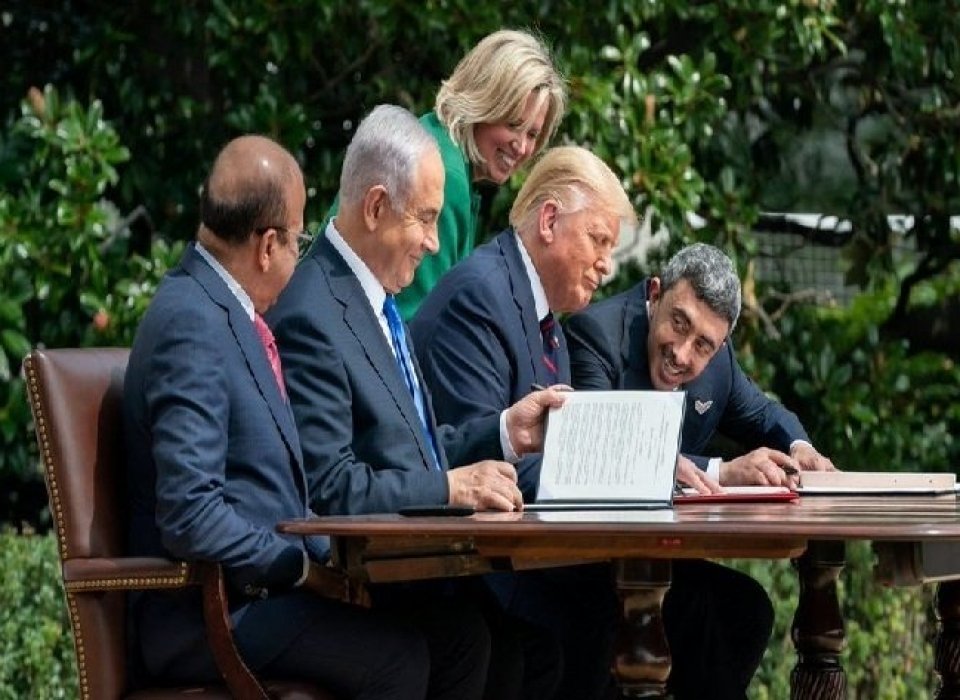
The signing of the Abraham Accords on the White House Lawn last year. Credit: Andrea Hanks
Israel can't continue its current policy regarding the Palestinians and expect full regional economic integration and also deeper cooperation with additional countries, including in Europe. The strategic reality is more complex than election campaign slogans.
The idea of "economic peace" and conflict management, presented over the years as an alternative to a political deal, has failed to create the desired breakthrough.
Moreover, it's likely to distance Israel from regional integration rather than bring it closer.
The promises of expanding the Abraham Accords and connecting Israel to Saudi Arabia and the Gulf states are often repeated as if they were inevitable developments.
However, there is no factual basis for this without altering policy.
You, the politicians promising an expansion of the Abraham Accords and Israel's integration into the India-Middle East-Europe Economic Corridor, don't understand that Israel will remain isolated without progress on the Palestinian issue.
Many politicians across the political spectrum ahead of the election repeatedly speak of the vision of Israel's economic integration in the Middle East. IMEC, the economic corridor connecting India with the Middle East and Europe, is a fixture at the heart of this vision. Some warn of the possibility that Saudi Arabia will prioritize routing the corridor through Syria rather than Israel. Others suggest increasing the number of trucks entering from Jordan or investing in rail lines as part of preparation for integration into the project.
However, there's one major contradiction here. These politicians are the very same ones who oppose the establishment of a Palestinian state, support the current policy in the West Bank and Gaza Strip and often present the struggle with Iran as the almost exclusive key to shaping the new Middle East. They act as if weakening Iran is sufficient to turn Israel into a natural partner in the region.

Displaced Palestinian beekeepers harvest honey from beehives at al-Dabba family bee farm in Gaza City on Saturday. Credit: Jehad Alshrafi/AP
It's an illusion. Israel cannot continue holding both ends of the stick. Any significant regional integration, and certainly integrating into strategic projects like IMEC, also depend on its ability to alter its relations with the Palestinians. Saudi Arabia has no incentive to provide Israel with such a strategic and economic win as long as the Palestinian issue remains unaddressed.
Moreover, even before we talk about IMEC, we should realize that we shouldn't take for granted even existing regional assets. While peace treaties with Egypt and Jordan are stable, they are under growing public and political pressure as long as the war in Gaza and the situation in the West Bank continue. Before dreaming about new economic corridors, it is worth confirming that the foundations upon which Israel's foreign policy rests are at risk.
The unpreparedness of Israeli politicians to tell the truth to the public regarding this issue is nothing new, but now it's more obvious than ever. Israel can't continue its current policy regarding the Palestinians and expect full regional economic integration and also deeper cooperation with additional countries, including in Europe. The strategic reality is more complex than election campaign slogans.
The idea of "economic peace" and conflict management, which has been presented over the years as an alternative to a political deal, has failed to create the desired breakthrough. Moreover, it's liable to distance Israel from regional integration rather than to bring it closer to it. The promises of expanding the Abraham Accords and connecting Israel to Saudi Arabia and the Gulf states are often repeated as if they were inevitable developments. However, there is no factual basis for this without altering policy.

U.S. Secretary of State Marco Rubio with heads of Gulf states, in New York in September. Credit: Stefan Jeremiah / AFP
If the next government really wants to see Israel integrated into projects like IMEC, it must understand that the key isn't only in Tehran's hands but also in Jerusalem, Ramallah and Gaza. The last confrontation with Iran may have highlighted Israel's military capabilities, but it also demonstrated to many in the region how regional instability is liable to damage their interests. Moreover, Saudi Arabia's official positions in recent years continue to stress that any significant progress in normalization depends on real progress on the Palestinian issue.
Of course, Israel can always choose a policy of annexation and continuing the status quo. This choice is politically legitimate. However, the public deserves to hear the truth: Such a policy has a price. It is liable to make it harder for Israel to be integrated into regional projects, to increase its isolation on several fronts and to turn the vision of economic integration to an electoral promise that doesn't hold up in practice.
You can't promise the public both continuation of the current policy toward the Palestinians and integration into the new Middle East. At least for now, these two promises do not dovetail with each other.
The writer is a senior researcher in the Iran and the Shi'ite Axis Program at the Institute for National Security Studies.
LATEST OPEN LETTERS
-
03-02TO WORLD LEADERS
-
06-01Standing in Solidarity with the People of Venezuela
-
21-07Freedom
-
20-03Stand up to Trump
-
18-02Average Americans Response
-
23-12Tens of thousands of dead children.......this must stop
-
05-06A Call to Action: Uniting for a Lasting Peace in the Holy Land
-
28-05Concerned world citizen
-
13-02World Peace
-
05-12My scream to the world
VIRTUAL POST OFFICE
PETITIONS
LINKS
DONATION
Latest Blog Articles
-
15-10Our Friday News Analysis | What the World THINKS Now!
-
14-10Our Wednesday News Analysis | Navi Pillay, head of UN commission that accused Israel of genocide, wins Nobel Peace Prize
-
13-10Navi Pillay, head of UN commission that accused Israel of genocide, wins Nobel Peace Prize
-
13-10No state has a ‘right’ to exist – least of all an apartheid, genocidal state like Israel
-
13-10‘By the Way, the World is Not Stopping Us’: The Secret of Israel’s ‘Success’
-
12-10Our Monday News Analysis | What the World THINKS Now!
-
08-10Our Friday News Analysis | What the World THINKS Now!
-
07-10Our Wednesday News Analysis | The West wants Netanyahu gone - so Palestinians can be killed more quietly again
-
06-10The West wants Netanyahu gone - so Palestinians can be killed more quietly again
-
06-10Israel turns Gaza into largest ghetto in modern history, killing residents one after another as three-year genocide continues
-
06-10Analysis Europe's Boycott of Israel Is Rapidly Expanding – and It Won't Be Easy to Stop
Latest Comments
 One of the most important and illuminating articles that I …
Comment by Benjamin Inbaraj-
And what's wrong here?
After all, there is the homeland …
Comment by Isac Boian -
Does this reinforce or deny my argument that Israel is …
Comment by Edward Campbell -
Many 'say' they support the Palestinian cause but do little …
Comment by Philip McFedries -
The UN is strangled by the "war for profit" cabal …
Comment by Philip McFedries -
I can't read the printing on the map.
Comment by Philip McFedries -
Good news!
Comment by Philip McFedries
COMMENTS
This article has 0 comments at this time. We invoke you to participate the discussion and leave your comment below. Share your opinion and let the world know.