 NEWSLETTER
Common Grounds
Blueprint of Failure: On Iran, Gaza, and How Europe Plotted Its Own Irrelevance
Source: Thinking Palestine
By Romana Rubeo
Published May 8, 2026
From Iran to Palestine, from Ukraine to quiet acquiescence under American dictates, Europe appears increasingly devoid of strategic direction. Worse still, in this critical reading of Europe’s relationship with the Middle East—and with its own future—Italian journalist and intellectual Romana Rubeo argues that the continent is not merely adrift, but actively complicit in charting a course toward its own decline.
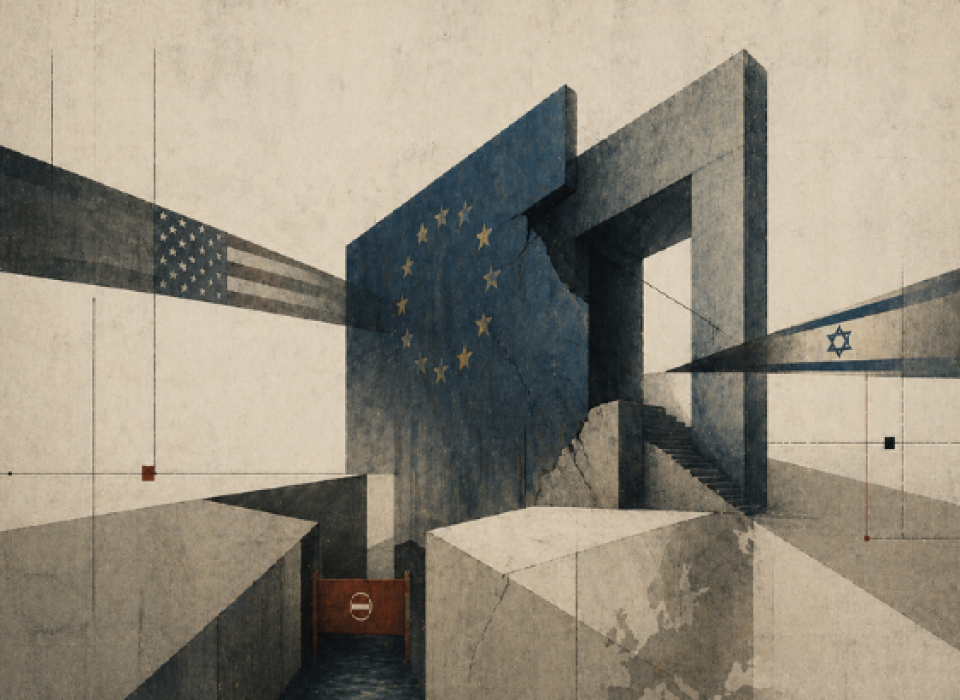
By clinging to the coattails of the US-Israeli military strategy, Europe is attempting to maintain a vestige of that old hierarchy. (Illustration: Palestine Chronicle)
In the theater of modern geopolitics, Europe has long sought to cast itself as a “normative power”—a champion of the rules-based international order.
However, the lack of actions undertaken during the Israeli genocide in Gaza and the events following the US-Israeli war on Iran on February 28, 2026, have stripped away this facade.
But why is Europe unable to take the ‘step forward’?
The reason is inextricably linked to the fact that many of the open wounds in the Middle East—specifically the tragedy of Palestine—were originally carved by European hands.
The current “aggression” and the regional instability are not isolated modern phenomena; they are the terminal stages of a crisis initiated by the British and French empires.
From the Balfour Declaration to the Sykes-Picot Agreement, Europe functioned as the primary architect of the region’s fragmentation.
By drawing arbitrary lines in the sand and issuing conflicting promises to local populations, European powers established a framework for perpetual conflict to maintain colonial influence over the ‘periphery’.
As the US and Israel engaged in an unprovoked military aggression against Iran outside the bounds of international law, the European response was not one of strategic autonomy, but of paralysis.
At this crucial appointment with history, Europe presents itself covered in shame, offering the world an undignified show of servility and inadequacy.
The Paradigm of Submission: Beyond the Trump Era
One might have expected that the friction of the last decade would have forged a more independent European foreign policy. Yet, the forma mentis (mindset) of the European leadership remains incapable of producing substantial change.
On February 28, 2026, the United States and Israel launched the so-called Operation Epic Fury, a massive joint military campaign against the Islamic Republic of Iran. The operation began with nearly 900 strikes in the first twelve hours, targeting military infrastructure, nuclear facilities, and the upper echelons of Iranian leadership.
The most significant outcome of the initial wave was the assassination of Supreme Leader Ali Khamenei in Tehran, alongside scores of senior officials. The strikes sparked an immediate regional escalation, including the closure of the Strait of Hormuz and wide-scale Iranian retaliatory missile strikes across the Middle East.
The illegality of Operation Epic Fury has been a subject of intense condemnation among international law experts. The consensus among many respected jurists—including those from the American Society of International Law and UN Secretary-General António Guterres—is that the attacks constitute a violation of the UN Charter.
Over 100 international law experts wrote in a letter on April 13 that “the initiation of the campaign was a clear violation of the United Nations Charter, and the conduct of United States forces since, as well as statements made by senior government officials, raise serious concerns about violations of international human rights law and international humanitarian law, including potential war crimes.”
According to the experts, there are concerns about the jus ad bellum, meaning the decision to go to war, and the jus in bello, as in the conduct of hostilities, which raise doubts about blatant violations of international and humanitarian law. For instance, a strike on the school of Minab, near Bandar Abbas, in the first hours of the war, killed over 120 students, along with their teachers.
Although European leaders partially recognized that the aggression initiated on February 28 ignored the UN Security Council, the reaction was disappointing nonetheless: a disjointed mix of tactical support, mild legal hand-wringing, and internal division.
Germany and the United Kingdom adopted a posture that prioritized the ‘special relationship’ with Washington over the letter of international law.
German Chancellor Friedrich Merz notably avoided “lecturing” the US, describing Iran as a “major security threat” whose nuclear ambitions necessitated a firm response. While Prime Minister Keir Starmer initially restricted the use of the Diego Garcia base, he quickly pivoted to allow US forces to use it for “defensive operations” to degrade missile sites, essentially providing the logistical backbone for the campaign.
France attempted to walk its usual diplomatic tightrope. French President Emmanuel Macron condemned the strikes as being “outside international law” and called for emergency UN Security Council discussions. However, Paris condemned Iranian retaliation and rushed to deploy the Charles de Gaulle aircraft carrier to the region, effectively ensuring that French strategic interests remained protected under the umbrella of the US-led operation.
The only European country to stand out and take a firm, principled stand against the legality of the attacks was Spain. Prime Minister Pedro Sánchez was the most vocal critic, unequivocally condemning the “unilateral military action” as a violation of the international order. Madrid, however, as often happened during the last two years, remained the singular voice that refused to be “complicit in something (…) contrary to our values,” standing alone in its refusal to allow its soil to be used for an unprovoked war.
This is a pitiless mirror of the irrelevance to which the Old Continent has relegated itself in the new world balances. Europe remains deaf to every attempt to carve out the space and margins necessary to survive in an increasingly multipolar world, choosing, once again, to remain anchored to a psychological and political dependency on the Washington-Tel Aviv axis, effectively subordinating its own sovereign interests to a fading unipolarity.
The ‘Chief of All Cowards’: The Callimard Indictment
In the face of blatant violations of international law, the EU’s primary contribution was the total folly of further sanctions on Iran—the victim of the aggression—rather than the aggressors.
The moral failure of the European position is clearly not limited to Iran. A pivotal moment in this display of servility, for example, was reached a few weeks following the beginning of the US-Israeli aggression, when Germany and Italy led a coalition of member states to block a proposal that would have suspended the EU-Israel Association Agreement.
Despite clear documentation of breaches of the agreement’s human rights conditions—and the fact that the military operations bypassed any UN mandate—the EU’s ‘pragmatic’ core chose to maintain preferential trade and diplomatic ties with the aggressors. This decision effectively silenced the legal and humanitarian concerns raised by countries like Spain, Ireland, and Slovenia, who argued that by refusing to trigger the agreement’s human rights clause, Europe was signaling that its “values” were secondary to its strategic alignment with Washington.
By blocking this suspension, the EU did more than just maintain the status quo; it effectively immunized the Israeli genocide from any meaningful European economic or diplomatic consequences, leaving Spain as the solitary major power willing to translate its “no to war” rhetoric into concrete action.
On that occasion, Agnes Callimard, Secretary General of Amnesty International – using an unprecedented bold language – captured the zeitgeist of this failure when she labeled the European leadership as the “chief of all cowards.”
In this landscape of moral desertion, once again, only the flicker of dignity from Pedro Sánchez and a few other willing actors prevented a total eclipse of European conscience. By advocating for a firmer stance, Spain highlighted the vacuum left by its neighbors.
Strategic Suicidalism: Ukraine, Russian Gas, and the Loss of Autonomy
The inability of the European Union to act on Gaza and Iran is a symptom of a larger disease: the inability to define its own strategic interest. We see the blueprint of this failure in the ongoing conflict in Ukraine and the energy crisis. For decades, European industry relied on stable Russian energy. While the military operation in Ukraine necessitated a shift, the EU’s total transition to expensive American LNG was not a strategic pivot, but a transfer of dependency.
By cutting itself off from the East without building an independent bridge to the Global South, the EU has effectively marginalized itself. It has chosen a path that leads to deindustrialization and economic subservience, proving that it is no longer capable of thinking in terms of its own survival.
The economic outlook for the EU, already precarious following the forced transition away from Russian gas, is now descending into a state of terminal decline as the conflict in the Middle East chokes the world’s most critical maritime artery. If the initial pivot to American LNG was a slow-motion tightening of the belt, the closure of the Strait of Hormuz represents a sudden and violent strangulation of the European continent’s entire industrial base.
The Strait of Hormuz functions as the absolute life-support system of global energy, and with the Iranian military declaring it a closed military zone in the wake of the assassination of Ayatollah Khamenei, the EU is facing a supply shock that makes the 1973 oil crisis look like a minor market correction.
This situation is particularly catastrophic because of Europe’s recent “pragmatic” shift toward Qatari Liquefied Natural Gas. After 2022, Germany and other industrial hubs signed massive, long-term deals with Qatar to replace the Russian pipeline infrastructure they dismantled. Now, those shipments are physically trapped behind a blockade with no viable pipeline alternative and no bypass capable of handling the necessary volumes.
The sheer scale of this energy crisis is hard to overstate. Within days of the strait’s closure, oil prices have reached astronomical records, and natural gas futures have reached levels where industrial production is no longer a viable business model. This isn’t just a temporary dip in output; it is the beginning of a systematic deindustrialization.
Fr instance, the German ‘Mittelstand’, the small and medium-sized manufacturers that form the backbone of the European economy, cannot survive energy costs that are ten times higher than those of their American or Chinese rivals. This ensures a permanent exodus of capital as factories flee to regions with more stable and affordable power.
Furthermore, the crisis is rapidly bleeding into the agricultural sector. Because natural gas is the essential feedstock for nitrogen-based fertilizers, the severing of the Qatari supply line has halted European fertilizer production. This guarantees that the energy crisis will inevitably evolve into a food security crisis, with the price of basic staples skyrocketing beyond the reach of many citizens.
Ultimately, Europe is discovering that its “strategic partnership” with Washington provides no safety net. While the US is a net energy exporter that can prioritize its own domestic prices, Europe remains entirely dependent and diplomatically exposed. By aligning with the military campaign that triggered this blockade, the EU has essentially participated in the destruction of its own security.
Unlike China, which maintained diplomatic bridges to Tehran to protect its flow of resources, the EU has cornered itself into a geopolitical dead end—doubling down on its posture by extending and expanding sanctions on Iran even amid the crisis—proving that it is a passenger in a vehicle driven by interests that are fundamentally indifferent to its economic survival.
The Colonial Essence and the Inability to Reinvent
But why is Europe unable to take the ‘step forward’? The reason is inextricably linked to the fact that many of the open wounds in the Middle East—specifically the tragedy of Palestine—were originally carved by European hands. The current “aggression” and the regional instability are not isolated modern phenomena; they are the terminal stages of a crisis initiated by the British and French empires.
From the Balfour Declaration to the Sykes-Picot Agreement, Europe functioned as the primary architect of the region’s fragmentation. By drawing arbitrary lines in the sand and issuing conflicting promises to local populations, European powers established a framework of perpetual conflict designed to maintain colonial influence over the ‘periphery’.
Therefore, when Europe today remains silent or subservient to US-Israeli military policy, it is not just failing to act; it is effectively protecting a status quo that it created. To take a step forward would require Europe to acknowledge that its foundational role in the Middle East was one of extraction and destabilization—a confession the current leadership is psychologically unprepared to make.
A colonial mind perceives the world only in terms of hierarchies and vertical power structures; it cannot conceive of a horizontal, multipolar world of equals because its very identity was historically predicated on the management and subjugation of the Global South.
Europe is not doing it because it cannot do it. It is not merely a matter of lacking the right leaders, but a matter of a structural forma mentis tied to an imperial world that no longer exists. The Old Continent is unable to reinvent itself on the basis of a new world order because it cannot even imagine a world where its role might be less central, yet more relevant through its independence.
By clinging to the coattails of the US-Israeli military strategy, Europe is attempting to maintain a vestige of that old hierarchy. However, in doing so, it ensures its own decline. It is choosing to be the loyal clerk of a crumbling empire rather than the architect of a new, sovereign future.
At its appointment with history, Europe presents itself covered in shame—the “chief of all cowards” precisely because it lacks the courage to dismantle the colonial legacy that still dictates its every move. Until it sheds this skin, it will remain an irrelevant spectator in a world that has finally decided to move on without its permission.
– Romana Rubeo is an Italian writer and the managing editor of The Palestine Chronicle. Her articles appeared in many online newspapers and academic journals. She holds a Master’s Degree in Foreign Languages and Literature and specializes in audio-visual and journalism translation.
LATEST OPEN LETTERS
-
03-02TO WORLD LEADERS
-
06-01Standing in Solidarity with the People of Venezuela
-
21-07Freedom
-
20-03Stand up to Trump
-
18-02Average Americans Response
-
23-12Tens of thousands of dead children.......this must stop
-
05-06A Call to Action: Uniting for a Lasting Peace in the Holy Land
-
28-05Concerned world citizen
-
13-02World Peace
-
05-12My scream to the world
VIRTUAL POST OFFICE
PETITIONS
LINKS
DONATION
Latest Blog Articles
-
15-10Our Friday News Analysis | What the World THINKS Now!
-
14-10Our Wednesday News Analysis | Navi Pillay, head of UN commission that accused Israel of genocide, wins Nobel Peace Prize
-
13-10Navi Pillay, head of UN commission that accused Israel of genocide, wins Nobel Peace Prize
-
13-10No state has a ‘right’ to exist – least of all an apartheid, genocidal state like Israel
-
13-10‘By the Way, the World is Not Stopping Us’: The Secret of Israel’s ‘Success’
-
12-10Our Monday News Analysis | What the World THINKS Now!
-
08-10Our Friday News Analysis | What the World THINKS Now!
-
07-10Our Wednesday News Analysis | The West wants Netanyahu gone - so Palestinians can be killed more quietly again
-
06-10The West wants Netanyahu gone - so Palestinians can be killed more quietly again
-
06-10Israel turns Gaza into largest ghetto in modern history, killing residents one after another as three-year genocide continues
-
06-10Analysis Europe's Boycott of Israel Is Rapidly Expanding – and It Won't Be Easy to Stop
Latest Comments
 One of the most important and illuminating articles that I …
Comment by Benjamin Inbaraj-
And what's wrong here?
After all, there is the homeland …
Comment by Isac Boian -
Does this reinforce or deny my argument that Israel is …
Comment by Edward Campbell -
Many 'say' they support the Palestinian cause but do little …
Comment by Philip McFedries -
The UN is strangled by the "war for profit" cabal …
Comment by Philip McFedries -
I can't read the printing on the map.
Comment by Philip McFedries -
Good news!
Comment by Philip McFedries
COMMENTS
This article has 0 comments at this time. We invoke you to participate the discussion and leave your comment below. Share your opinion and let the world know.