 NEWSLETTER
Common Grounds
Silencing Palestine: America’s Shameful History of Repression Continues
Source: Palestine Chronicle
Published October 24, 2026
The repression of Palestinian speech on American campuses occurred in partnership with the Trump administration’s vicious crackdown on student activism.
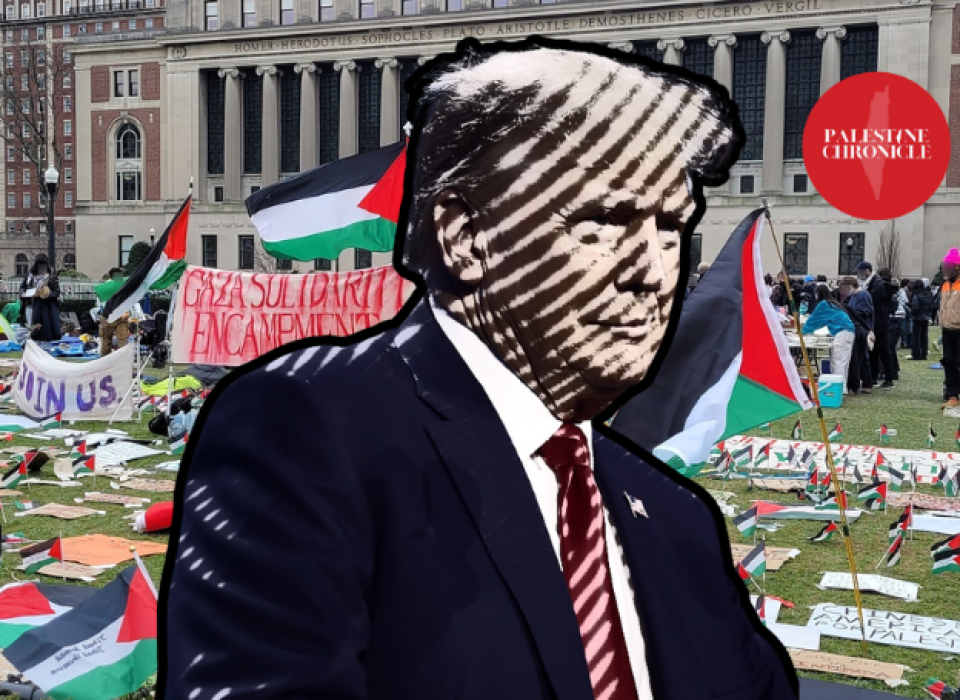
US President Donald Trump. (Design: Palestine Chronicle)
The Trump administration, in collusion with scores of public and private colleges and universities, has unleashed one of the most widespread and coordinated campaigns to suppress free speech and restrict the right to protest in US history.
The targets? People who have the courage to support Palestinian liberation and sovereignty and to condemn the Israeli government’s genocide in Gaza and its atrocities in the West Bank.
While we have seen many attacks on constitutionally protected civil liberties throughout American history, the scope and scale of the systemic repression of Palestinian speech makes this one of the worst. And it’s far from over.
The history of the United States has been stained by repeated episodes in which the government, aided and abetted by private organizations and institutions, has deliberately censored speech and punished protests that espouse political views at odds with those in power. While the direct victims of such systemic repression suffer the most, the American people as a whole are also being victimized.
We are being denied exposure to facts and perspectives which, if freely available, would drive our opposition to policies that the Trump administration, the Israeli government, and their henchmen would prefer go unchallenged. Repression skews public debate in one direction, insulating government propaganda from scrutiny and thereby marginalizing, if not eliminating, inconvenient information and contrary positions.
Yet, in tandem, a very different American tradition has taken hold. As brave defenders of the Palestinian people and outspoken critics of Israel are being punished for nothing more than expressing their political views, they and their allies are fighting back, exposing the injustices and organizing nationwide resistance.
Indeed, time and again we have seen that the cruel and unjust acts of repression at the hands of the American government and its compliant enablers are eventually exposed by the people themselves, thereby strengthening our resolve to resist and redoubling our demands for justice.
Weaponizing Civil Rights Law to Silence Palestine Advocacy
Recently, the vast scope of the campaign of repression against Palestinian free speech has been documented in detail in two separate reports from well-recognized defenders of First Amendment rights.
Last November, the American Association of University Professors (AAUP) and the Middle East Studies Association (MESA) released a 40-page report entitled ‘Discriminating Against Dissent: The Weaponization of Civil Rights Law to Repress Campus Speech on Palestine’.
And in September of this year, the ACLU released a comprehensive 322-page report entitled ‘Student Speech Under Attack: Suppression of Pro-Palestine Speech and Dissent on Campus’.
The AAUP and MESA report documented how, over the past two years, “the United States government has taken unprecedented steps to suppress campus speech – including scholarship, advocacy, and protest – opposing the state of Israel’s genocidal war against the Palestinian people in the Gaza Strip,” thereby paving “the way for profound transformations in U.S. colleges and universities.”
The latest suppression goes far beyond the longstanding “Palestine exception” to the First Amendment. “Palestine is less an exception to academic freedom than it is a pretext for erasing the norm altogether, as part of an authoritarian assault on the autonomy of higher education and on the very idea of racial and gender equity.”
Counterintuitively, the AAUP and MESA report found that “the most important legal tool of repression against campus speech has been civil rights law – specifically, Title VI of the 1964 Civil Rights Act, which prohibits institutions that receive federal financial assistance from engaging in discrimination on the basis of ‘race, color, or national origin.’
Over the past two decades, pro-Israel actors inside and outside the government have pushed for a reinterpretation of Title VI to include a broad notion of antisemitism that can be easily used to recast many criticisms of Israel as unlawful discrimination.
Since late 2023, according to the report, “pro-Israel groups have flooded school administrators and the federal government with claims of antisemitism, which have prompted a wave of investigations; in parallel, these organizations have filed numerous private lawsuits in federal court.”
Under pressure from pro-Israel groups, “the Biden administration took steps to advance the conflation of antisemitism and anti-Zionism and thereby rubber-stamped universities’ crackdown on critics.” And the Trump administration “has gone even further, weaponizing antisemitism as a pretext to advance broader far right agendas in higher education.”
AAUP and MESA found that all but one of the 102 so-called “antisemitism” complaint letters focus on speech critical of Israel; of these, 79% contain allegations of antisemitism that simply describe criticisms of Israel or Zionism with no reference to Jews or Judaism; and at least 50% of complaints consist solely of such criticism.
According to the report, to date, no antisemitism Title VI lawsuits have proceeded to trial or resulted in a judgment for plaintiffs, while Title VI allegations have been dismissed in nine lawsuits, two of which are currently on appeal.
While reasons for dismissal have varied, “judges have in some cases exhibited skepticism toward the weaponization of antisemitism claims and raised concerns about First Amendment protections.”
In the only appellate decision so far, the First Circuit Court of Appeals declined to characterize Palestine protests at the Massachusetts Institute of Technology as antisemitic harassment, rejecting attempts “to stifle anti-Zionist speech by labeling it inherently antisemitic.”
“However noble the objective of nondiscrimination, institutions cannot be threatened with civil liability for declining to censor First Amendment protected speech,” noted US District Court Judge Gerald Austin McHugh in rejecting Title VI claims against Haverford College. “Title VI is not a portal for students … to advance their view of how contentious issues should be handled on campus.”
In dismissing an antisemitism lawsuit against the University of Pennsylvania, Judge Mitchell Goldberg noted that allegations, “even when read in the most favorable light, could (not) be interpreted as antisemitic …; at worst, Plaintiffs accuse Penn of tolerating and permitting the expression of viewpoints which differ from their own.”
Campus Repression and the Cost of Dissent
In its report, the ACLU found what could easily be called an unholy alliance of repression between the Trump administration and American colleges and universities.
Based on its two-year investigation covering events at 46 public and 34 private university and college campuses located in 28 states and the District of Columbia, the ACLU documented “the heavy-handed and excessive responses by some university and college administrators and police to campus protests concerning Israel’s assault on Gaza following the Hamas-led attacks in southern Israel on October 7, 2023.”
According to the organization Armed Conflict Location & Event Data (ACLED), more than 1,360 student demonstrations took place in the United States between October 7, 2023, and May 3, 2024, protesting the Israeli government’s ongoing military campaign against Palestinians in Gaza and calling for university divestment from Israel and support of Palestinian rights. More than 170 encampments were established in the first semester of 2024. ACLED found that 97 percent of those protests remained peaceful.
Indeed, in the more than 10,000 pro-Palestine actions nationwide between October 7, 2023, and May 10, 2024, Crowd Counting Consortium identified property damage at only 128 and police injuries at 13. The vast majority of the instances of property damage involved graffiti or similar defacement of property, and virtually all of the police injuries occurred while making arrests. On campuses, the incidence of property damage was only 30 and police injuries 6.
In some cases, students, faculty, and staff engaged in acts of civil disobedience, such as occupying campus buildings, graffitiing, and disrupting classes, as a form of protest.
Civil disobedience is part of a long and honorable tradition in America and throughout the world. Henry David Thoreau, Mahatma Gandhi, British suffragettes, Rosa Parks, Nelson Mandela, Occupy Wall Street, and Black Lives Matter come to mind. The American philosopher John Rawls defined civil disobedience as a “public, nonviolent, conscientious yet political act contrary to law usually done with the aim of bringing about a change in the law or policies of the government.”
The German philosopher Jürgen Habermas argued that in a mature democracy, since protesters who engage in civil disobedience are motivated by a social conscience rather than personal gain, they should be treated leniently, with only nominal punishments or even dismissal of the charges. That’s not what is happening to pro-Palestinian protesters.
Overall, the ACLU documented “suppression and retaliation against pro-Palestine speech and expression on campus that began in late 2023 and continues today,” in which colleges and universities “violated basic free speech, association, and assembly rights and caused serious harm when they summoned campus police and local law enforcement, resulting in arrests and unlawful and unnecessary use of force.” Colleges and universities “imposed sweeping restrictions on student speech, initiated disciplinary actions against students, and imposed severe punishments including expulsions and suspensions.”
The ACLU found that thousands of protesters have been arrested and disciplined by their schools. In 2024, protesters were detained at more than 70 schools in at least 30 states, according to data collected by The New York Times.
More than 3,200 people were arrested by police on university campuses, including students, teachers, human rights observers, and journalists, in many instances for “trespassing.” Students and faculty who participated in Palestine solidarity actions were also subject to doxxing, profiling, and retaliatory attacks by third parties, with little to no protection from their universities and colleges.
Since the initial encampment movement, from late 2024 through to publication of the ACLU report in fall 2026, colleges and universities have censored pro-Palestinian expression; punitively enforced campus policies through internal disciplinary or code of conduct processes against students; punished them with suspensions, expulsions, and other sanctions; conducted ongoing surveillance of their activities; and made restrictive changes to school policies governing peaceful assemblies and free speech on campus.
The ACLU found that universities have “punitively enforced campus policies through internal disciplinary or code of conduct processes against students, faculty, and staff for campus-related Palestine advocacy.”
Hundreds of students have faced sanctions such as campus bans, suspensions, and expulsions for alleged code of conduct violations or disciplinary charges related to their participation in pro-Palestinian demonstrations.
These punishments can impose severe and lifelong consequences and profoundly disrupt students’ lives and academic careers. Universities have swiftly imposed interim suspensions and campus bans on students who have been merely arrested or charged with violating campus codes of conduct, before they have been convicted of any crime, the disciplinary process has concluded, or, in some cases, internal investigations have even begun.
Hundreds, if not thousands, of students at universities nationwide have faced campus disciplinary proceedings for alleged code of conduct violations carrying potential sanctions. Palestine Legal reported in 2024 that it received 580 requests, and in 2025, 663 requests for legal assistance in cases in which university administrations had launched investigations or imposed sanctions for campus-related Palestine advocacy. The most common punishments students faced in 2025 were interim suspensions and campus bans.
In some cases, public universities have expelled students for engaging in protected political speech. In other cases, in demonstrations, off-campus protests, and graduation speeches that led to disciplinary actions, the students’ speech was constitutionally protected, and the institutions themselves violated their own student conduct rules and laws.
The repression of Palestinian speech on American campuses occurred in partnership with the Trump administration’s vicious crackdown on student activism. The ACLU documents “the Trump administration’s widespread, McCarthyite censorship and retaliation campaign deployed against pro-Palestine advocates on university and college campuses, and against universities that were sites of pro-Palestine student activism.”
The administration “abused civil rights laws to suppress criticism of Israel, withhold federal research grants from universities due to their refusal to conform to the government’s preferred ideological approach, and coerce universities into accepting broad-ranging agreements to restore federal funding in exchange for making institutional changes in programs, curricula, admissions, and hiring, curtailing the free speech rights of students and faculty.”
The Trump administration also “targeted noncitizen students and scholars for arrest, detention, and deportation based on their political views and in direct retaliation for their advocacy for Palestinian rights.”
All told, the ACLU concludes that these repressive measures “have profoundly chilled student speech and advocacy, resulting in a steep decline in protests and a less visible protest movement on campuses across the country.” Fears of “punishment, retribution, or deportation have deterred students and faculty from criticizing Israel or advocating for Palestinian rights.”
With over 100 years of experience litigating constitutional law, the ACLU finds that the Trump administration’s actions “violate foundational academic freedom principles, First Amendment rights, and the rights to freedom of peaceful assembly, expression, and association enshrined in international law.”
Free Speech and the American Tradition of Resistance
In 1860, former slave and eloquent abolitionist Frederick Douglass spoke words on behalf of his enslaved brothers and sisters that reverberate today on behalf of the Palestinian people:
No right was deemed by the fathers of the Government more sacred than the right of speech. It was in their eyes, as in the eyes of all thoughtful men, the great moral renovator of society and government. (…) Liberty is meaningless where the right to utter one’s thoughts and opinions has ceased to exist. That, of all rights, is the dread of tyrants. It is the right which they first of all strike down. They know its power. Thrones, dominions, principalities, and powers, founded in injustice and wrong, are sure to tremble, if men are allowed to reason of righteousness, temperance, and of a judgment to come in their presence. Slavery cannot tolerate free speech. Five years of its exercise would banish the auction block and break every chain in the South. They will have none of it there, for they have the power. But shall it be so here?
Shall it be so today? Shall it be that the sacred right of Palestinians to freely utter their thoughts and opinions in defense of their liberation and sovereignty will be the great moral renovator of society and government?
Only if we, their allies, make it so by organizing, mobilizing, resisting, and voting to banish from power the repressive forces in government, at our colleges and universities, and in every corner of society who cannot tolerate robust, wide-open, and uninhibited free speech protected by the First Amendment.
– Stephen Rohde is a journalist, political activist, and retired civil rights lawyer with nearly 50 years of experience defending constitutional freedoms. A former chair of the ACLU Foundation of Southern California, he co-founded Interfaith Communities United for Justice and Peace. He has authored books on constitutional rights and contributes to numerous publications. He hosts Speaking Freely and co-hosts Law and Disorder. His work advancing civil liberties, free expression, and human rights has earned recognition from leading legal and advocacy organizations.
LATEST OPEN LETTERS
-
03-02TO WORLD LEADERS
-
06-01Standing in Solidarity with the People of Venezuela
-
21-07Freedom
-
20-03Stand up to Trump
-
18-02Average Americans Response
-
23-12Tens of thousands of dead children.......this must stop
-
05-06A Call to Action: Uniting for a Lasting Peace in the Holy Land
-
28-05Concerned world citizen
-
13-02World Peace
-
05-12My scream to the world
VIRTUAL POST OFFICE
PETITIONS
LINKS
DONATION
Latest Blog Articles
-
27-10Israel’s objectives unlikely to shift as a result of election
-
27-10Silencing Palestine: America’s Shameful History of Repression Continues
-
27-10A New Israeli Government Must Make Arabs Partners, Not Enemies
-
26-10Our Monday News Analysis | What the World THINKS Now!
-
15-10Our Friday News Analysis | What the World THINKS Now!
-
14-10Our Wednesday News Analysis | Navi Pillay, head of UN commission that accused Israel of genocide, wins Nobel Peace Prize
-
13-10Navi Pillay, head of UN commission that accused Israel of genocide, wins Nobel Peace Prize
-
13-10No state has a ‘right’ to exist – least of all an apartheid, genocidal state like Israel
-
13-10‘By the Way, the World is Not Stopping Us’: The Secret of Israel’s ‘Success’
-
12-10Our Monday News Analysis | What the World THINKS Now!
-
08-10Our Friday News Analysis | What the World THINKS Now!
Latest Comments
 One of the most important and illuminating articles that I …
Comment by Benjamin Inbaraj-
And what's wrong here?
After all, there is the homeland …
Comment by Isac Boian -
Does this reinforce or deny my argument that Israel is …
Comment by Edward Campbell -
Many 'say' they support the Palestinian cause but do little …
Comment by Philip McFedries -
The UN is strangled by the "war for profit" cabal …
Comment by Philip McFedries -
I can't read the printing on the map.
Comment by Philip McFedries -
Good news!
Comment by Philip McFedries
COMMENTS
This article has 0 comments at this time. We invoke you to participate the discussion and leave your comment below. Share your opinion and let the world know.