 NEWSLETTER
The Monday Edition
Our Monday News Analysis | What the World THINKS Now!
Bridging Differences to Help Heal a Broken Humanity (Part 12)
The Hague, 2 November 2026 | If you know of a decisive story, tell the world! We're still searching.

Photo by Bernardo Ramonfaur on Unsplash
Living Words from John Paul II | ‘We Are All Brothers and Sisters’’

Guadalajara, 30 January 1979
As Christians, you are called to be architects of justice and absolute freedom,
and forgers of social charity.
Work is a call from God to build a new world where justice and brotherhood dwell,
a foretaste of the Kingdom of God, where there will certainly be no shortages or limitations.
Work must be the means by which the whole of creation is subjected to human dignity.
Work gives us the chance to serve the whole community without resentment, bitterness, or hatred, guided by Christ’s universal love—a love that excludes no one and embraces everyone.
The central mystery of our Christian life—the paschal mystery—
points us toward the New Heaven and the New Earth.
Saint Pope John Paul II
Apostolic Journey to the Dominican Republic, Mexico, and the Bahamas
Meeting With Workers In Guadalajara
Guadalajara, Mexico
30 January 1979
Read the Vatican text

Building the Bridge Foundation
FROM THE BRIDGE| Build The Bridge Before The Last Light Fades
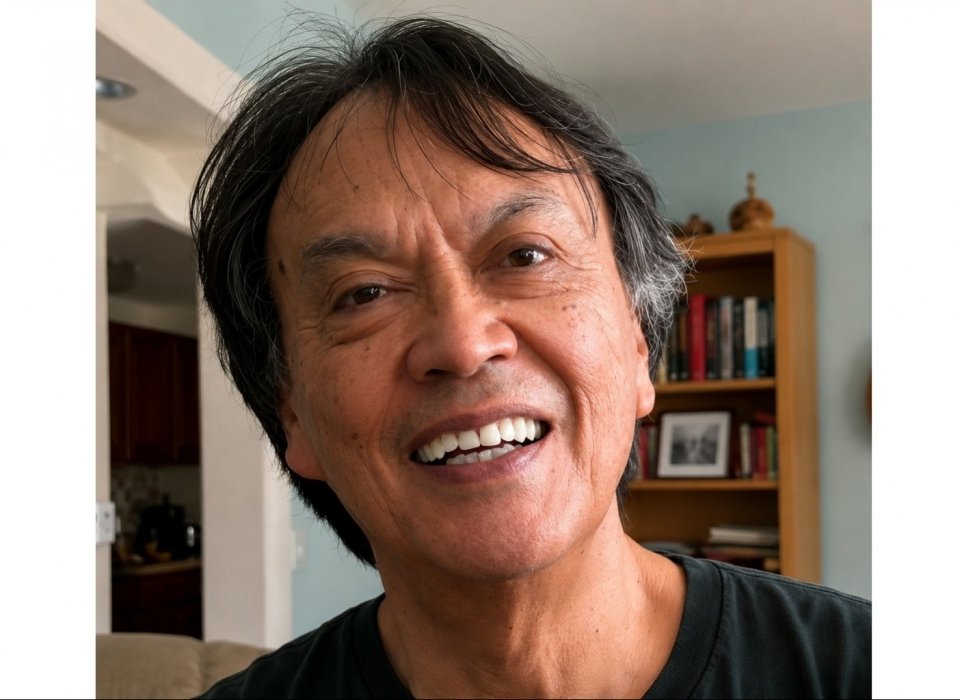
By Abraham A. van Kempen
Founder and Chairman
2 November 2026
With every good wish to you, I am,
Sincerely yours,
Abraham A. van Kempen, Founder and Chairman
Building the Bridge Foundation, The Hague
Bridging Differences to Heal a Broken Humanity
Remember! Diplomacy is catalytic—transformative —while military action is cataclysmic—destructive and catastrophic.
When faced with the options to be good, bad, or ugly, let’s build bridges, not burn them. After all, mutual deterrence reigns.
THE GREAT GLENN DIESEN
BY JOHN J. MEARSHEIMER
SUBSTACK.COM
1 NOovember 2026
On October 28, 2026, I appeared on Glenn Diesen’s popular podcast. Before discussing the topic, I want to emphasize that Glenn faces constant attacks in his home country of Norway for expressing views that challenge conventional wisdom about the war in Ukraine. The attacks have become so vicious and relentless that he plans to leave Norway after Christmas. This situation is disgraceful and fundamentally at odds with the core liberal values the West claims to cherish and uphold.
The reason for this campaign against Glenn is straightforward: Europe’s war against Russia is failing, just as he has long predicted. European elites, including those in Norway, are desperate to silence anyone who tells them their policies are failing, that they led Ukraine down the primrose path, and that they have a great deal of blood on their hands—not their own, of course.
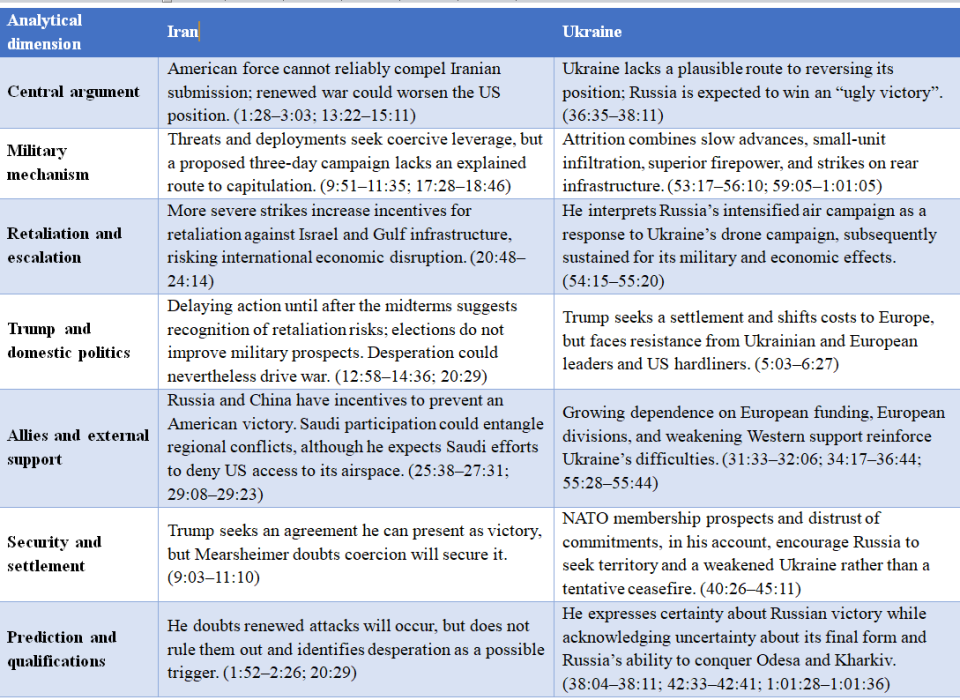
Turning to the substance of our discussion, I argued that the American foreign policy elite now has a much clearer understanding of the limits of US military power. The wars in Iran and Ukraine, along with earlier conflicts in Afghanistan and Iraq, have shown that although the United States has long been the world’s most powerful country, there are significant limits to what it can achieve through that power.
Relatedly, I argued that projecting U.S. military power into the Persian Gulf will become increasingly difficult in the years ahead. Finally, Glenn and I discussed how Napoleon’s 1812 invasion of Russia, Russia’s defeat by Imperial Germany in 1917, and Hitler’s June 1941 invasion of the Soviet Union have shaped Russian thinking about NATO expansion and the ongoing war in Ukraine.
JOHN MEARSHEIMER: NATO'S CHOICE AS UKRAINE COLLAPSES - NEGOTIATIONS OR WAR WITH RUSSIA
Click here to watch this video, which we featured last Friday.
Comparison: Mearsheimer’s Arguments on Iran and Ukraine
SCOTT RITTER | ANCTIONING TRUTH
A word from Scott Ritter:
- I want to close with an appeal to viewers. Many issues involve uncertainty and nuance, but I see this one clearly: I support Jacques Baud and oppose the sanctions imposed on him.
- Americans who value free expression should question whether European governments share those values when they treat him this way. I encourage viewers to contact their elected representatives and Vice President J.D. Vance, whom I regard as a strong defender of free speech, and ask them to hold Europe accountable.
- If this can happen to one person, it can happen to others. In my view, this is a cause worth standing up for. Thank you for watching.
Click here to review Jacques Baud’s books

Watch the Video Here (1 hour, 8 minutes, 11 seconds)
Host: Scott Ritter
Substack.com
31 October 2026
ESSAY | When the Battle of Ideas Becomes a Locked Door – Free Expression Demands Accountability
By Abraham A. van Kempen
2 November 2026
What would freedom mean tomorrow morning if you could still speak, but your money couldn’t leave your bank account? You could argue, publish, and explain yourself. Yet ordinary life would become a corridor of locked doors, with every key just beyond your reach. Reading Scott Ritter’s conversation with Jacques Baud, I can’t shake the image of a man speaking into an open microphone as he describes a world closing in around him.
What makes the image unsettling is how ordinary the things behind those doors are: a pension, a bank card, books that might earn royalties, a journey home to Switzerland. In his account, EU sanctions turned these everyday freedoms into matters requiring permission. Ritter responds with outrage, sometimes calling the consequences a death sentence. I understand the emotional force of that language. But our argument grows stronger, not weaker, when we distinguish its metaphor from what we can establish.
To understand how those doors closed, we must start with the designation: the EU listed Baud on December 15, 2025. Reports on the designation describe asset freezes and travel restrictions, and reproduce the Council’s allegation that he spreads pro-Russian propaganda and conspiracy narratives. This was not merely an official announcement that his opinions were unpopular; it was a sanctions designation with material consequences. We should face those consequences without pretending the authorities gave no grounds. They did. The question is whether those grounds justify such intrusive measures.
In response to those allegations, Baud’s central defense deserves a hearing: he says he was explaining Russia’s perception of the war, not endorsing it. He also disputes the claim that he accused Ukraine of engineering its own invasion, saying he quoted former presidential adviser Alexey Arestovych to shed light on Russian thinking. The distinction matters for you and me: describing an adversary’s reasoning doesn’t automatically mean agreeing with it. Understanding is not surrender.
That distinction reflects the approach he describes: assess sources separately from the information they provide, and reject compelling claims when their provenance is unreliable. This is his stated method, not a guarantee that every conclusion is correct. Still, his strongest argument is methodological: a strategy built on a comforting caricature will fail when confronted with reality. If we refuse to examine how an opponent thinks, we give up our ability to challenge them intelligently.
From the question of understanding comes the question of free expression—not as a halo around Baud, but as protection for the argument itself. You don’t have to believe his account of Ukraine, and neither do I. We can demand evidence, expose errors, and reject conclusions. What troubles me is the prospect of replacing that contest with financial pressure. The battle of ideas needs windows thrown open to scrutiny, not the quiet click of a blocked payment.
That concern becomes tangible in his disclosures about publishing. Baud says publishers retain royalties they cannot transfer to him, and that FNAC removed his books while Amazon continued selling them. These are claims made in the interview, not independently established here. Still, the mechanism he describes is chilling: a book need not be formally prohibited for its author’s livelihood to be constricted. Silence can arrive wearing an accountant’s jacket rather than a censor’s uniform.
Beyond publishing, his account describes a wider vicious cycle. Restrictions make life harder, while challenging them demands sustained legal work; meanwhile, he says, the restrictions are renewed. Speaking publicly risks reinforcing the very narrative he disputes. He also alleges that officials saw his apparent neutrality as making his influence more dangerous. Without the correspondence, I cannot verify that claim. Still, it is easy to see why he describes a trap: in his telling, the qualities he cites in his defense become reasons for suspicion.
Still, taking his predicament seriously does not mean claiming that every exit is sealed. In February 2026, reports confirmed that Belgium granted Baud a humanitarian exemption, giving him access to his bank account for essential needs. Baud confirmed the development himself. This materially qualifies the interview’s portrayal of absolute financial deprivation. Given this reported relief, we cannot responsibly present him as having no lawful means to meet his basic needs
.
Yet that relief does not resolve the larger question. Easing the harshest consequences is not the same as vindication, restored autonomy, or a resolved challenge. The disturbing image is not necessarily of a man condemned to starve, but of a man whose ordinary independence has become conditional. Opening a window in a locked room brings welcome air; it does not explain why the door remains shut. Permission to breathe more freely is welcome, but it does not answer whether the restraints were justified.
That brings us to accountability. The record identifies the institutions responsible: the EU High Representative proposed the measure, and the Council of the European Union adopted it. Kaja Kallas signed it on the Council’s behalf. This establishes their formal roles; it does not prove that she personally devised every allegation. The member-state governments, acting through the Council, cannot evade responsibility by hiding behind the word “Brussels”.
Beyond the documented responsibility, there is a separate suspicion: Baud believes France initiated his case, but explicitly acknowledges that he has no proof. We should not present this suspicion as fact. His criticism of Switzerland also needs qualification: reports indicate that Switzerland did not adopt this sanctions regime, but do not establish that its refusal amounted to a formal ruling vindicating him on free-speech grounds. His disappointment with Swiss assistance remains his account.
Setting that suspicion aside, the underlying EU regulation expressly invokes the rights to an effective remedy, a fair hearing, and a defense. Those guarantees provide a standard for judging the machinery. Baud says he was not given a hearing before designation and is challenging the sanctions before the General Court. A challenge is not a victory, but it also does not show that no legal route exists. The question is whether review offers meaningful protection while the restrictions remain in force.
Measured against those promises, I consider it an autocratic abuse when a security label replaces a demonstrable, proportionate case. Calling Baud’s treatment an atrocity conveys moral anger, but it does not establish a judicial finding. My demand is more concrete: explain the evidence, address his defense, justify the restrictions, and provide effective review. Do not let a person’s dignity disappear amid departmental signatures.
You and I must defend this principle most fiercely when the voice belongs to someone we distrust. Otherwise, freedom becomes a privilege we grant to friends and deny to strangers. Imagine your own voice on the other side of that locked door. Would permission to speak be enough if it cost you your ordinary independence? Do not look away simply because you disagree. Let the argument stand in daylight. Let evidence answer evidence. Demand accountability, but not silence. Europe should defend the battle of ideas—not padlock the life of someone taking part. The freedom we refuse to defend for another is the freedom we leave undefended for ourselves.
ALEX KRAINER | THE ECONOMIC & POLITICAL UNRAVELING OF EUROPE
Prof. Glenn Diesen’s conversation with former Hedge Fund Manager Alex Krainer explores France’s unrest, the changing relationship between the United States and Europe, and the economic risks facing Western economies. The speakers discuss economic hardship alongside suspicions about protest organization, then examine differences over Russia, Ukraine, trade, and industrial policy.
Krainer argues that unresolved debt and energy pressures could lead to stagflation, eroding savings and public services, while expressing longer-term hope for democratic renewal. The discussion presents the speakers’ interpretations and forecasts; allegations of coordinated unrest and predictions of inevitable collapse should not be read as established facts.
00:00 Introducing Alex Krainer and the unrest in France
01:27 France’s economic strain and questions about protest organization
05:48 Comparisons with France’s 2023 riots
09:14 US influence, NGOs, and Europe’s political direction
14:35 Europe’s foreign-policy choices and the missing middle ground
17:22 Hamilton’s American System versus British free trade
22:24 The Iran war and the shift away from reindustrialization
25:30 US-Russia commerce and Europe’s reluctance to engage
32:39 Europe’s debt burden and the risk of stagflation
39:51 Why a change of government may not fix the fundamentals
41:17 Social media, political narratives, and cautious optimism

Watch the Video Here (49 minutes, 31 seconds)
Host: Prof. Glenn Diesen
Substack.com
31 October 2026
ESSAY | I Want More Than a Different Flavor of Decline – A Personal Response to Alex Krainer’s Arguments About Europe, Economic Renewal and the Possibility of Hope
By Abraham A. van Kempen
2 November 2026
You And I Deserve More Than Getting By.
Before we discuss bond markets or geopolitics, let me ask you this: when did simply getting by become the best we could hope for? That’s what stays with me after listening to Alex Krainer—not his darkest prediction, but his insistence that politics has forgotten the people it’s meant to serve.
For you. For me. For someone choosing between heating the kitchen and buying decent food. For the pensioner watching a lifetime of careful savings lose purchasing power. For the young graduate wondering if adulthood now means permanent insecurity.
We’re offered grand strategies, solemn declarations, and yet another enemy to fear. Still, the ordinary question keeps coming back: when will any of this make our lives better?
I hear Krainer ask that question repeatedly throughout the interview. His answer is uncomfortable: changing the faces at the top won’t necessarily repair the foundations beneath. You can repaint a leaking roof, but you’ll still wake up wet.
I don’t accept every suspicion he raises, nor do I believe his bleakest forecasts are inevitable. But I think you and I should consider his central challenge: Are our leaders rebuilding the foundations of shared prosperity, or merely managing the appearance of control?
A Debt Crisis Wears Ordinary Clothes
Krainer’s strongest economic argument is that a cabinet reshuffle cannot make debt disappear. Nor, he argues, would cheaper energy alone solve the structural problem. Relief matters, but it is not the same as repair.
He fears stagflation: when the economy struggles to grow as prices keep rising. You work harder, but your income buys less.
As he describes it, the danger reaches beyond financial markets. Inflation erodes the purchasing power of savings and fixed incomes, while austerity weakens the services that hold communities together. Meanwhile, public support for banks and corporate borrowers can leave ordinary households feeling that help goes first to those who need it least.
That is the moral question at the heart of his argument: who is protected when the system fails, and who is left to absorb the loss?
I wouldn’t treat comparisons to Weimar Germany or the Soviet collapse as a timetable for our future. Historical comparisons can warn without predicting what comes next. Still, the underlying question deserves an answer: how can we reduce economic fragility without making ordinary people bear the cost?
Build Something We Can Stand On
This is where Krainer’s discussion of the American System becomes more than a history lesson: he contrasts an economy shaped by financial interests with one focused on productive capacity, industrial investment, and national development. Finance can also serve that purpose when it directs savings and credit toward businesses, infrastructure, and skills that improve everyday life.
Put simply: do we want prosperity on a screen, or prosperity we can experience firsthand?
A functioning factory. A reliable energy supply. A school with enough teachers. A hospital that doesn’t feel perpetually besieged. These aren’t sentimental extras; they are the substance of a country’s promise to its people.
Imagine a local manufacturer borrowing, for example, to buy more efficient equipment and train apprentices. If the investment pays off, the lender earns a return, the business can produce more, and young people gain useful skills. That’s finance helping build something—not just moving numbers around.
Krainer initially heard the Trump administration’s messaging as a commitment to industrial renewal. He later saw the war with Iran diverting the attention and energy that could have supported that project.
Whatever you think of his interpretation, the trade-off deserves scrutiny. Governments have limited attention and resources. If we want investment to improve everyday life, we also need to consider whether foreign policy supports that effort or makes it harder. That brings me to Krainer’s case for dialogue.
Diplomacy Should Not Be a Dirty Word
For Krainer, commercial cooperation with Russia offers a way to link economic interests and diplomacy: reliable business relationships can build trust, which can, in turn, make negotiations possible.
I’m not asking you to mistake a business deal for peace or disregard Ukraine’s interests. I’m asking whether refusing to talk is a strategy—or merely a posture that becomes harder to abandon.
Krainer believes Europe risks falling behind as Washington pursues a more pragmatic relationship with Moscow. His challenge is to explain how Europe’s stance serves its people without treating dialogue as surrender.
I Would Like the Clean Water, Please
Perhaps Krainer’s most memorable image is his political menu: Coca-Cola or Pepsi, with no clean water available.
He sees factions offering different foreign-policy allegiances, but no convincing alternative focused on Europe’s well-being. I understand the frustration. You change the label, open the bottle, and find the same sweet promise of something better.
The missing option is not mysterious: democratic accountability, independent media, education, healthcare, affordable energy, and productive investment. It is sovereignty measured by the ability to improve everyday life—not simply by speeches about national pride.
And yes, France’s unrest belongs in this conversation. Economic strain can make the divide between rulers and the ruled feel intolerable. But this is where I part ways with Krainer’s more speculative reasoning.
He suspects the unrest may be orchestrated to justify restrictions, but that suspicion needs evidence. We should not mistake a troubling coincidence for proof or let distrust replace investigation.
We can defend the right to protest without claiming to know who is behind every broken window. Our task is to demand transparency, proportionate policing, and accountability—not to replace one unquestioned narrative with another.
Hope Is Not a Forecast. It Is a Responsibility.
What surprises me is that Krainer ends on an optimistic note. Beneath his warnings lies a belief that people can communicate, challenge established narratives, and insist on different arrangements.
I share that hope, but cautiously. The internet helps us exchange information, yet it can also spread falsehoods. Repeating a claim a thousand times doesn’t make it true. Our freedom to speak matters most when we also listen carefully, check the facts, and admit uncertainty.
Still, you and I are more than spectators. We can ask whether an economic policy strengthens productive life, whether an emergency measure is properly limited, whether a diplomatic position offers a credible path to peace, and whether a political alternative is truly different or simply packaged differently.
Let’s put that into practice. Choose an issue that affects your life—energy costs, healthcare, or your local school. Ask your elected representative what will change, when it will happen, and how they'll measure progress. Compare their answer with reliable evidence, share what you learn, and follow up. Hope calls for our attention, not just our applause.
To me, the best way to carry Krainer’s arguments forward is not as a prophecy of collapse, but as an invitation to reclaim our standards.
I don’t want to offer you despair and pass it off as insight. I want us to remember that a country is more than its bond market, military posture, or governing class.
It’s the light in your kitchen, the care available when you fall ill, and the future your children can reasonably envision. Like clean water, these are essentials—not luxuries we should have to plead for.
Let us judge politics by whether those lights stay on.
EINAR TANGEN: CHINA'S NEW ECONOMIC STRATEGY VS. THE WEST'S IDEOLOGICAL TRAP
Prof. Glenn Diesen’s conversation with Einar Tangen explores the links between political legitimacy, economic performance, and institutional adaptability. Einar Tangen contrasts China’s focus on long-term planning and measurable outcomes with what he sees as the West’s reliance on democratic procedures and ideological certainty. The discussion raises a useful question: should governments be judged by their stated principles, their results, or both? Still, its sharply contrasting portrayals deserve scrutiny, especially where broad claims lack supporting evidence and competing interpretations receive little attention.

Watch the Video Here (49 minutes, 58 seconds)
Host: Prof. Glenn Diesen
Substack.com
31 October 2026
ESSAY | The Future Will Ask What We Built -- China, The West, and the Lives Behind the Promises
By Abraham A. van Kempen
2 November 2026
When future historians look back on our century, what will move them most: the promises we polished or the lives we made less painful? Will they remember our speeches, or the moment an ordinary person no longer dreaded tomorrow? Einar Tangen’s comparison of Chinese and Western governance brings that question close enough to hurt. Beneath the political labels, I hear a human challenge: how does a government earn our trust—not in a single moment of triumph, but repeatedly, through the patient work of helping people live.
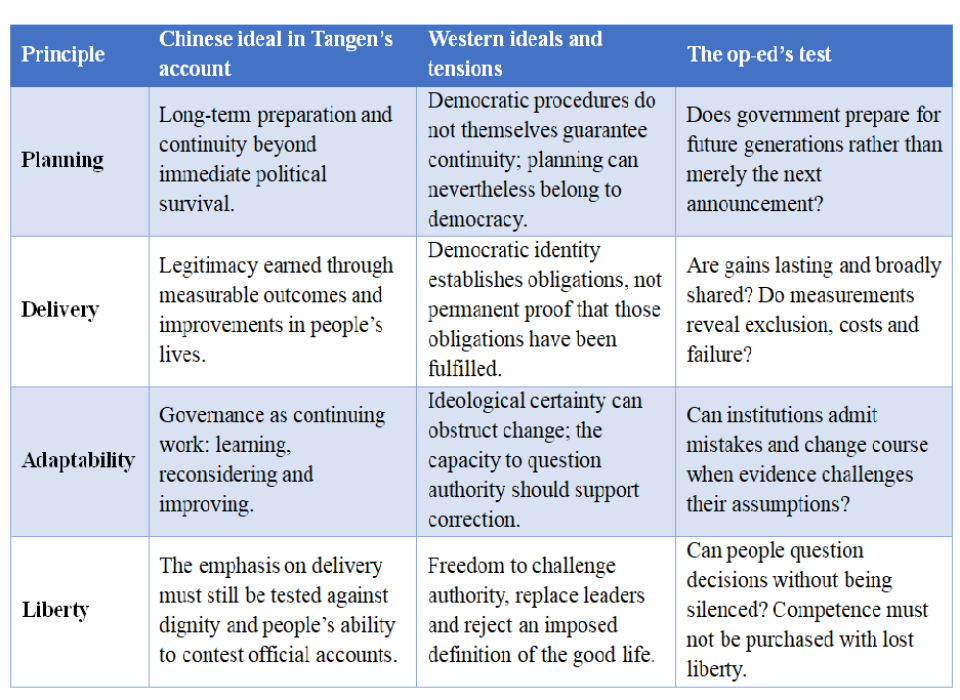
Tangen contrasts China’s emphasis on long-term planning and measurable outcomes with what he sees as the West’s reliance on democratic procedures and ideological certainty. What moves me is the gap between a system’s proud self-description and the experience of living within it. A constitution can shine on paper. An election can be impeccably conducted. Yet you still have to face the morning, pay the bills, and wonder what your children will inherit. Procedures matter profoundly. But they create an obligation; they do not fulfill it. I cannot admire a beautiful doorway without asking whether the house offers shelter.
Please don’t mistake this for an invitation to trade freedom for efficiency. I would never ask you to give up your voice for a tidier world. That bargain is too crude, and its cost can be terrible. What troubles me is something else: have we become so accustomed to proclaiming our ideals that we barely notice when we fail to live up to them? In Tangen’s account, Western democracy risks treating its identity as lasting proof of legitimacy, while China places greater emphasis on delivery. That challenge deserves a hearing. Yesterday’s credentials offer little comfort to someone abandoned by today’s government.
Long-term planning speaks to me more quietly than political argument usually does. You and I live beyond the next announcement: children grow taller, parents grow frailer, and decisions made today cast shadows we may not see for years. I want government to recognize both that tenderness and that responsibility. Imagine politics as a garden, not a stage. Applause cannot deepen roots. Someone must tend the soil through seasons without flowers and keep watering after the cameras have left. In Tangen’s account, China’s planning ideal offers that kind of patience. I find it compelling because our lives need continuity, not just excitement.
And yes, I want promises to match reality. I want to know what changed for you—not just what officials congratulated themselves for believing. But I can’t let a handsome table of results end the conversation. Whose life does it describe? Whose hardship falls between its columns? A gleaming average can leave an entire street in darkness. If China’s approach is to become an ideal admired by historians, performance must mean more than impressive totals. It must show who benefits unevenly, acknowledge failures, and bring ordinary lives into view. Otherwise, the report card is just another polished mirror, reflecting power back at itself.
Adaptability may be the part of Tangen’s argument that gives me the most hope. I want institutions humble enough to admit they don’t have all the answers. A changing century cannot be met with a cupboard locked against inherited certainties. Institutions should carry memory without becoming museums. China’s ideal, as he describes it, is attractive because it treats governance as ongoing work: learn, reconsider, improve. But my hope cannot exempt China from that test. Learning must withstand unwelcome evidence and include the difficult words, “We were wrong.” Without that possibility, adaptability becomes a slogan rather than a living practice.
Here, though, I need to hold on to what Western democratic ideals protect. The right to challenge authority is no decorative ribbon. Nor is the ability to replace leaders or reject someone else’s definition of a good life. These freedoms matter most when exercising them inconveniences those in power. I don’t want competence bought with silence, or liberty reduced to a speech while everything around us decays. Planning and performance can be part of democracy, too. Why should we accept a choice between two wings? We need the strength to act and the freedom to question.
Nor will I let admiration for China become an excuse to look away. Tangen’s sharp comparison needs evidence, and competing interpretations deserve attention. An argument can stir my heart without settling the facts, and I owe you that distinction. We must ask whether these ideals describe institutions in practice, whether the gains endure, and whether people can challenge official accounts without their objections being dismissed. If we are proposing a model for humanity, we cannot judge it only by the light of its finest achievements. We must look into the shadows, too, and listen to those standing there.
Even with those reservations, I can imagine future historians taking China’s governance ideal seriously. If sustained, comparable evidence showed that long-term planning, accountable delivery, and genuine adaptation helped people weather this century’s pressures, that would be an achievement worth studying. Admiration would not mean every society had to reproduce China’s political structure. What might travel is a standard of responsibility, not a universal blueprint: government must earn trust by helping people build their lives. That possibility matters to me. It asks us to stop treating the future as somebody else’s problem and start making room for it at our table.
So this is what I want to leave you with. China’s system could become a demonstrable ideal—but only if its achievements withstand scrutiny, its learning remains genuine, and dignity accompanies delivery. That is a possibility, not a prophecy. Still, Tangen’s challenge is too important to dismiss: legitimacy must be renewed through what government actually does. I want a politics that plants trees whose shade its leaders may never enjoy, without silencing anyone who questions where they are planted. Perhaps historians will admire that patient courage: building without abandoning compassion, listening without fearing disagreement, and changing before the people carrying tomorrow lose hope.
Governance ideals compared
This table summarizes the op-ed’s interpretation of Tangen’s argument, not a verified assessment of either system’s performance.
References:
The Putin Doctrine: ‘A Unified European Home,’ Speech, Berlin Bundestag, 25 September 2001
The Putin Doctrine: ‘Security for One is Security for All,’ Speech, Munich, 10 February 2007
The Trump Doctrine: ‘Nation Builders Harm Societies,’ Speech, Riyadh,/ 13 May 2025
The Xi Jinping Doctrine: ‘Global Governance As a Shared Project,’ Speech, SCO Tianjin, 1 September 2025
BUILDING THE BRIDGE! | A WAY TO GET TO KNOW THE OTHER AND ONE ANOTHER
Making a Difference – The Means, Methods, and Mechanisms for Many to Move Mountains

Photo Credit: Abraham A. van Kempen, our home away from home on the Dead Sea
By Abraham A. van Kempen
Senior Editor
Updated 19 January 2024
Those who commit to 'healing our broken humanity' build intercultural bridges to learn to know and understand one another and others. Readers who thumb through the Building the Bridge (BTB) pages are not mindless sheep following other mindless sheep. They THINK. They want to be at the forefront of making a difference. They're seeking the bigger picture to expand their horizons. They don't need BTB or anyone else to confirm their biases.
Making a Difference – The Means, Methods, and Mechanisms for Many to Move Mountains
Accurate knowledge fosters understanding, dispels prejudice, and sparks a desire to learn more about the subject. Words have an extraordinary power to bring people together, divide them, forge bonds of friendship, or provoke hostility. Modern technology offers unprecedented possibilities for good, fostering harmony and reconciliation. Yet, its misuse can cause untold harm, leading to misunderstandings, prejudices, and conflicts.
A Free Trial for Life – SUBSCRIBE NOW!

• It's quick and straightforward.
• We won’t ask for your credit card number.
• Just enter your e-mail address to receive your complimentary free-for-life subscription to our newsletter.
• Please include your First and Last Name.
• We won’t share or sell your e-mail address.
_________________________
Related Articles Recently Posted on www.buildingthebridgefoundation.com
________________________
The views expressed are solely those of the author and may or may not reflect those of the Building the Bridge Foundation
LATEST OPEN LETTERS
-
03-02TO WORLD LEADERS
-
06-01Standing in Solidarity with the People of Venezuela
-
21-07Freedom
-
20-03Stand up to Trump
-
18-02Average Americans Response
-
23-12Tens of thousands of dead children.......this must stop
-
05-06A Call to Action: Uniting for a Lasting Peace in the Holy Land
-
28-05Concerned world citizen
-
13-02World Peace
-
05-12My scream to the world
VIRTUAL POST OFFICE
PETITIONS
LINKS
DONATION
Latest Blog Articles
-
02-11Our Monday News Analysis | What the World THINKS Now!
-
29-10Our Friday News Analysis | What the World THINKS Now!
-
28-10Our Wednesday News Analysis | Israel’s objectives unlikely to shift as a result of election
-
27-10Israel’s objectives unlikely to shift as a result of election
-
27-10Silencing Palestine: America’s Shameful History of Repression Continues
-
27-10A New Israeli Government Must Make Arabs Partners, Not Enemies
-
26-10Our Monday News Analysis | What the World THINKS Now!
-
15-10Our Friday News Analysis | What the World THINKS Now!
-
14-10Our Wednesday News Analysis | Navi Pillay, head of UN commission that accused Israel of genocide, wins Nobel Peace Prize
-
13-10Navi Pillay, head of UN commission that accused Israel of genocide, wins Nobel Peace Prize
-
13-10No state has a ‘right’ to exist – least of all an apartheid, genocidal state like Israel
Latest Comments
 One of the most important and illuminating articles that I …
Comment by Benjamin Inbaraj-
And what's wrong here?
After all, there is the homeland …
Comment by Isac Boian -
Does this reinforce or deny my argument that Israel is …
Comment by Edward Campbell -
Many 'say' they support the Palestinian cause but do little …
Comment by Philip McFedries -
The UN is strangled by the "war for profit" cabal …
Comment by Philip McFedries -
I can't read the printing on the map.
Comment by Philip McFedries -
Good news!
Comment by Philip McFedries
COMMENTS
This article has 0 comments at this time. We invoke you to participate the discussion and leave your comment below. Share your opinion and let the world know.