 NEWSLETTER
The Friday Edition
Our Friday News Analysis | What the World THINKS Now!
Bridging Differences to Get to Know the OTHER and One ANOTHER (Part 15)
The Hague, 13 November 2026 | If you know of a decisive story, tell the world! We're still searching.

Living Words of Saint Pope John Paul II | “Finding the Gold in the Soil on Which We Stand …”
We must not be tempted to think that the value of our lives depends solely on tangible results.
Every life has value. In light of Jesus' life, everyday acts matter: working together, neighbors helping one another, and recipients responding with gratitude.
All this makes us witnesses of the Good News.
God's hidden power helps us flourish where He plants us.
He invites us to be big in the small things ...
It means finding the gold in our soil—making the life the Lord gave us valuable.
Saint Pope John Paul II
Homily for the sick and the handicapped in Houtrusthal
The Hague, Netherlands
13 May 1985
This week’s reflection: “Finding the Gold in the Soil on Which We Stand …”

Building the Bridge Foundation
For six decades, Saint Pope John Paul II spoke to billions—from young people and presidents to peacemakers, the forgotten, and the powerful.
John Paul II was a theologian, world leader, statesman, poet, and pastor, revered by billions.
He addressed war and peace, human dignity, mercy, and the deepest longings of the human heart.
Those words did not stay in the past. They are living words. And they speak now.
Even more alive today, the Pope's Message invites readers to pause and reflect.
There is no cost. There never will be.
OUR WEDNESDAY NEWS ANALYSIS | ISRAEL’S ELECTION SHOWS ITS DEMOCRACY IS A SHAM, BUT THE WEST CAN’T STOP BUYING THE LIE
The same racist, Zionist logic that justified the Gaza genocide is now making it impossible for the Jewish opposition to reach a deal with Palestinian parties to oust Netanyahu
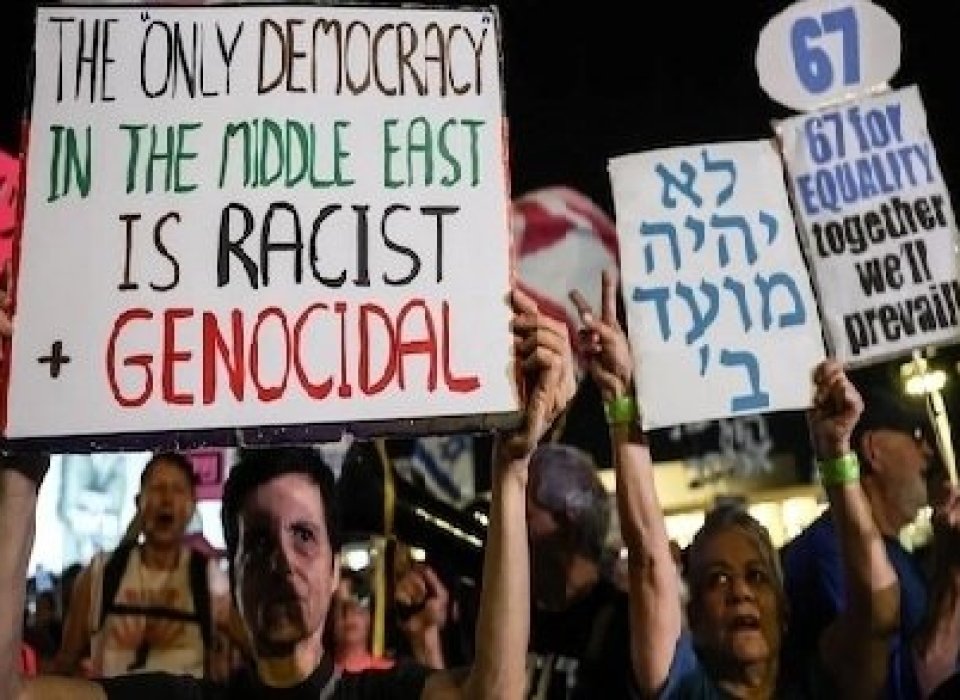
Israel’s general election last week unmasked beyond question the West’s much-cherished fiction of Israel as a “Jewish and democratic state”.
By Jonathan Cook
Source: Jonathan Cook Blog
https://www.jonathan-cook.net/2026-11-03/israel-election-democracy-sham/
3 November 2026
It was the warped logic of Zionism, not some need for security, that propelled Israel into
leveling Gaza and killing and maiming tens of thousands of Palestinian children.
And it is the same racist logic that makes it impossible for Israel’s Jewish parties to reach a compromise with the Palestinian minority to oust Netanyahu.
The overwhelming majority in Israel is bent on the eradication of the Palestinians.
Western politicians and media stubbornly cling to the idea that Israel’s racist, genocidal behavior is peculiar to Netanyahu, and can be fixed by an election.
The next weeks will prove, once again, how wrong they are.
Sham democracy
Because Israel has one person, one vote – including for what today are some two million Palestinian “citizens” – it must be considered a Western-style liberal democracy, we are told.
It should have been easy to show how nonsensical that argument is, were there any appetite in western capitals for laying bare the truth about Israel’s sham democracy.
The past week of post-election maneuvering from Israel’s Jewish parties – whether the governing bloc led by Benjamin Netanyahu or the so-called “opposition” – should finally lay this lie to rest.
FROM THE BRIDGE | The Numbers ... A Voice in the Wilderness
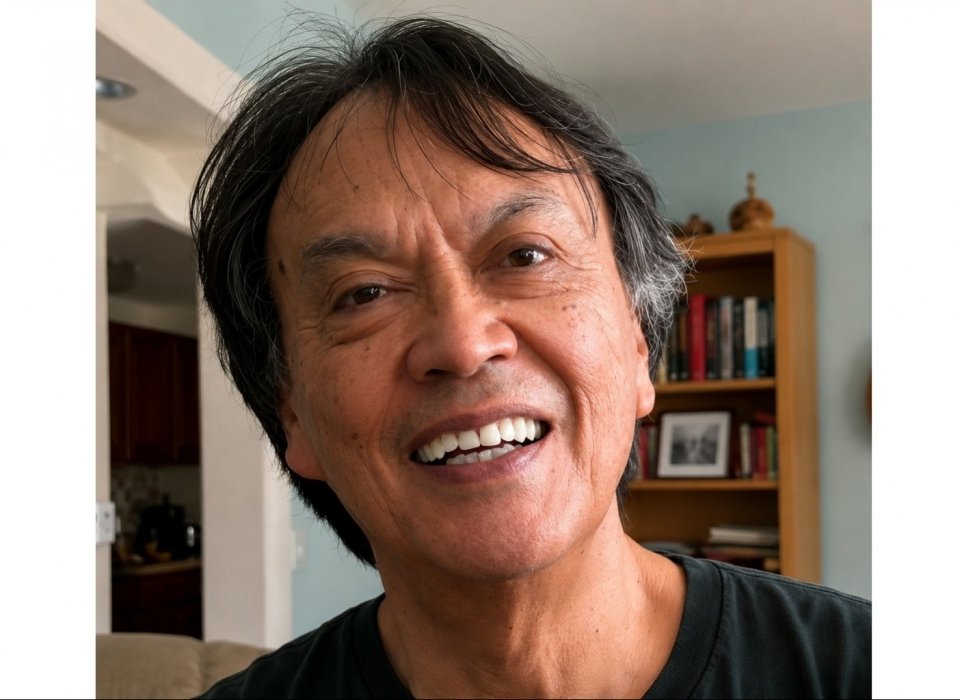
By Abraham A. van Kempen
Founder and Chairman
13 November 2026
Last Monday, in our 9 November edition, I caused an uproar. Let me summarize:
Our editorial is titled: The American Way ... Why Not? I don’t have to tell you how my friends and relatives ridicule me for suggesting that President Trump should work with Presidents Xi and Putin to help heal our broken humanity, especially a broken and decadent Europe. Worse, I’m even suggesting that Trump’s American Way resembles Putin’s Russian Way and Xi’s Chinese Way. I don’t have to tell you that they’re the three most hated men in Western Europe and North America. And yet, I don’t know anyone else who can step up to save humanity from itself.
...
My suggestion that “Trump’s American Way resembles Putin’s Russian Way and Xi’s Chinese Way” was viewed by some as an act of treason, to put it mildly. I defend my statement with: read, compare, and contrast the American Way, the Russian Way, and the Chinese Way for yourself:
The Putin Doctrine: ‘A Unified European Home,’ Speech, Berlin Bundestag, 25 September 2001
The Putin Doctrine: ‘Security for One is Security for All,’ Speech, Munich, 10 February 2007
The Trump Doctrine: ‘Nation Builders Harm Societies,’ Speech, Riyadh, 13 May 2025
The Xi Jinping Doctrine: ‘Global Governance As a Shared Project,’ Speech, SCO Tianjin, 1 September 2025
To paraphrase Henry Kissinger, nations have neither friends nor enemies—only interests. The recent tit-for-tat in Eastern Europe, West Asia (the Middle East), South America, and East Asia has caused major hiccups in the global economy. It’s time to build bridges. Besides, certainly the U.S. can no longer afford wars, especially if it is spilling blood and wasting treasure to uphold Eurocentric policies, not American ideals.
Look at the numbers! Everybody is talking about AI. Companies like Amazon, Apple, Facebook, Google, Microsoft, OpenAI, Oracle, SpaceX, and several more in the United States believe they can outsource and outcompete each other to reach market dominance. What will it take in real dollars and cents to build the data centers, including the land, the buildings, the electrical capacity with acres of turbines or nuclear power plants, the water to cool down the energy, etc.?
Current estimates reported in the mainstream media range from $5 trillion to $8 trillion, and these funds are needed now. To put the figures in perspective, let’s use $7,000,000,000,000, or $7 trillion. That’s compared with $13 trillion in outstanding home mortgages, U.S. GDP of $32 trillion, and a national debt of $40 trillion. Even more strikingly, compare the $7 trillion needed for AI investment to the U.S. population of 340 million. In short, U.S. citizens – every man, woman, and child – need to cough up $20,588 each of investment capital to build the U.S. AI infrastructure. For a family of five, this means $102,940 per household.
What’s my point? If the United States must choose, should it increase its national debt to fund wars or develop AI? I’m glad Presidents Trump, Xi, and Putin are discussing these issues without Europe. Europeans can join when they're ready.
...
GUEST EDITORIAL | THE FRAGMENTING WEST & EUROPE’S FAILURE TO ADJUST TO A MULTIPOLAR WORLD
By Glenn Diesen
Substack.com
11 November 2026
Editor’s Note | Prof. Glenn Diesen explains how the shift toward a multipolar order exposes divisions within the West and curbs U.S. power. He calls for the U.S. to set clearer priorities and build stronger partnerships with Europe. He also warns that Europe’s focus on past dominance and its confrontation with Russia could weaken its autonomy, prolong the war, and fuel instability.
The following essay is adapted from Prof. Diesen’s The Fragmenting West and Europe’s Failure to Adjust to a Multipolar World.
ESSAY |A Changing World, a Divided West – Europe’s Search for Independence as Global Power Shifts
For decades, the West was held together by a shared force: first, the Cold War’s two rival camps, cast as the ‘Free World’ versus the ‘Red Scare’ (Russia) and the ‘Yellow Peril’ (China); later, a Western-led world order ostensibly spearheaded by the United States. Now, as power spreads across several centers, the foundations of Western unity may begin to fracture. Europe’s difficulty adapting could turn this strain into a broader international crisis.
The Cold War and the Post-Cold War Era – ‘Us’ versus ‘Them’
The transatlantic order emerged during World War II, as the West united to counter Soviet power. Rival ideologies divided “us” from “them,” while economic rivalries took a back seat to military competition with the Soviet bloc.
After the Cold War, the United States became the sole superpower. Western unity relied on shared dominance in Europe through NATO expansion, not the inclusive security framework in the 1990 Charter of Paris for a New Europe, which recognized Russia’s security interests.
Washington and Europe envisioned different futures: Washington wanted a partner to uphold U.S. global leadership; Europeans sought two equal pillars—the United States and the European Union.
Those differences remained manageable, despite the Wolfowitz Doctrine’s view—rooted in the February 1992 Defense Planning Guidance—that Germany’s rise could challenge U.S. dominance.
The era’s reassuring message: under liberal democracy, Western influence would benefit humanity by spreading democracy and human rights.
But universal values could justify dominance and unequal sovereignty—the right to self-govern. Promoting democracy and humanitarian intervention upheld that right for liberal-democratic “us” while restricting it for “them.”
The Inevitable and Chaotic End of Hegemony
A world dominated by one power could not last forever. As resources shifted to other countries, leading powers weakened while rising powers had greater incentive to unite against them. This unstable transition was inevitable.
The West faces mounting pressure from unsustainable debt and a finance-driven economy. Meanwhile, BRICS is emerging as a counterweight, advocating a multipolar world where civilizational differences coexist with universal values.
Western dominance, justified by liberal values, has lost credibility: its promises of equality, self-determination, and democracy contradict unequal sovereignty. Many see the West’s appeals to liberal democracy over the past three decades as masking strategic interests often pursued by force.
Old habits are hard to leave behind, especially those of dominance. Trying to act everywhere can blur a country’s focus and weaken its judgment. Relying on force gives more influence to those calling for war, while the ability to absorb losses can encourage costly mistakes.
Threats and ultimatums begin to crowd out diplomacy. Peace comes to mean defeating rivals and promoting good values, rather than balancing competing security needs.
A power convinced of its own goodness may stop listening to its rivals’ fears and dismiss disagreement as illegitimate. Seen this way, poor Western leadership may be partly a legacy of dominance in the name of liberal values.
The Multipolar World and the Fragmentation of the West
Whether we welcome it or not, a world with several centers of power is here. Ignoring it will not make it go away—and could cost us dearly. The United States needs clear priorities: the Western Hemisphere and East Asia, where China is its peer competitor. For the first time, Europe would come a distant third.
A large U.S. presence there uses up resources and may threaten Russia, pulling it closer to China. Washington should step back, rebuild its strength, and give other great powers room to balance one another.
Being everywhere is not the same as getting enough done. Unless the United States adjusts to this changing balance of power, it risks taking on more than it can handle.
Consider the interceptor missiles: after supplying them for its proxy war against Russia, Washington had too few to counter Iran. It moved missiles from Europe and East Asia to the Middle East.
East Asian allies now see the danger of becoming frontline states for a declining dominant power; Europeans may come to the same conclusion. Gulf states see that risk, too, after Israel received priority for missiles in the region. Washington can scale back its empire and choose its priorities—or risk a disorderly collapse.
As U.S. and European security interests diverge, NATO may weaken or dissolve. Its expansion under U.S. dominance brought Europe’s dividing lines closer to Russia, reinforcing Western dominance and casting Russia as an adversary. Expansion into Ukraine went too far, prompting Russia to respond.
Meanwhile, Iran and China have counterbalanced U.S. power in the Middle East and East Asia. Europe expected war with Russia to bring renewed American commitment. Instead, defeat accelerated America’s departure.
For most small and medium-sized countries, a world with several power centers opens more doors. It offers more economic and strategic choices, more independence, and less reliance on any one country. Europe could open those doors, too, by building ties with Russia, China, India, and others.
Yet its leaders still reach for the old model of shared Western dominance. Policies that cut ties with America’s rivals could leave Europe more dependent on Washington, not more influential.
Nor can an independent Europe hold together simply by treating Russia as a common enemy. Its prosperity and security need workable relations with Russia. Europe’s geopolitical ambitions could undermine its economic interests.
European leaders who support continuing the war with Russia are losing support in the polls. As the era of U.S. dominance ends and Washington withdraws, new leaders may ask why Europe is rebuilding old dividing lines and returning to Cold War thinking.
In Germany, they may see constructive ties with Russia as essential to peace and prosperity. Moving Ukraine away from the front lines of a divided continent could spare it further destruction.
Current leaders may also have to confront a difficult question: Did they mislead the public? If the war was about Europe’s security arrangements, why wasn’t diplomacy pursued earlier—before hundreds of thousands of young men lost their lives, economies were weakened, and nuclear risks increased?
Leaders under pressure to keep their hold on power may prolong the war instead. That could deepen the public’s loss of faith in them and raise the risk of another world war.
...
Presidents Trump, Xi, and Putin are on their way to Yalta. If they do, each deserves to share the 2027 Nobel Peace Prize.

Churchill, Roosevelt, and Stalin at Yalta brokering peace that turned out to be make-believe
What happened at Yalta?
Stalin got and occupied Eastern Europe, including East Germany. Roosevelt got and occupied West Germany. Churchill got and ‘occupied ’ (figuratively speaking) the United States.
Even before World War II, the United States had been Europe’s most powerful ally and proxy. I’ll fill you in in the coming months. Since World War II, Europe has crowned the United States the ‘Leader of the Free World.’ If there is ever an oxymoron, it is ‘Free World.’ There has never been a free world.
A country cannot lead the ‘free world’ through force. President Trump knows this; he has learned his lesson. I expect him to challenge Europe’s views on Globalism—neocolonialism—with the ‘American Way.’
Are you ready for the ironies of ironies? Trump’s American Way resembles Putin’s Russian Way and Xi’s Chinese Way.
References:
The Putin Doctrine: ‘A Unified European Home,’ Speech, Berlin Bundestag, 25 September 2001
The Putin Doctrine: ‘Security for One is Security for All,’ Speech, Munich, 10 February 2007
The Trump Doctrine: ‘Nation Builders Harm Societies,’ Speech, Riyadh, 13 May 2025
The Xi Jinping Doctrine: ‘Global Governance As a Shared Project,’ Speech, SCO Tianjin, 1 September 2025
To be continued on Monday, 16 November 2026.
With Every Good Wish to you, I am,
Sincerely yours,
Abraham A. van Kempen
Founder and Chairman
Building the Bridge Foundation, The Hague
A Way to Get to Know One Another and the Other
Remember! Diplomacy is catalytic—transformative —while military action is cataclysmic—destructive and catastrophic.
When faced with the options to be good, bad, or ugly, let’s build bridges, not burn them. After all, mutual deterrence reigns.
WITKOFF AND KUSHNER ARRIVE IN MOSCOW FOR UKRAINE TALKS WITH PUTIN (VIDEO)
The US envoys are expected to brief the Russian president on the outcome of two days of trilateral negotiations in Abu Dhabi

Russian presidential envoy Kirill Dmitriev greets Jared Kushner and Steve Witkoff upon their arrival in Moscow. © X / Kirill Dmitriev
Watch the Video Here (21 seconds)
HomeWorld News
12 November 2026
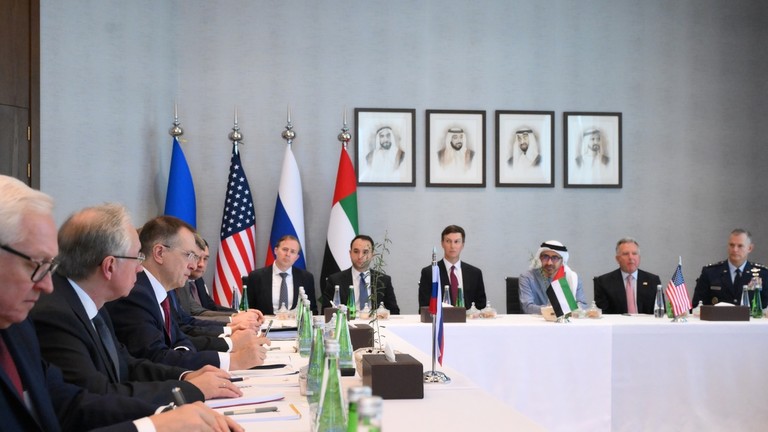
US envoys Jared Kushner and Steve Witkoff arrived in Moscow for Ukraine peace talks after two days of trilateral negotiations with Russia and Ukraine in Abu Dhabi, UAE.
On Wednesday, representatives of the three countries ended two days of talks in Abu Dhabi, their first formal three-way meeting since February. Kushner said afterward he sees room for progress.
Kushner and Witkoff arrived at Moscow’s Vnukovo Airport Thursday morning, greeted by Russian envoy Kirill Dmitriev. Footage shows Dmitriev embracing Witkoff as Kushner smiles under an umbrella. Dmitriev posted on X that the negotiators were in a positive mood before their talks.
Kremlin aide Yury Ushakov told Kommersant Kushner and Witkoff will meet Putin before noon.
“We do not yet know the outcome of the Abu Dhabi negotiations,” he said.
Kushner called the Abu Dhabi talks “very substantive,” saying delegates addressed all major issues. He said a final deal requires resolving territorial disputes. Moscow has long insisted any lasting agreement address the crisis’s root causes.
Russian presidential aide Vladimir Medinsky, who led Moscow’s delegation, said the negotiations produced a preliminary agreement on a major prisoner exchange with Ukraine. The number of prisoners remains undecided.
Kushner said his meeting with Putin would discuss involving European countries in future negotiations.
European representatives remain excluded from trilateral talks, despite meeting US and Ukrainian officials separately Tuesday. Moscow questions their role, accusing European governments of undermining past peace agreements and prolonging the fighting with weapons supplies.
After Moscow, Kushner and Witkoff plan to meet Ukraine’s Vladimir Zelensky in Dublin.
ANALYSIS | ABU DHABI TALKS SIGNAL A MAJOR SHIFT IN THE UKRAINE PEACE PROCESS
Moscow’s calls to rethink European security were rejected before the war. The Abu Dhabi talks suggest Washington is now prepared to discuss them.
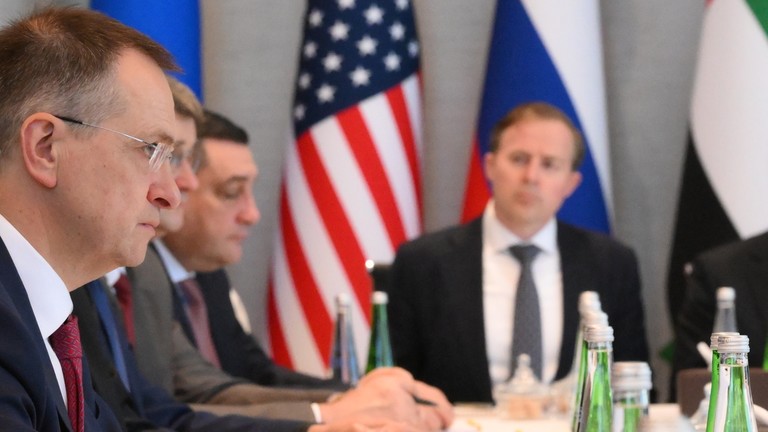
Russian Presidential Aide Vladimir Medinsky attends trilateral talks between Russia, Ukraine and the United States on settling the Ukrainian conflict, in Abu Dhabi, United Arab Emirates. © Sputnik / Grigory Sysoev / Sputnik
By Fyodor Lukyanov, the editor-in-chief of Russia in Global Affairs, chairman of the Presidium of the Council on Foreign and Defense Policy, and research director of the Valdai International Discussion Club.
Russia in Global AffairsRGA on Telegram
HomeWorld News
11 November 2026
Reactions to the Abu Dhabi trilateral talks on Ukraine are mixed, but most observers warn against expecting a breakthrough. Despite senior delegations, discussions remain technical, with no authority to make political decisions. Moscow and Kiev’s public positions leave little room for compromise.
The talks seem serious. For perhaps the first time since the conflict began, Europe’s security architecture and necessary guarantees are central to negotiations—a significant shift.
To understand its significance, consider five years earlier: In November 2021, Putin directed Russia’s Foreign Ministry to discuss Europe’s security with NATO. Moscow had long rejected the post-Cold War, NATO-centred order, while successive expansions turned unease into a belief that the alliance posed a direct threat.
The Foreign Ministry later proposed revising that order, but talks in January 2022 revealed just how far apart the sides were. The Americans and Western Europeans would not consider Moscow’s central argument—that the existing security system required fundamental change—because, in their Western view, there was no problem to solve.
What followed is well known. Washington and Western European capitals once spoke with one voice. Five years later, a new U.S. administration recognizes that resolving the Ukraine crisis requires security guarantees for all parties and is ready to discuss them in Abu Dhabi.
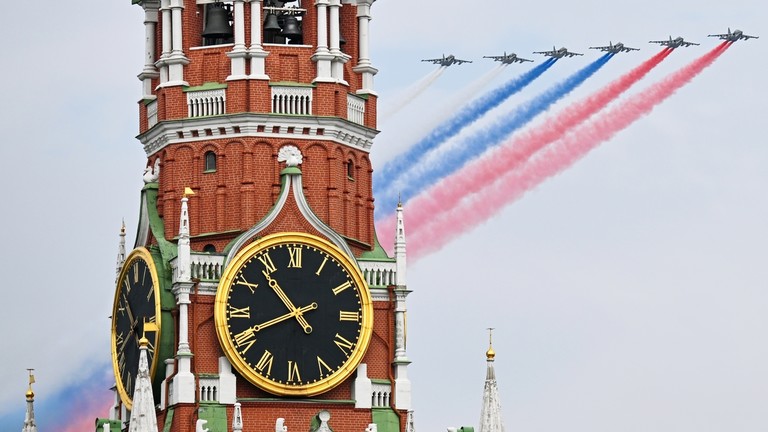
Read more
The West must realize that Russia won’t collapse like the USSR
Western Europe hasn’t followed suit: its governments insist NATO remain the basis of continental security and Russia cannot dictate the rules. Still, the U.S. shift matters: a once-dismissed subject is now on the negotiating agenda.
Until recently, Washington focused on territorial issues, apparently the main topic at the August 2025 Anchorage meeting. Moscow has consistently identified the conflict’s root causes as broader European security arrangements. For the first time, the other side is addressing these issues in a potential settlement. Still, an agreement is not imminent; significant obstacles remain.
Two factors are at play: Western Europe opposes any settlement allowing Moscow to reshape the continent’s security order, while Republicans’ midterm defeat has weakened Trump and strengthened critics of his Russia policy.
Trump insists he will pursue his foreign policy regardless, and he may well do so, but domestic resistance will grow. Western European leaders—many of whom would like to see him go from a lame duck to a dead duck—will take heart. Along with Kiev, they have already shown they can frustrate White House initiatives, and will now believe their leverage has grown.
Still, Abu Dhabi could mark a turning point—not only because the agenda has expanded, but also because the circumstances surrounding the negotiations are changing.
Read more
Russia-US-Ukraine trilateral talks: What are the experts saying?
Ukraine’s financial and military needs keep growing: Kiev needs more funding to run its government, weapons, and external support for nearly every part of its war effort. Western Europe is struggling to meet these demands, while the United States is unwilling to fund Ukraine at previous levels, a stance that may outlast the Trump administration. Democrats will accuse Trump of appeasing the Kremlin and abandoning Kiev, but pressure to prioritize domestic concerns is growing among them too.
Ukraine’s position is increasingly precarious as economic, social, and political pressures mount. Zelensky has little incentive to compromise, which could undermine his authority. He still has room to maneuver, but prospects during and after winter are uncertain, especially without increased Western aid.
There are also signs of concern within the Western European establishment. Recent calls to Putin by the Norwegian prime minister and Finnish president, whatever explanations were offered, suggest a growing recognition that the current policy may have reached its limits. It’s difficult to expect a seat at the negotiating table while declining to engage with one of the principal parties.
A united Western boycott of Russia made strategic sense while Washington participated. But once the U.S. resumed direct engagement, Western Europe’s refusal to follow hindered diplomacy and weakened its influence.
The possibility of a trilateral meeting in Shenzhen involving the Presidents Trump, Xi, and Putin remains open. Should it proceed, its symbolism would be unmistakable: the major powers are increasingly discussing the future of international security without Europe.
That is Abu Dhabi’s deeper significance. An immediate agreement remains elusive, and peace will require time and effort. Still, debate is shifting beyond Ukraine’s front line to Moscow’s prewar question: what security order Europe can accept, and who gets to shape it.
This article was first published by Rossiyskaya Gazeta, and was translated and edited by the RT team
CHAS FREEMAN: US, RUSSIA & UKRAINE MEET - EUROPEANS KEPT AWAY
- Amb. Chas Freeman argues that Western power is waning as coercion replaces diplomacy, strategic empathy, and coherent statecraft.
- He supports a European security settlement that addresses Russia’s concerns and includes European participation, rather than relying on exclusion and military pressure as lasting solutions.
- Regarding Iran, he portrays sanctions and blockades as impractical, economically self-defeating, and dangerously escalatory, while viewing American claims of victory as a potential exit strategy.
- He also anticipates reduced American support for Israel and the fragmentation of Washington’s alliances.
- His central argument is that lasting stability depends on inclusive negotiations and a realistic strategy, though his analysis also relies partly on acknowledged uncertainty and speculation.

Watch the Video Here (57 minutes, 34 seconds)
Host: Prof. Glenn Diesen
Substack.com
11 November 2026
Ambassador Chas Freeman, a former Assistant Secretary of Defense, received the Department of Defense's highest public service awards for helping design a NATO-centered post-Cold War European security system and reestablish defense and military relations with China. He served as U.S. Ambassador to Saudi Arabia during Operations Desert Shield and Desert Storm.
00:00 Negotiations in Abu Dhabi: A New Approach to European Security
08:30 The Role of Geography in Russian Security Concerns
15:29 Understanding Russian Fears and Historical Context
20:25 The Impact of Domestic Politics on Foreign Policy
26:49 The Future of U.S.-Iran Relations and Regional Stability
29:39 Regional Dynamics and Iranian Influence
35:28 Shifting Alliances and Israeli Politics
41:09 The Evolving Nature of Warfare
44:49 Global Power Shifts and Strategic Autonomy
52:55 The Future of American Influence
MAX OTTE: EUROPE AT BREAKING POINT - EU WILL NOT SURVIVE
Max Otte argues that Europe’s economic decline, political disaffection, and tensions with Russia are closely connected and reinforce one another.
- He points to French public finances and Germany’s weakening industrial base as particular vulnerabilities.
- At the heart of his argument is the view that only a severe economic crisis can bring about meaningful reform in Europe, though he also acknowledges the hardship and risk of escalation this could involve.
- He advocates greater German autonomy, renewed Russian energy supplies, reforming or leaving the euro, and selective cooperation across Europe.
- His analysis links sovereignty, prosperity, and diplomacy, but relies heavily on broad claims about elite repression and American influence.
- It also offers little evidence that collapse would lead to a peaceful, democratically accountable renewal.

Watch the Video Here (48 minutes, 58 seconds)
Host: Prof. Glenn Diesen
Substack.com
10 November 2026
Max Otte is an entrepreneur, political economist, investment manager, philanthropist, and political activist. He came in second in the February 13, 2022, election for President of the Federal Republic of Germany, receiving 141 votes.
00:00 The Current State of Europe
09:33 Economic Crisis as a Catalyst for Change
19:38 The Legitimacy Crisis in European Leadership
24:01 Future of US-Europe Relations
25:16 The Challenge of Consensus in Democracies
26:36 Germany's Independent Path: A New Approach
30:05 Navigating Energy Security and Economic Interests
34:07 The Future of the Euro and European Integration
39:03 Germany's Relationship with Russia: A Path Forward
ABU DHABI AND THE END OF THE WESTERN SECURITY ORDER
The struggle to define Europe's future
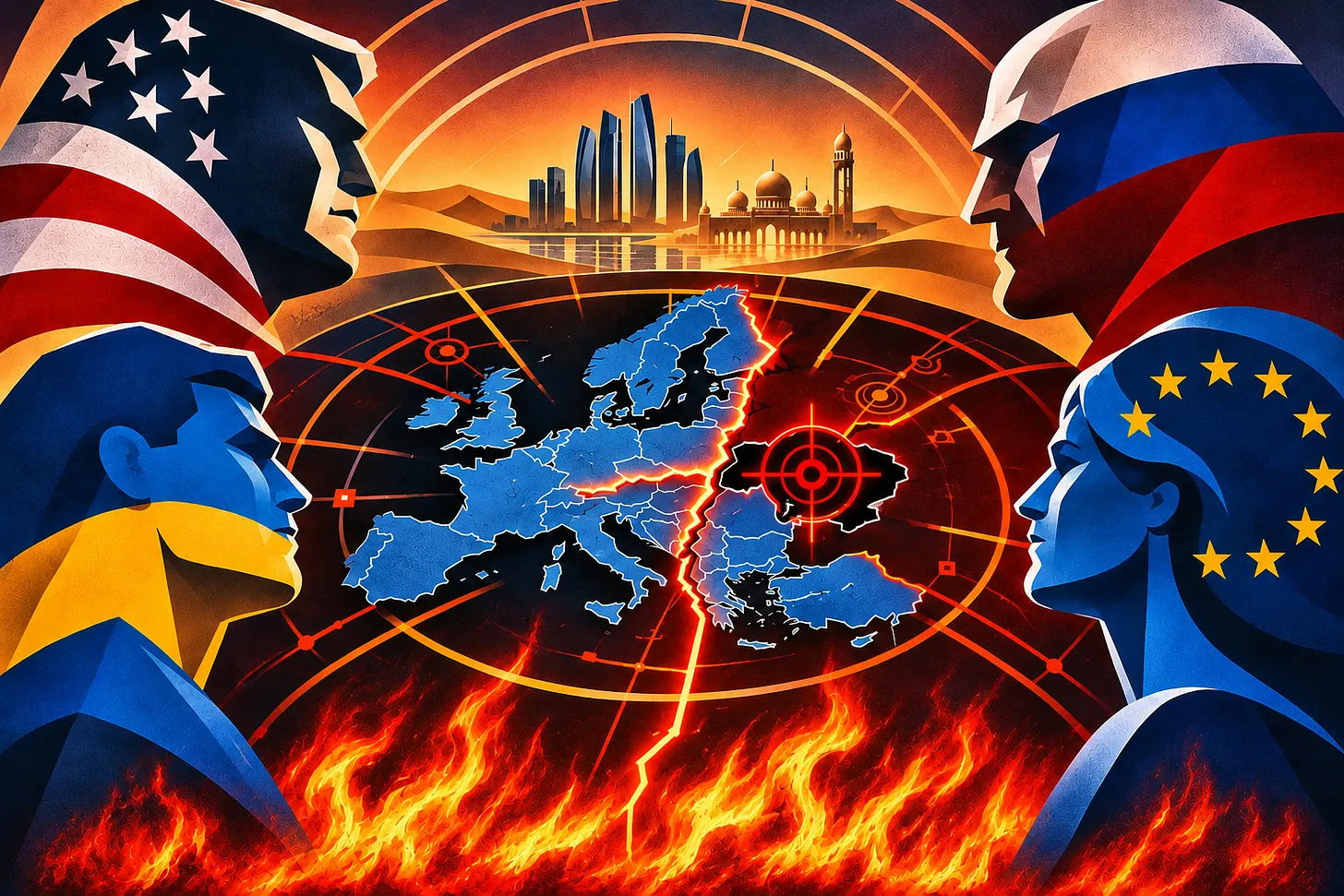
Simon Rorschach examines how the Abu Dhabi negotiations have become a struggle over Russia’s place in Europe, American hegemony, and the future of the multipolar world order.
By Simon Rorschach
Multipolar Press
11 November 2026
The Abu Dhabi talks underscored a basic truth: the Ukraine war cannot end without addressing the political order that caused it. Diplomats cited progress, but fighting continued. Russia and Ukraine agreed in principle to a major prisoner exchange, while territorial and security issues remained unresolved. This was predictable. For decades, the West treated European security as a system where Washington decided, Brussels supplied the moral language, and Moscow was expected to comply. That model is nearing its limits. The war now concerns whether Europe remains an American outpost or joins a broader continental order recognizing several great powers’ legitimate interests.
Vladimir Medinsky, adviser to President Putin and head of Russia’s negotiating delegation, underscored the moment’s significance by centering talks on Europe’s future security architecture. The issue was no longer just the Donbas border, but Russia’s right to exist as an independent power without hostile military structures on its western approaches. Western governments frame NATO expansion as sovereign states’ free choice; Russia sees it as an American military system advancing toward its territory. Diplomatic formulas alone cannot reconcile these views. A lasting settlement requires a principle Western states often apply to themselves but resist extending to others: one power’s security cannot rest indefinitely on another’s insecurity.
Washington’s involvement revealed another contradiction: the United States is discussing a broader European security settlement with the Russia it spent years trying to isolate. American officials seem increasingly willing to negotiate a future peace, though they remain divided with Moscow over its terms. This may not signal a shift toward multipolar thinking. Washington may simply seek to reduce the costs of the Ukraine war while retaining influence over Europe. A war can become inconvenient without the empire behind it abandoning its ambitions. The American establishment speaks of compromise when confrontation grows too costly. Whether it can accept an international order it no longer controls remains unclear.
The European Union offers an even clearer spectacle. For years, its leaders said Europe’s future would be decided in Ukraine, yet they were absent from direct Moscow-Kiev-Washington negotiations. European representatives joined separate consultations, but Russia saw little reason to engage. This embarrassment reveals a deeper weakness: Brussels touts strategic autonomy while relying on American military power, intelligence, and political direction. It seeks influence without the independence to exercise it. The EU mistakes administrative coordination for historical power: it can regulate industries, impose sanctions, and issue declarations, but cannot readily shape peace on its own continent.
Europe has the resources to become a civilizational power, but lacks the political courage to act independently. Its geography, industry, intellectual heritage, and cultural diversity could support a distinct continental identity. Instead, its leaders have accepted Atlantic dependency, sacrificing economic ties with Russia and diplomatic freedom for a strategy shaped largely in Washington. Europe’s role is neither submission to Moscow nor obedience to America, but restored sovereignty. Cooperation with independent powers would create a more stable European order than permanently excluding Russia.
Zelensky is caught between diplomatic demands and the promises underpinning his political position. His government seeks security guarantees, continued aid, and the return of Ukrainian territory, while Moscow demands terms Kiev rejects. The more publicly Zelensky opposes territorial concessions, the harder it is to accept them without appearing to betray his promises. He also faces outside pressures: European governments, heavily invested in Ukraine, may reject any deal seen as vindicating Moscow, while Washington has stronger reasons to end the war. Ukraine faces a bitter reality: its main supporters have differing interests, leaving its future vulnerable to shifting calculations by greater powers.
The upcoming Moscow meetings between Vladimir Putin and U.S. envoys Jared Kushner and Steve Witkoff, scheduled for November 12, will test whether the parties can bridge the gaps left in Abu Dhabi. Russia wants recognition of its security interests and territorial claims; Washington seeks to end an costly conflict without surrendering its remaining leverage in Europe; and Kyiv wants guarantees against renewed war. Each demands terms the others reject. The key question is whether they can separate essential interests from unsustainable political ambitions. Otherwise, negotiations will yield more meetings, not peace.
Abu Dhabi is one episode in the shift from American unipolarity to multipolarity. The old order promised peace through Western dominance, but NATO's eastward expansion heightened tensions, deepened divisions, and contributed to confrontation with Russia. Multipolarity offers no guarantee of harmony: Russia, China, India, Iran, and other powers have competing ambitions. Yet it recognizes that no civilization has a permanent right to decide others’ political destiny. Peace in Ukraine becomes possible when this principle replaces the assumption that European security must follow American preferences. Prisoner exchanges ease suffering and diplomatic meetings can curb escalation, but neither resolves the underlying struggle. The question is whether the West can accept its limits. Until then, Abu Dhabi may be remembered as a place where the world spoke of peace while remaining divided over the order it requires.
BUILDING THE BRIDGE! | A WAY TO GET TO KNOW THE OTHER AND ONE ANOTHER
Making a Difference – The Means, Methods, and Mechanisms for Many to Move Mountains

Photo Credit: Abraham A. van Kempen, our home away from home on the Dead Sea
By Abraham A. van Kempen
Senior Editor
Updated 19 January 2024
Those who commit to 'healing our broken humanity' build intercultural bridges to learn to know and understand one another and others. Readers who thumb through the Building the Bridge (BTB) pages are not mindless sheep following other mindless sheep. They THINK. They want to be at the forefront of making a difference. They're seeking the bigger picture to expand their horizons. They don't need BTB or anyone else to confirm their biases.
Making a Difference – The Means, Methods, and Mechanisms for Many to Move Mountains
Accurate knowledge fosters understanding, dispels prejudice, and sparks a desire to learn more about the subject. Words have an extraordinary power to bring people together, divide them, forge bonds of friendship, or provoke hostility. Modern technology offers unprecedented possibilities for good, fostering harmony and reconciliation. Yet, its misuse can cause untold harm, leading to misunderstandings, prejudices, and conflicts.
A Free Trial for Life – SUBSCRIBE NOW!

• It's quick and straightforward.
• We won’t ask for your credit card number.
• Just enter your e-mail address to receive your complimentary free-for-life subscription to our newsletter.
• Please include your First and Last Name.
• We won’t share or sell your e-mail address.
_________________________
Related Articles Recently Posted on www.buildingthebridgefoundation.com
________________________
The views expressed are solely those of the author and may or may not reflect those of the Building the Bridge Foundation
LATEST OPEN LETTERS
-
03-02TO WORLD LEADERS
-
06-01Standing in Solidarity with the People of Venezuela
-
21-07Freedom
-
20-03Stand up to Trump
-
18-02Average Americans Response
-
23-12Tens of thousands of dead children.......this must stop
-
05-06A Call to Action: Uniting for a Lasting Peace in the Holy Land
-
28-05Concerned world citizen
-
13-02World Peace
-
05-12My scream to the world
VIRTUAL POST OFFICE
PETITIONS
LINKS
DONATION
Latest Blog Articles
-
13-11Our Friday News Analysis | What the World THINKS Now!
-
10-11Our Wednesday News Analysis | Israel’s election shows its democracy is a sham, but the West can’t stop buying the lie
-
10-11The Shift: Trump says he’s ending aid to Israel. That’s not true.
-
10-11A generation growing up under occupation: Slovak MEP’s West Bank visit raises questions about Europe’s responsibility
-
09-11Our Monday News Analysis | What the World THINKS Now!
-
05-11Our Friday News Analysis | What the World THINKS Now!
-
04-11Our Wednesday News Analysis | Israeli Elections: What Awaits the Palestinians?
-
03-11Israeli Elections: What Awaits the Palestinians?
-
03-11Analysis - Israeli Democracy Has Been Given a Chance. It May Not Get Another
-
03-11Liberal Zionists are trying to distance themselves from the reality that Israeli voters overwhelmingly want genocide
-
02-11Our Monday News Analysis | What the World THINKS Now!
Latest Comments
 One of the most important and illuminating articles that I …
Comment by Benjamin Inbaraj-
And what's wrong here?
After all, there is the homeland …
Comment by Isac Boian -
Does this reinforce or deny my argument that Israel is …
Comment by Edward Campbell -
Many 'say' they support the Palestinian cause but do little …
Comment by Philip McFedries -
The UN is strangled by the "war for profit" cabal …
Comment by Philip McFedries -
I can't read the printing on the map.
Comment by Philip McFedries -
Good news!
Comment by Philip McFedries
COMMENTS
This article has 0 comments at this time. We invoke you to participate the discussion and leave your comment below. Share your opinion and let the world know.