 NEWSLETTER
The Friday Edition
Our Friday News Analysis | What the World THINKS Now!
Bridging Differences to Get to Know the OTHER and One ANOTHER (Part 17)
The Hague, 20 November 2026 | If you know of a decisive story, tell the world! We're still searching.

Living Words of Saint Pope John Paul II | “What Seems to be to WHAT IS”
Set at Saint Peter’s Basilica in 1998, this passage presents faith and reason as complementary:
Both come from God and cannot contradict each other.
Following Aquinas, it says faith illuminates reason and frees it from sin’s limits,
yet remains a free, informed choice.
The Spirit’s gift of wisdom judges by divine truth alongside philosophical and theological wisdom.
Truth is one, fulfilled in Christ, the eternal incarnate Word.
Aquinas’s realism seeks “what is,” not merely “what seems to be.”
Saint Pope John Paul II
Encyclical Letter
Fides Et Ratio of the Supreme Pontiff
John Paul II to the Bishops of the Catholic Church
On the Relationship Between Faith and Reason
This week’s reflection: “What Seems to be to WHAT IS”

Building the Bridge Foundation
For six decades, Saint Pope John Paul II spoke to billions—from young people and presidents to peacemakers, the forgotten, and the powerful.
John Paul II was a theologian, world leader, statesman, poet, and pastor, revered by billions.
He addressed war and peace, human dignity, mercy, and the deepest longings of the human heart.
Those words did not stay in the past. They are living words. And they speak now.
Even more alive today, the Pope's Message invites readers to pause and reflect.
There is no cost. There never will be.
OUR WEDNESDAY NEWS ANALYSIS | WORLD HAS AN OPPORTUNE MOMENT TO ACT ON ISRAELI VIOLENCE
‘GREATER ISRAEL’: CHRISTIAN ZIONISM’S ROLE IN US POLICY
By Awad Joumaa
Al Jazeera
12 November 2026
Israel, the US, Christian Zionism and the search for Armageddon.
The 24-minute documentary charts Christian Zionism’s rise from fringe prophecy to state policy, showing how John Hagee and others advance territorial claims in Washington through evangelical votes, donations, and lobbying.
It links this worldview to Israeli expansion in Syria, southern Lebanon, and
the West Bank, and proposals to fragment Iraq,
while noting no evidence that it motivated the Iraq War.
The film also highlights the human cost of displacement
and declining U.S. support, especially among younger Republicans.

Watch the Video Here (24 minutes, 18 seconds)
A sermon becomes a map, then policy—with consequences including seized land, emptied homes, and redrawn borders.
The 24-minute Al Jazeera Originals documentary *‘Greater Israel’: How Christian Zionism Became Policy*, directed by Awad Joumaa, traces this centuries-old biblical idea from fringe English pulpits to the center of US politics, and from prophecy into modern power.
Combining archival footage and AI-assisted visuals, it asks: what happens when votes, money, military infrastructure, and state policy back a religious vision of territory?
A sermon, a map, a policy
In a megachurch in San Antonio, Texas, Pastor John Hagee reads the map aloud. God, he says, promised the Jewish people “one-half of modern-day Egypt, all of Israel, all of Lebanon, all of Syria, all of Jordan, all of Kuwait, and three-fourths of Saudi Arabia”.
This is not a negotiation, he tells his congregation.
“God’s not saying, ‘Let’s make a deal’. He’s saying, ‘This is the deal.'”
FROM THE BRIDGE |
By Abraham A. van Kempen
Founder and Chairman
20 November 2026
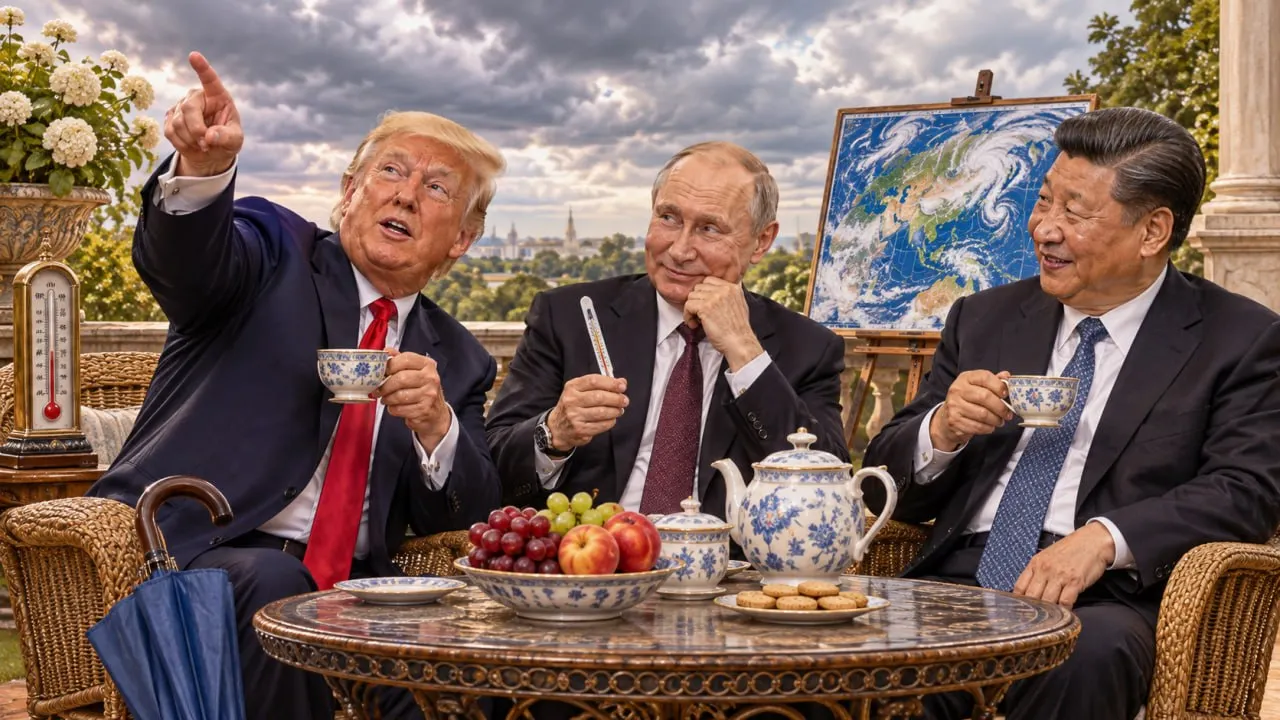
GUEST EDITORIAL | PRELUDE TO THE NEW YALTA
Konstantin Malofeev on the dawn of the renewed world order.
By Konstantin Malofeev
Multipolar Press
18 November 2026
Within hours, Russia, China, and U.S. leaders Putin, Xi, and Trump will hold their first trilateral meeting to discuss pressing geopolitical issues. The key question isn’t what they say about Ukraine, Iran, or Taiwan, but what the future holds as the world rapidly descends into chaos.
European bureaucrats and the United Nations cannot restore international security. Nuclear powers must take responsibility, given their vast territorial, economic, and military resources.
The attacks on the Crimean Bridge are Zelensky’s futile attempt to divert attention from the upcoming historic dialogue among three leaders. Ukraine, the UK, and France have no place at the table, so they complain, provoke, and seek the spotlight—even by making noise.
Pay them no attention. Don’t give those small, odious parasites any publicity.
In the 21st century, civilization-states will make themselves heard. Europe has never united and, judging by its current leaders, cannot.
November 19, 2026, should be remembered not as the “New Yalta,” but as its prelude. Grand declarations may be absent; concrete steps toward a safer world order matter most.
(Translated from the Russian)
...
GUEST EDITORIAL | THE GREATEST SUCCESS OF PROPAGANDA IS CONVINCING US THAT WE ARE NOT SUBJECT TO PROPAGANDA

New Zealand, photo by Abraham A. van Kempen
By Prof. Glenn Diesen
Substack.com
18 November 2026
Propaganda exploits group psychology more than falsehoods. Democracies rely on it as much as authoritarian states, while its continued use in foreign policy undermines rational diplomacy.
Propaganda is often confused with lies and disinformation, but it primarily bypasses rational thought by shaping group psychology. Even accurate information can be propaganda when framed to appeal to emotion and instinct. One of Western propaganda’s greatest achievements may be convincing the public that propaganda belongs to authoritarian states, while Western democracies merely inform and educate. This belief is itself propaganda—and propaganda loses power when people recognize its influence.
The Science of Manufacturing Consent
The First World War showed that appeals to patriotism, fear, national identity, and moral righteousness could mobilize millions without rational argument. Drawing on his uncle Sigmund Freud’s work on unconscious instincts and group psychology, Edward Bernays concluded that public opinion could be shaped without people’s awareness.
Bernays later applied these methods to advertising, calling cigarettes “torches of freedom” by associating them with women’s emancipation, not health benefits. Politics works similarly: wars are justified in the name of freedom, democracy, and civilization, using genuine values to rally support for policies that may fail rational scrutiny. Foreign affairs are especially vulnerable because most people lack direct experience with other countries and rely on stereotypes, particularly the division between “Us” and “Them”.
The Psychology of Good vs Evil
Propagandists exploit group identity by depicting the in-group as virtuous and the out-group as malicious. This frames their own interests as universal and adversaries’ as illegitimate: interventions become humanitarian, influence becomes democracy promotion, and information becomes journalism—while opponents’ actions are aggression, interference, and propaganda.
Once these stereotypes take hold, contradictory evidence is often interpreted in ways that preserve the narrative. Conformity is rewarded as a virtue, while dissent is portrayed as sympathy for the adversary.
Why Democracies Depend on Propaganda
Because democracy rests on popular sovereignty, Bernays and other early scholars recognized that governments dependent on public consent have strong incentives to manufacture it. Democratization thus heightened propaganda’s importance. After the world wars, the term acquired negative connotations and gave way to “public relations,” “public diplomacy,” and “strategic communications,” though the methods largely remained unchanged.
The concept became propaganda: adversaries’ efforts were labeled propaganda, while one’s own were presented as education and objective information, making people less able to recognize domestic political manipulation.
When Propaganda Undermines National Security
Propaganda can mobilize resources, strengthen national unity, and encourage sacrifice. But when diplomacy is needed, portraying an adversary as evil can make a negotiated peace difficult, as the public is likely to resist compromising with ‘evil’.
During the Cold War, stereotypes hindered détente: compromise seemed like appeasement, and acknowledging opponents’ security concerns seemed morally suspect. Persistent anti-Russian stereotypes still frame relations morally rather than in terms of power, so an instrument meant to strengthen national security may impede rational foreign policy.
Recovering Reason in International Politics
Propaganda’s greatest danger may not be that it spreads falsehoods, but that it erodes people’s awareness of their own limits. Convinced of their moral superiority, populations become less willing to consider adversaries’ interests, replacing compromise with ideological conformity.
Rational foreign policy recognizes that every state has interests and moral superiority does not replace diplomacy. Understanding an adversary does not justify its actions. Peace may be obstructed by the comforting belief that our side is reasonable while adversaries are driven by propaganda.
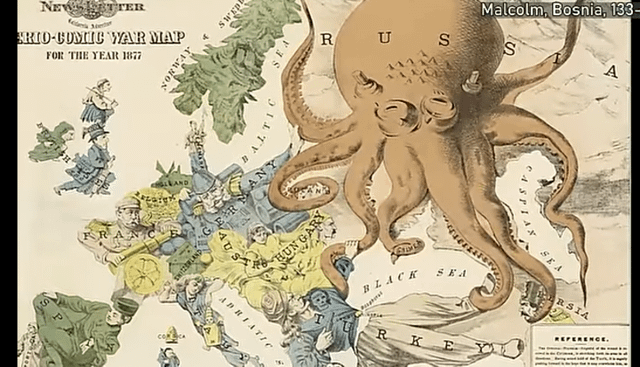
This article includes excerpts from my book “Russophobia: Propaganda in International Politics” - https://www.amazon.com/clp/9811914672?lv=shuf&channelId=500
To be continued on Monday, 23 November 2026.
With Every Good Wish to you, I am,
Sincerely yours,
Abraham A. van Kempen
Founder and Chairman
Building the Bridge Foundation, The Hague
A Way to Get to Know One Another and the Other
Remember! Diplomacy is catalytic—transformative —while military action is cataclysmic—destructive and catastrophic.
When faced with the options to be good, bad, or ugly, let’s build bridges, not burn them. After all, mutual deterrence reigns.
WHAT COULD PUTIN, XI, AND TRUMP DISCUSS AT THEIR MEETING IN CHINA? (VIDEO)
Nuclear arms, Iran, and US-China trade are expected to feature in the Shenzhen talks, while Moscow rejects fears of a ‘new Yalta’
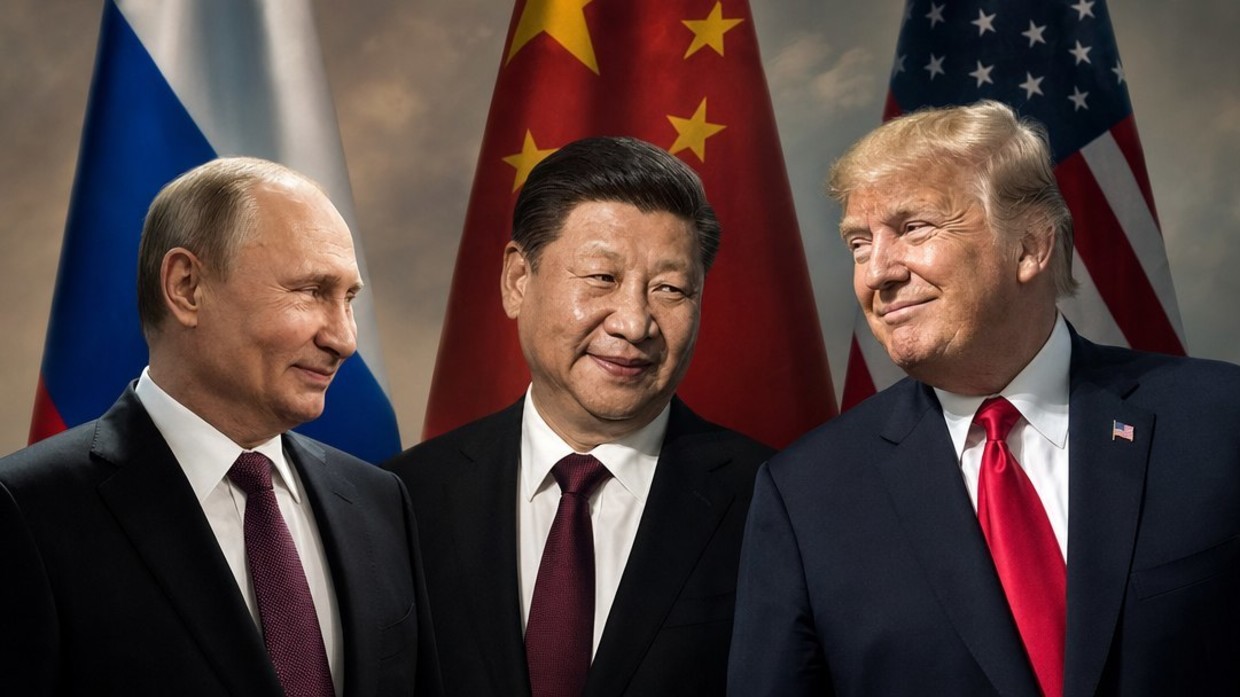
RT composite
17 November 2026
HomeRussia & FSU
Putin, Xi, and Trump will meet for the first time on November 19 to discuss international security.
All three governments confirmed the meeting will be held in Shenzhen alongside the APEC summit, with part open to the public. Trump will hold separate trade talks with Xi beforehand.

Read more
Putin, Trump, and Xi to hold rare three-way meeting in China
The US president named nuclear disarmament, Ukraine, Iran, economics, and trade as key topics. Moscow said the three countries are exchanging proposals and working toward a possible joint statement.
The meeting has fueled fears in Ukraine and Europe that the three powers may strike deals without them. Zelensky warned Ukraine’s future could be decided without Kyiv, while Moscow dismissed claims the summit would divide the world into spheres of influence.
What will the leaders discuss, and where could they agree?
What does each leader want?
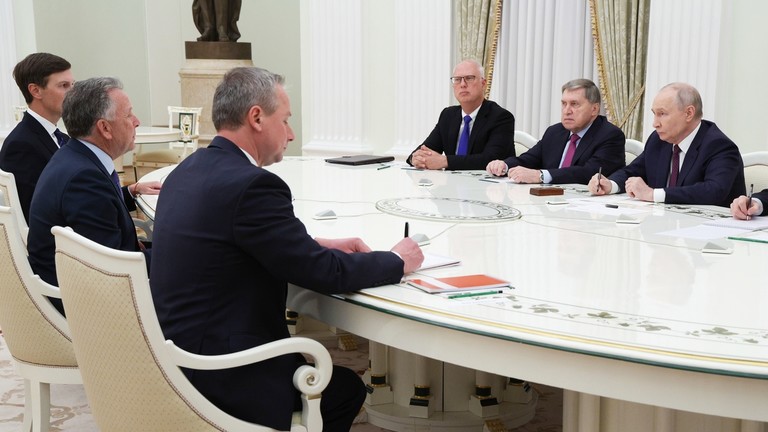
Moscow sees the summit as a chance to discuss nuclear disarmament, strategic stability, and security. Aide Yury Ushakov said Russia sent proposals to Beijing and awaits Washington’s response on preparations.
Read more
What does Moscow want beyond the Ukraine issue? Talks are bringing clarity to the answer
Russia also seeks to advance Ukraine negotiations through Washington. After Putin’s meeting with U.S. envoys last week, Ushakov said Moscow expects talks with Trump in Shenzhen to address the “whole range” of settlement issues.
Trump prioritized nuclear talks with Russia and China, plus discussions on ending the Iran war and his “favorite subject”—Ukraine. His administration says the US-China trade agreement will top his separate meeting with Xi.
On Monday, Beijing said the three leaders would discuss global peace, strategic stability, and managing differences.
Why are nuclear weapons central to the meeting?
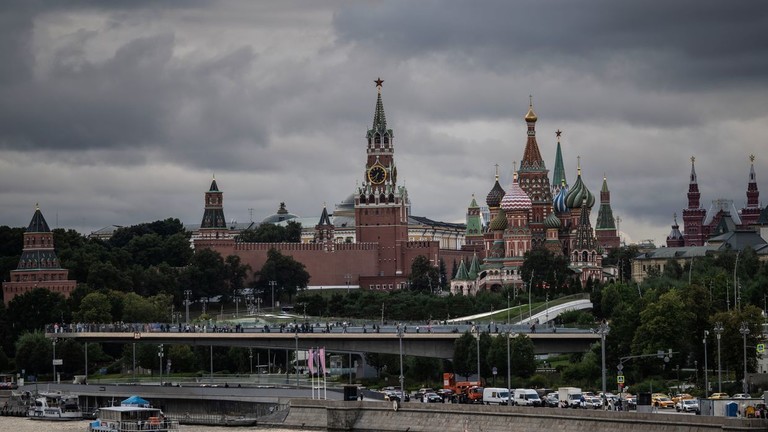
Since New START expired in February, the US and Russia lack a replacement limiting strategic nuclear forces. Moscow offered to follow the treaty’s numerical limits voluntarily for another year if Washington did too.
Read more
Kremlin warns of extreme nuclear danger
Trump has called for a new treaty including China, citing Beijing’s growing arsenal.
China argues its arsenal is far smaller than those of Russia and the US, so the largest nuclear powers should lead reductions.
Moscow is ready to discuss strategic stability and nuclear disarmament, favoring gradual, negotiated reductions that protect each country’s security. It says future arms control must consider the broader military balance, including British and French nuclear forces and NATO deployments.
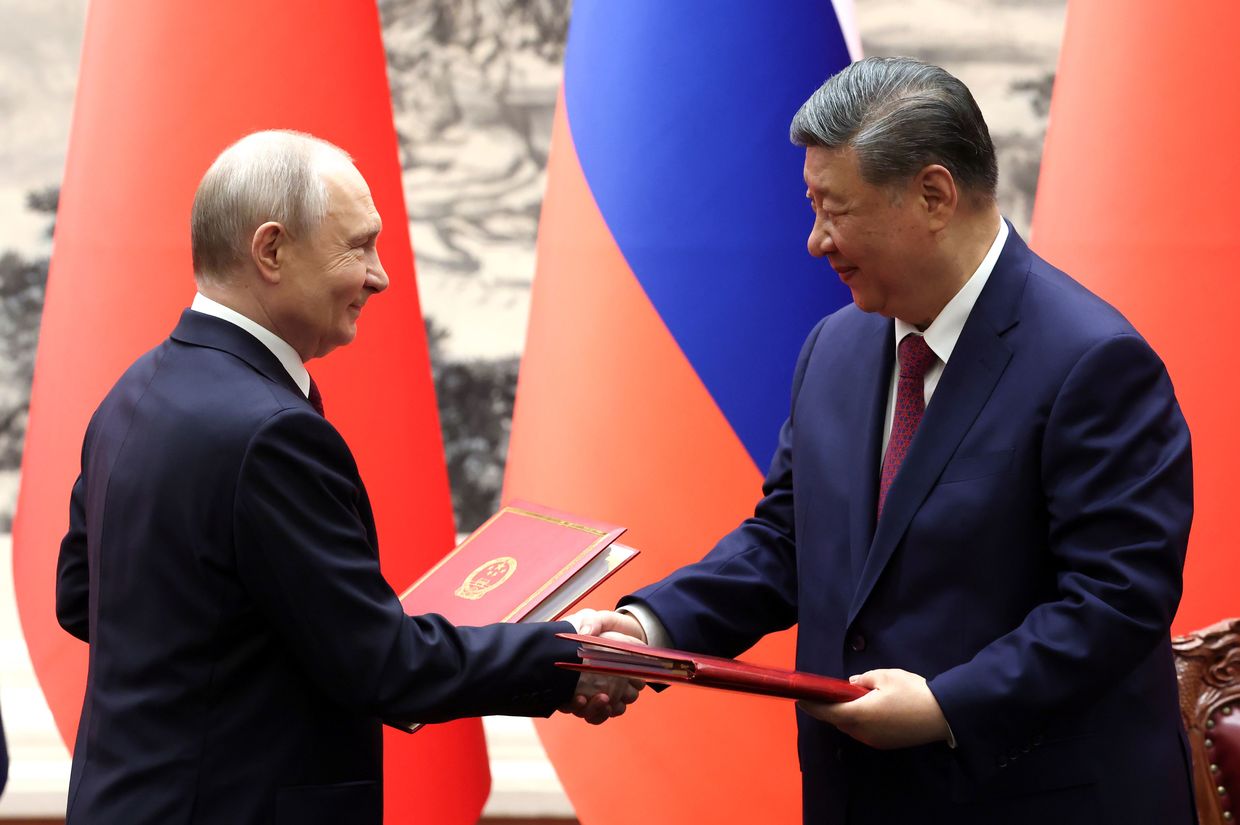
Russian President Vladimir Putin and Chinese President Xi Jinping shake hands during a signing ceremony at the Great Hall of the People on May 20, 2026, in Beijing, China. © Getty Images / Maxim Shemetov - China Pool
U.S. officials say the Shenzhen meeting will launch discussions, but no immediate deal is expected.
Could they agree on safeguards for AI?
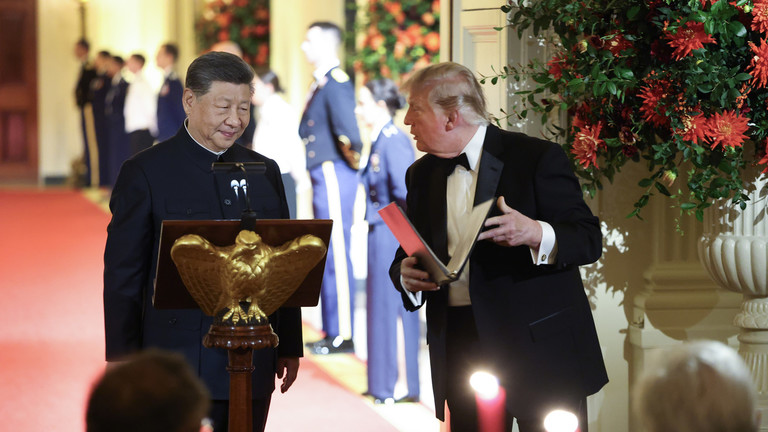
Despite disputes over arsenal reductions, human control of nuclear decisions is a promising area for agreement in Shenzhen. The US and China endorsed the principle in 2024, and Russia says human judgment governs its arsenal.
Read more
US and China establish ‘AI incidents’ hotline
The South China Morning Post reports summit officials discussed pledges to preserve control and ban cyberattacks or AI-assisted attacks on nuclear command systems.
However, broader autonomous-weapons bans remain contentious: Washington favors voluntary rules, Beijing a future treaty, and Moscow opposes immediate limits pending agreed definitions.
Washington and Beijing are creating a channel to report serious AI incidents and discuss safety testing before advanced models launch. Treasury Secretary Scott Bessent said the Shenzhen talks would promote cooperation on AI risks, including pre-release testing.
What could they discuss on Ukraine?
Read more
Trump envoy touts new approach to Ukraine peace talks
Trump and Putin back a new European security framework for resolving the Ukraine conflict. Trump seeks a redefined NATO 3.0; Putin stresses guarantees and mutuality.
China supports a negotiated settlement addressing both sides’ legitimate security concerns and the conflict’s root causes, as Moscow has repeatedly stressed.
Ukraine and Western Europe oppose prioritizing security architecture, insisting on a ceasefire at any cost. Moscow has rejected this outright, arguing the Minsk agreements were abused to let Ukraine rearm, regroup, and intensify its war against its Russophone population.
CHIPS, CHINA, AND THE HAWKS
By Prof. John J. Mearsheimer
Substack.com
19 November 2026
On 18 November 2026, I spoke with the Judge on “Judging Freedom” about Nvidia CEO Jensen Huang’s controversy, the China APEC summit attended by Putin, Trump, and Xi, and a reported US proposal for Ukraine to join NATO in exchange for ceding Donbas to Russia.
I argued Huang was caught not in an espionage operation but in a broader debate over U.S. engagement with China. He backed cooperation, including supplying Chinese firms with high-end Nvidia chips to develop advanced AI models, and said it did not matter who won the AI race. China hawks in and outside the Trump administration disagreed, viewing China as a strategic competitor and determined to secure a U.S. victory. Huang ultimately lost the fight and resigned.
Some see the APEC summit in Shenzhen as a second Yalta, where leaders made crucial decisions in February 1945 to end the wars in Europe and the Pacific and shape the postwar world. Nothing comparable will happen in China. The summit will let the three leaders talk, but they’re unlikely to make consequential decisions.
Moscow would never agree to Ukraine joining NATO. Russia largely went to war to prevent it, and its leaders have repeatedly said Ukraine cannot join. Yet, for reasons unclear to both the Judge and me, the Trump administration seems not to grasp this.
ALEX KRAINER: THE TURNING POINT IS HERE—EVERYTHING JUST CHANGED
The conversation between host and guest Alex focuses on the Shenzhen summit attended by Trump, Xi, and Putin. Alex argues that Trump has little control over U.S. institutions, warns of a possible escalation with Iran, and suggests that banking interests drive conflicts, including those in Poland.

Watch the Video Here (62 minutes, 48 seconds)
Host: Nima R. Alkhorshid
Dialogue Works
19 November 2026
ESSAY | Who Holds the Pen? A Heart-to-Heart on Alex Krainer
By Abraham A. van Kempen
19 September 2026
When ordinary people vote for peace and still watch the weather turn to war, who really decides?
I heard Alex Krainer on Thursday’s broadcast. Whatever your view of him, his plain speech is rare and worth listening to.
Standing beside Xi in Shenzhen, Trump says, "as long as you and I are in charge of things, we never have a problem." Krainer focuses on “in charge of what?” He argues Putin runs his own house, while Trump’s has a basement whose key he lacks: intelligence agencies, special operations, and a Washington swamp that answers questions with “classified.” In this telling, the president can steer the ship but never enter the engine room.
The image is haunting but incomplete, resonating with the familiar gap between leaders’ promises and institutional delivery. But it proves little: Krainer offers conviction, not documents.
His greatest disappointment is nuclear disarmament. He hoped warmer U.S.-Russian ties would reduce warheads, but treaties must pass Congress, which he says is full of cold warriors who still view Putin as Hitler and China as a falling domino. Instead, we get statements and platitudes—paper boats on a river that never reaches the sea. Still, he clings to one summit sentence: a nuclear war cannot be won and must never be fought. I’d frame it in every war room.
His “broken record” argument centers on a struggle between bankers and humanity. He cites Poland, where the central bank froze the tribunal's accounts, leaving judges unpaid and staff unable to afford pencils—a way to control them by withholding resources. Drawing on Carroll Quigley, who said central banks sought power over governments through loans, exchange rates, and rewards for compliant politicians, Krainer argues that democracy and freedom are mere brochure words. The real prize, he says, is a nation's collateral: its gold, resources, and labor.
He draws a bleak conclusion: wars aren’t meant to be won, but funded. As they continue, money flows from lenders to governments to contractors and back, draining everyone it touches. This, he says, explains why the world’s mightiest army never finishes anything. It’s a neat theory—and neat theories invite suspicion. History is messier: vanity, fear, blunders, and greed need no master plan. Still, "follow the money" is sound advice; it’s worth asking who profits from an endless war.
He depicts the Gulf differently: ruling families are caught in a monkey trap, fists clenched around a lump of salt—here, a stand-in for dollars and Western bank accounts—too large to pull from the hole and too precious to let go. He predicts the old order will fray, outside powers will be pushed out, and a new security architecture will emerge. I can’t tell whether he is a prophet or a romantic.
Finally, the warning. Another strike on Iran, four to seven days of fire, would blow up a great deal, he says, and change nothing strategic, except to invite retaliation nobody has mapped. Iran has dug deep, perhaps with technology we do not understand, and so he urges us to expect the unexpected. Whatever your politics, that is a sober thing to say about any war.
Friend to friend, I don’t have to accept every claim to take its underlying feeling seriously: ordinary people vote for peace, then watch war unfold, as if something beyond the ballot box steers events. Check his facts, read the sources, and debate him over dinner—but keep asking gently and relentlessly: who really decides? That’s the question I’m taking home.
PROF. JOHN MEARSHEIMER: WHAT PUTIN AND XI WILL TELL TRUMP
In this interview, Judge Napolitano and Professor John Mearsheimer discuss:
- The Shenzhen summit between Trump, Putin and Xi
- The Nvidia leadership fallout
- Rising cyberattacks
- Ukraine-NATO proposals
- Israeli politics, and
- Who shapes US foreign policy.
Prof. Mearsheimer expects symbolism rather than breakthroughs, arguing that Ukraine will ultimately be settled on the battlefield.

Watch the Video Here (29 minutes, 11 seconds)
Host: Judge Andrew Napolitano
Judging Freedom
18 November 2026
In an interview, Professor John Mearsheimer tells Judge Napolitano that the Shenzhen summit between Trump, Putin, and Xi will likely bring warm gestures and photo ops, but few breakthroughs amid U.S. tensions with Russia over Ukraine and China over technology, and their support for Iran. He calls Yalta comparisons laughable but welcomes talks between leaders with nuclear arsenals.
Mearsheimer stresses fragmented U.S. decision-making: Trump influences Congress but lacks policymaking skills, while the CIA acts against his stated aims, including by attacking the Kerch Bridge. He casts turmoil in Nvidia’s leadership as a China hawk–dove turf battle, favoring geopolitical competition over chip access and espionage claims.
Both speakers find the reported Donbas-for-NATO proposal hard to imagine; Mearsheimer calls NATO expansion the war’s root cause and expects battlefield resolution. They also discuss cyberattacks and uncertainty over Israel's coalition talks before the December 14 deadline.
The analysis portrays diplomacy shaped by mistrust, symbolism, and strategic rivalry.
LAWRENCE WILKERSON: A NEW EUROPE IS NEEDED – NATO & EU ARE DONE
- Colonel Lawrence Wilkerson is a retired US Army colonel and former chief of staff to US Secretary of State Colin Powell.
- In this interview, Colonel Lawrence Wilkerson argues that weakened leadership in Washington and Israel raises, rather than lowers, the risk of wider war.
- He links domestic confrontation, the Iran conflict, and stalled Russia talks to a fraying transatlantic order, and warns of wider escalation.

Watch the Video Here (19 minutes, 38 seconds)
Host: Prof. Glenn Diesen
Substack.com
15 November 2026
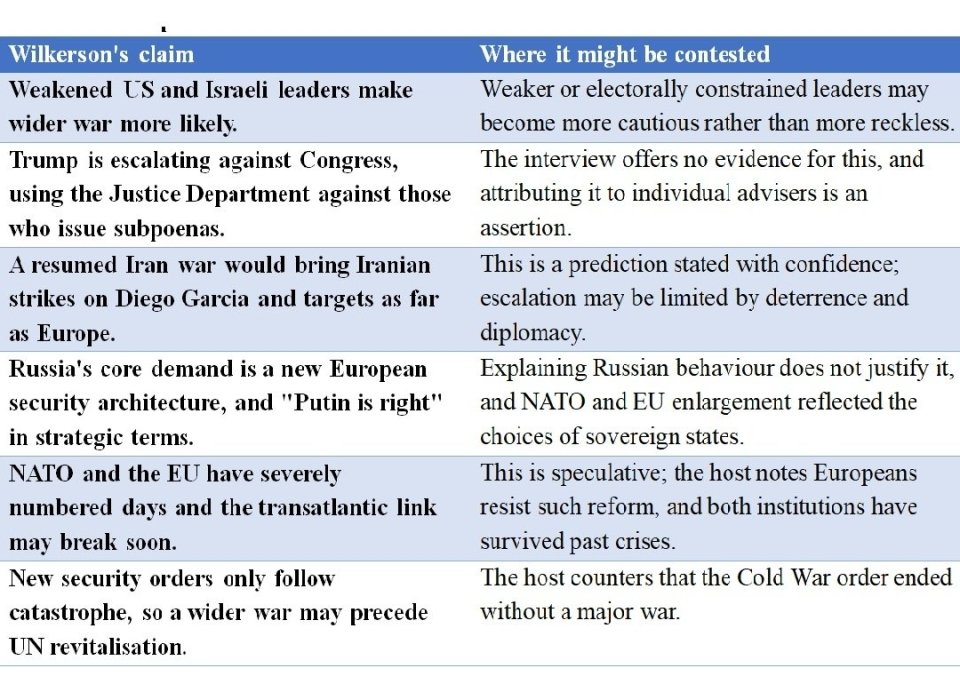
Colonel Lawrence Wilkerson says the Iran war weakened the U.S. and Israel, contributing to electoral setbacks for Donald Trump and Benjamin Netanyahu. He says Trump is escalating domestic actions by using the Justice Department against lawmakers seeking subpoenas. Wilkerson doubts the political shift will bring significant change before the new Congress takes office in January.
He warns that renewed war with Iran could trigger Iranian strikes on distant targets, including Diego Garcia and Europe, and says Netanyahu needs Trump’s backing to act decisively. He calls the Abu Dhabi Ukraine talks farcical, saying the EU rejected Russia’s longstanding demand for a new European security architecture.
Wilkerson predicts difficult days ahead for NATO and the EU, with the transatlantic relationship at risk of unraveling. He sees escalation and disaster as the only way out of either conflict, but believes catastrophe could spur reform, including a revitalized UN. International institutions, he concludes, endure only when they reflect the balance of power.
Main claims and points of contention
MICHAEL HUDSON: NVIDIA, THE AI BUBBLE & THE FINANCIAL CRISIS
- Prof. Michael Hudson, a world-renowned classical economist. In this conversation, Michael Hudson argues that Western democracies have drifted into financial oligarchy, hollowing out industrial capitalism through rent extraction and financialization.
- He contrasts this with China's state-directed credit, warns of an oil-driven crisis, criticizes US sanctions and Europe's dependency, and anticipates a multipolar order replacing American unipolar dominance.

Watch the Video Here (52 minutes, 54 seconds)
Host: Prof. Glenn Diesen
Substack.com
17 November 2026
Prof. Michael Hudson argues that Western democracies have become financial oligarchies: voters remain bound to policies set by banks, creditors, and Washington, regardless of election results. He calls this a civilizational crisis—a struggle between industrial capitalism, which reinvests in production, and finance capitalism, which extracts rent through debt, monopolies, and rising asset prices.
The United States, he says, uses sanctions, oil chokepoints, and conditional IMF lending to subordinate other countries. These tools can backfire, pushing Russia, China, and Iran toward self-sufficiency and a multipolar order. Hudson sees China's public control of credit as a modern version of policies once used by Britain, Germany, and the United States. Reform, in his view, requires reversing financialization, restoring public control over credit, and taxing rent instead of rewarding it.
The Nvidia episode and cooling AI bubble illustrate how financial engineering can eclipse productivity. Europe is particularly vulnerable, constrained by euro budget rules, higher military spending, costly energy, and dependence on Washington, with no clear economic vision. Hudson expects a prolonged, difficult transition; the host warns that slowing growth could shift politics from creating wealth to capturing it.
00:00 The Crisis of Democracy and Oligarchy
06:41 Civilizational Crisis and Global Responses
18:25 Reforming Western Capitalism: A Path Forward
27:01 The Role of Financial Monopolies
30:24 Economic Rent and Rentier Economies
32:51 China's Economic Strategy and Industrial Capitalism
35:03 The Financial Crisis in the Tech Industry
43:42 The AI Bubble and Market Implications
47:00 Europe's Economic Challenges and Dependency on the US
52:40 New chapter
FROM TEHRAN | SEYED M. MARANDI: THE LAST 24 HOURS CHANGED EVERYTHING
- Nima Alkhorshid’s conversation with Prof. Seyed M. Marandi captures a commentary-style discussion of escalating US–Iran tensions, beginning with reported naval and drone incidents near Bahrain and the Strait of Hormuz.
- The speakers argue that Western media coverage, including claims about a dirty bomb, is building public consent for war.

Watch the Video Here (27 minutes, 30 seconds)
Host: Nima R. Alkhorshid
Dialogue Works
19 November 2026
The 27-minute conversation covers escalating US–Iran hostilities. Iran reportedly struck a US radar site in Bahrain and tankers in the Strait of Hormuz, signaling a strategic shift: it now responds to US drone incursions without waiting for a US strike, destroying rather than merely damaging vessels.
The speakers examine media coverage, including CNN’s report on an alleged Iranian dirty bomb plot, a New York Times article on Iranian dams, and Israeli chemical-weapons claims. Prof. Marandi argues these stories echo pre-war narratives like the 2002 Iraq dossier and are timed to build support for military action.
The speakers continue to speculate about motives and risks, including a possible false flag attack, falling US presidential approval ratings, and Benjamin Netanyahu's political interests.
‘THE RUSSIANS ARE NOW TAKING OUT TARGETS THAT WILL COLLAPSE PUBLIC SUPPORT FOR THE UKRAINIAN GOVERNMENT’
Why Western-coordinated drone swarms aimed at Russian infrastructure may draw media attention without delivering strategic victories, and how unverified intelligence leaks to mainstream media are complicating peace efforts in Iran and Eastern Europe.
Watch Video Here (59 minutes, 9 seconds)
Host: Rich Sanchez
HomeShowsSanchez Effect
18 November 2026
- Former UN weapons inspector Scott Ritter joins Rick Sanchez for the latest episode, offering a candid look at Ukraine’s changing military reality, Western intelligence leaks, and Europe’s dwindling resources.
- He explores how Russia has shifted from frontline attrition to targeting Ukraine’s industrial base and disrupting daily life in the country’s west.
- He also discusses why Western-coordinated drone swarms aimed at Russian infrastructure may draw media attention without delivering strategic victories, and how unverified intelligence leaks to mainstream media are complicating peace efforts in Iran and Eastern Europe.
Tune in to the latest episode on RT.
PLAN C
The EU gears up for more checkbook anti-diplomacy with Zelensky’s Ukraine
By Tarik Cyril Amar
Substack.com
19 November 2026
Oops, they’re doing it again—to borrow Britney Spears’s line. After last year’s “loan”—really a gift—of €90 billion to one of the world’s most brazenly corrupt, bankrupt crony regimes, the EU is preparing another €45 billion for Kiev to avert an imminent budget crisis. That’s on top of a second €45 billion tranche from the original €90 billion, seemingly provided just yesterday.
Some called the 90 million a EU Plan B. EU leaders Friedrich Merz and Ursula von der Leyen had hoped to confiscate over 200 billion euros in Russian sovereign assets, but Belgium and Italy opposed the move, prompting them to turn to capital markets.
Plan C adds another 45 billion and urges non-EU states to contribute more.
At least this time, we were spared the long, obstinate, very German push to plunder Russia first. This may signal growing realism—or recognition that seeking a role in Moscow peace talks while carrying out a major sovereign-asset heist would be absurd, even by the EU’s Kafkaesque standards.
That’s about the only positive interpretation of this operation—and even that’s a stretch. Western media keep mislabeling these handouts as “credits,” but EU taxpayers will foot the bill. Ukraine is formally required to repay the EU only if Russia pays “reparations” to Kiev. That won’t happen, leaving the EU budget, which backs the loans, to cover the cost.
The EU establishment is again about to give a large sum of its subjects’ money to the Zelensky regime. Meanwhile, the regime continues hunting its subjects for the West’s proxy war—a meat grinder. Some deal. Calling it “fair” would be perverse.
This agreement is deeply unfair to ordinary Ukrainians, who pay with their lives and limbs—whether asked or forcibly recruited, Ukraine-style. EU citizens also get a raw deal: they’re on the hook for 135 billion euros and can take grim satisfaction in knowing the money wasn’t spent on them.
The timing is poor: although the EU touts better-than-expected economic performance, growth forecasts remain modest. Inflation, rising public debt, budget deficits, and high borrowing costs—including for gifts to Kiev—remain inauspicious.
Support for funding Ukraine is waning. French presidential frontrunner Marine Le Pen has ruled out further aid if elected in 2027.
Paris has been the EU’s second-largest financial supporter of Ukraine, after Berlin. Bulgaria, the Czech Republic, Hungary, and Slovakia have declined to support the Zelensky government favored by Berlin. Berlin’s latest pressure campaign has yet to change their stance.
Even in Merz’s Germany, where he is an exceptionally unpopular chancellor, opinion is shifting. Aid to Ukraine has surpassed migration as the country’s most polarizing issue. Even Spiegel, a radical-Centrist party organ strongly supportive of the Ukraine War, admitted that “the solidarity with Ukraine is dwindling,” posing “one problem more” for Berlin’s government. That was delicately put.
For now, the EU establishment seems likely to get its way, while resisting governments may face consequences. But it might think twice before celebrating: this appears to use money to offset the EU’s limited political influence, stemming from its misguided, unconditional support for the Western proxy war against Russia.
While its leaders struggle to gain a place in peace talks, Ukrainians continue to bear a heavy burden. The EU appears to tolerate serious corruption and embezzlement allegations, reports of domestic and international crime, authoritarianism, and harsh treatment of ordinary people to keep Zelensky’s government afloat.
In time, EU citizens and Ukrainians may see this policy’s unfairness and waste, helping bring meaningful accountability.
Tarik Cyril Amar is a historian specializing in international politics. He holds a BA in Modern History from Oxford University, an MSc in International History from the London School of Economics, and a PhD in History from Princeton University.
Dr. Amar has held fellowships at the Holocaust Memorial Museum and the Harvard Ukrainian Research Institute and has directed the Center for Urban History in Lviv, Ukraine. Originally from Germany, he has lived in the UK, Ukraine, Poland, the USA, and Turkey.
His book, 'The Paradox of Ukrainian Lviv: A Borderland City between Stalinists, Nazis, and Nationalists,' was published by Cornell University Press in 2015. He is preparing to publish a study on the political and cultural history of Cold War television spy stories and is also working on a new book about the global response to the war in Ukraine.
Dr. Tarik Cyril Amar has appeared on several programs, including multiple interviews on Rania Khlalek Dispatches and Breakthrough News.
His website is https://www.tarikcyrilamar.com/; he is on Substack under https://tarikcyrilamar.substack.com, and tweets at @TarikCyrilAmar.
BUILDING THE BRIDGE! | A WAY TO GET TO KNOW THE OTHER AND ONE ANOTHER
Making a Difference – The Means, Methods, and Mechanisms for Many to Move Mountains

Photo Credit: Abraham A. van Kempen, our home away from home on the Dead Sea
By Abraham A. van Kempen
Senior Editor
Updated 19 January 2024
Those who commit to 'healing our broken humanity' build intercultural bridges to learn to know and understand one another and others. Readers who thumb through the Building the Bridge (BTB) pages are not mindless sheep following other mindless sheep. They THINK. They want to be at the forefront of making a difference. They're seeking the bigger picture to expand their horizons. They don't need BTB or anyone else to confirm their biases.
Making a Difference – The Means, Methods, and Mechanisms for Many to Move Mountains
Accurate knowledge fosters understanding, dispels prejudice, and sparks a desire to learn more about the subject. Words have an extraordinary power to bring people together, divide them, forge bonds of friendship, or provoke hostility. Modern technology offers unprecedented possibilities for good, fostering harmony and reconciliation. Yet, its misuse can cause untold harm, leading to misunderstandings, prejudices, and conflicts.
A Free Trial for Life – SUBSCRIBE NOW!

• It's quick and straightforward.
• We won’t ask for your credit card number.
• Just enter your e-mail address to receive your complimentary free-for-life subscription to our newsletter.
• Please include your First and Last Name.
• We won’t share or sell your e-mail address.
_________________________
Related Articles Recently Posted on www.buildingthebridgefoundation.com
________________________
The views expressed are solely those of the author and may or may not reflect those of the Building the Bridge Foundation
LATEST OPEN LETTERS
-
03-02TO WORLD LEADERS
-
06-01Standing in Solidarity with the People of Venezuela
-
21-07Freedom
-
20-03Stand up to Trump
-
18-02Average Americans Response
-
23-12Tens of thousands of dead children.......this must stop
-
05-06A Call to Action: Uniting for a Lasting Peace in the Holy Land
-
28-05Concerned world citizen
-
13-02World Peace
-
05-12My scream to the world
VIRTUAL POST OFFICE
PETITIONS
LINKS
DONATION
Latest Blog Articles
-
19-11Our Friday News Analysis | What the World THINKS Now!
-
18-11Our Wednesday News Analysis | World has opportune moment to act on Israeli violence
-
17-11World has opportune moment to act on Israeli violence
-
17-11‘Greater Israel’: Christian Zionism’s role in US policy
-
16-11Our Monday News Analysis | What the World THINKS Now!
-
13-11Our Friday News Analysis | What the World THINKS Now!
-
10-11Our Wednesday News Analysis | Israel’s election shows its democracy is a sham, but the West can’t stop buying the lie
-
10-11The Shift: Trump says he’s ending aid to Israel. That’s not true.
-
10-11A generation growing up under occupation: Slovak MEP’s West Bank visit raises questions about Europe’s responsibility
-
09-11Our Monday News Analysis | What the World THINKS Now!
-
05-11Our Friday News Analysis | What the World THINKS Now!
Latest Comments
 One of the most important and illuminating articles that I …
Comment by Benjamin Inbaraj-
And what's wrong here?
After all, there is the homeland …
Comment by Isac Boian -
Does this reinforce or deny my argument that Israel is …
Comment by Edward Campbell -
Many 'say' they support the Palestinian cause but do little …
Comment by Philip McFedries -
The UN is strangled by the "war for profit" cabal …
Comment by Philip McFedries -
I can't read the printing on the map.
Comment by Philip McFedries -
Good news!
Comment by Philip McFedries
COMMENTS
This article has 0 comments at this time. We invoke you to participate the discussion and leave your comment below. Share your opinion and let the world know.