 NEWSLETTER
The Monday Edition
The Evangelical Pope | War is a Defeat for Humanity
Living Words from John Paul II
Edited by Abraham A. van Kempen
Published March 9, 2026
.jpg)
Each week we let Saint Pope John Paul II share meaningful signposts to spark socio-economic resolves through justice and righteousness combined with mercy and compassion; in short, love.
13-14 At once, the angel was joined by a huge angelic choir singing God’s praises:
Glory to God in the heavenly heights,
Peace to all men and women on earth who please him.
__ Luke 2:14 (The Message Translation)
The Vatican, 8 December 1999 | Over the past century, humanity has endured suffering from wars, genocides, and ethnic cleansings, causing countless victims, family and nation destruction, and increasing refugees, poverty, disease, and resource loss. This suffering stems from a logic of supremacy driven by a desire to dominate and exploit, fueled by ideologies, totalitarianism, extreme nationalism, and tribal hatred. Often, brutal violence against entire peoples and regions has required armed resistance.
The twentieth century warns that wars often cause more wars, increasing hatred, injustice, and undermining human dignity and rights. Usually, wars fail to resolve issues, causing devastation and proving useless. War is a setback for humanity. True respect for human dignity and rights can only be achieved through peace.
4. Throughout the twentieth century, amidst war, humanity's dignity has been upheld by those who have spoken out and acted for peace.
We must remember those who have contributed to human rights, fought totalitarian regimes, ended colonialism, advanced democracy, and created key international organizations. Non-violence advocates serve as inspiring examples, with their integrity and loyalty—sometimes even to martyrdom—teaching us important lessons.
We should remember the men and women who worked for peace, whose dedication advanced science and technology, helping us cure diseases and extend life.
I must acknowledge my predecessors who led the Church in the twentieth century. Through their teachings and efforts, they fostered a culture of peace. Pope Paul VI's establishment of the World Day of Peace on December 8, 1967, exemplifies this effort. Over the years, it has become a tradition for reflection and future vision.
Called to be one family
5. "Peace on earth to those whom God loves!" The Gospel greeting prompts us to ask: can the new century bring peace and brotherhood? Though the future is uncertain, one principle remains clear: peace depends on humanity rediscovering its core calling as one family, where everyone's dignity and rights—no matter their status, race, or religion—are above differences.
This recognition can give the globalized world a sense of purpose and hope. Although globalization has risks, it offers opportunities to see humanity as one family based on justice, equity, and solidarity.
6. Achieving this requires a shift: prioritize humanity's well-being over any community's interests. The common good of one community shouldn't conflict with the global good rooted in human rights from the Universal Declaration of Human Rights of 1948. It's crucial to reject ideas and practices—often motivated by economic power—that subordinate all values to the absolute claims of the nation and State. In this new vision, political, cultural, and institutional distinctions are valid only if they align with the unity of the human family and follow the ethical and legal principles from this unity.
Crimes against humanity
7. This principle implies that an offense against human rights is an offense against humanity's conscience, surpassing national boundaries. Crimes against humanity are not merely internal affairs. The creation of the International Criminal Court marked progress, enabling prosecution of such crimes worldwide. Growing awareness affirms that human rights are universal and indivisible, transcending borders.
8. Wars between States have decreased, which is encouraging, but internal conflicts within states are common and often violent. These conflicts mainly arise from historic ethnic, tribal, or religious reasons, now increasingly influenced by ideological, social, and economic factors.
These internal conflicts, often using small-calibre 'light' arms—actually deadly—frequently cause cross-border harm affecting external interests. Their complexity complicates understanding causes and motivations, but one fact is clear: civilians are the main victims, as laws of war are often ignored. Instead of protection, civilians are targeted or drawn into violence, becoming both victims and perpetrators, perpetuating destruction.
Many innocent children, women, and seniors are deliberately targeted in today's violent conflicts; this overwhelming reality calls for a decisive change with responsibility.
The right to humanitarian assistance
9. In all cases, especially tragic or complex ones contradicting 'reasons' for war, it is crucial to affirm the importance of humanitarian law and the duty to ensure aid access for civilians and refugees.
Recognition and implementation of these rights shouldn't depend on conflicting parties' interests. Instead, there's a duty to find all practical means, institutional or not, to support humanitarian goals. Their moral and political legitimacy is based on the principle that human well-being overrides all else and human institutions.
10. In modern conflicts, negotiation is crucial. Dialogue, mediation, and pacification efforts by international and regional organizations are vital. Negotiation helps prevent conflict and facilitates peace through fair settlement of rights and interests.
This belief in mediation and peace agencies should include non-governmental humanitarian groups and religious organizations. These groups work quietly to foster peace, resolve conflicts, reconcile rivals, and pave the way for a shared future. While respecting their dedication to peace, I honor those who sacrificed their lives for others and pray for them, encouraging others to join in these prayers.
"Humanitarian intervention"
11. When civilians face imminent danger from unjust attacks and peaceful efforts fail, it is legitimate and necessary to take temporary, targeted measures to disarm the aggressor, in accordance with international law and under an authorized body's authority, avoiding reliance solely on armed intervention.
All provisions of the United Nations Charter should be fully used to define effective intervention methods within international law. The United Nations must also ensure equal participation for all member states, removing privileges and discrimination that weaken its role and credibility.
12. This development invites reflection and debate in politics and law, emphasizing renewing international law and institutions with humanity's well-being and dignity at the core. This is urgent given the paradox of modern warfare: armies prioritize security while civilians face danger. Respecting civilians' rights to safety is non-negotiable.
Besides legal and institutional issues, everyone should actively promote peace via education, peace structures, non-violent methods, and encourage conflicting parties to negotiate.
Peace in solidarity
13. "Peace on earth to those loved by God!" War shifts our focus to solidarity. Peace, rooted in humanity's calling to be one family, depends on the principle of the earth's resources being for everyone. This doesn't weaken private property but broadens its role to serve the common good and society's vulnerable. Sadly, this principle is often ignored, evidenced by the growing divide: the resource-rich, aging North and the South where most youth live but lack prospects.
No one should believe that avoiding war alone leads to lasting peace, which needs fairness, truth, justice, and solidarity. Plans separating the right to peace from development through solidarity will fail. Injustice, inequalities, envy, distrust, and pride threaten peace and cause conflicts. Addressing these issues helps build peace and prevent war.
14. At the start of a new century, the biggest challenge to our human and Christian consciences is widespread poverty affecting millions. This tragedy worsens with the understanding that the main economic issues are not resource shortages but the inadequacy of current economic, social, and cultural systems to support true development.
The poor, in any nation, seek access to goods and to work, offering an opportunity for moral, cultural, and economic growth. Instead of seeing them as a problem, we should view them as potential builders of a more humane future.
The urgent need to rethink the economy
15. Many economists and financial professionals worry about issues related to poverty, peace, ecology, and future generations. They focus on the market's role, the influence of financial interests, the growing gap between economy and society, and related economic concerns.
Maybe it's time to re-examine the economy and its goals. We urgently need to reevaluate "prosperity" to ensure it isn’t limited to a narrow utilitarian view that excludes values like solidarity and altruism.
16. I urge economists, financial experts, and political leaders to develop economic practices prioritizing everyone's well-being. Sustainable success depends on valuing individuals, encouraging participation, sharing knowledge, and fostering solidarity.
These values aren't foreign to economics and business; they help make them a truly "human" discipline. An economy that ignores ethics and individual well-being can't genuinely be considered an economy, as it fails to rationally and constructively manage wealth.
Which models of development?
17. Humanity, meant to be a single family, remains painfully divided by poverty, with over 1.4 billion people in extreme poverty at the start of the twenty-first century, highlighting the urgent need to reevaluate development policies.
Excerpted from:
MESSAGE OF HIS HOLINESS, POPE JOHN PAUL II, FOR THE CELEBRATION OF THE WORLD DAY OF PEACE, 1 JANUARY 2000
https://www.vatican.va/content/john-paul-ii/en/messages/peace/documents/hf_jp-ii_mes_08121999_xxxiii-world-day-for-peace.html
_________________________
Editor’s Note: Have Mercy on Us
As I stated last Friday, before it gets better, it will get worse.
- US War Secretary Hegeseth and PM Netanyahu plan to obliterate Iran like Gaza. Good luck! Iran is the size of Western Europe.
- Iran is committed to taking decisive actions against those responsible for causing internal harm. What does that mean?
- Russia and China are not exactly on the sidelines. Neither are BRICS.
- When will the Gulf States shift their allegiances?
- Who will win? None!
Have mercy on us.
__________________________
‘PUNCHING THEM WHILE THEY'RE DOWN': US & ISRAEL BOMB IRAN'S SCHOOLS & HOSPITALS, WITH 'NO STUPID RULES OF ENGAGEMENT'
The US & Israel bombed 20 schools & 13 hospitals in Iran in 1 week. War Secretary Pete Hegseth boasted of unleashing "death and destruction" to provoke collapse, with "no stupid rules of engagement".
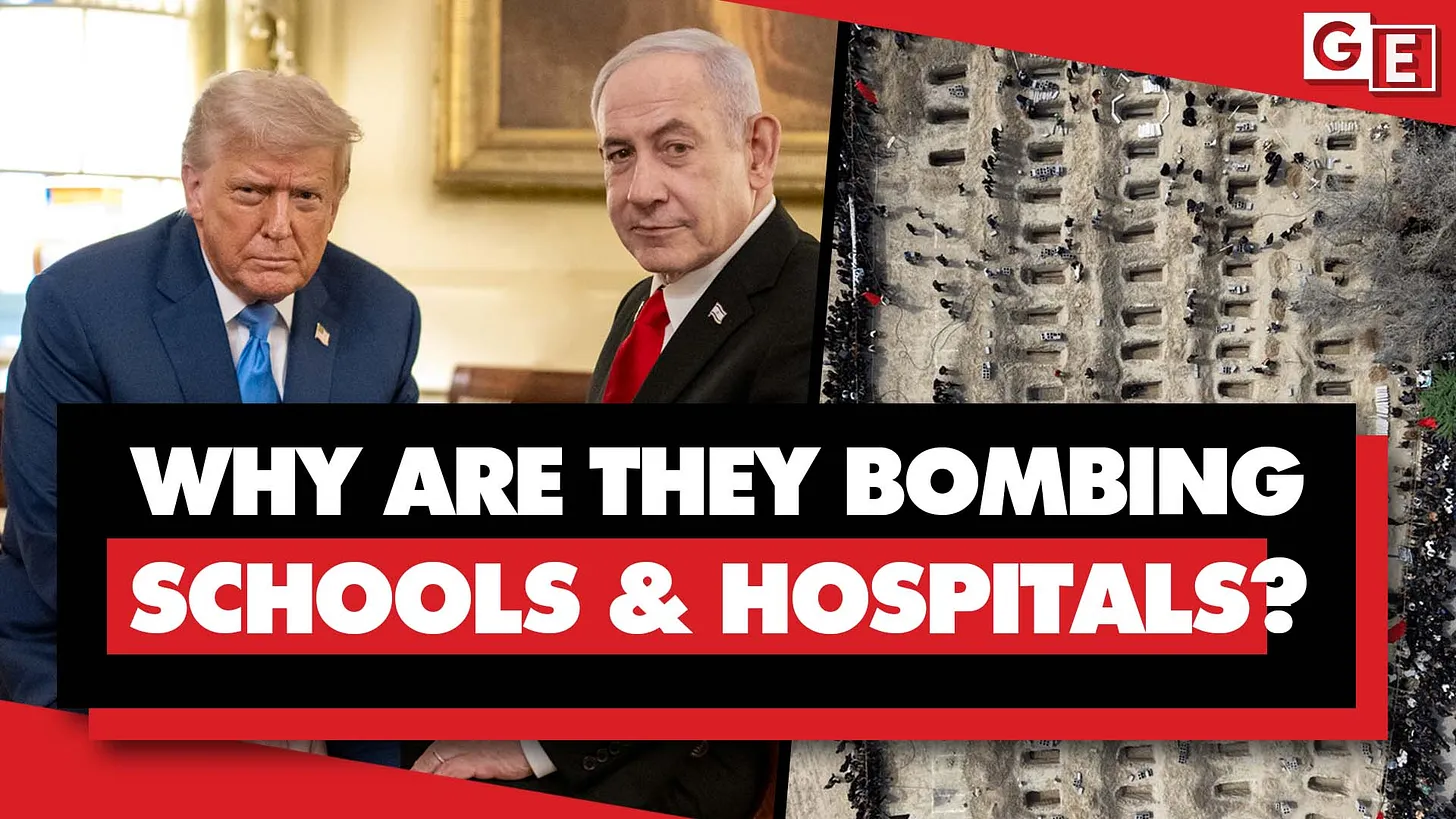
By Ben Norton
GEOPOLITICAL ECONOMY
8 MARCH 2026
The United States and Israel are deliberately attacking civilian areas in Iran, including schools, hospitals, and neighborhoods, with the goal of dismantling the state and destabilizing Iranian society.
US Secretary of War Pete Hegseth explained the scorched-earth strategy during a Pentagon press briefing on March 4.
“This was never meant to be a fair fight, and it is not a fair fight.
We are punching them while they’re down, which is exactly how it should be”, Hegseth boasted.
He added with pride that the US and Israel are raining upon Iran “death and destruction from the sky, all day long”.
Hegseth noted that, in the first four days of the war on Iran (named Operation Epic Fury), the US military employed “twice the air power” that it had used in the “shock and awe” invasion of Iraq in 2003.
In another press briefing on March 2, the US Secretary of War condemned international organizations like the United Nations and proclaimed, “America, regardless of what so-called international institutions say, is unleashing the most lethal and precise air power campaign in history”.
Hegseth bragged that the US is fighting with “no stupid rules of engagement”. By his admission, the Pentagon is purposefully targeting civilian areas and does not care about the rules of war.

Watch the Video Here (21 minutes)
The US and Israel bomb 20 schools and 13 hospitals in Iran in one week
According to the World Health Organization, the US and Israel bombed at least 13 hospitals and health facilities in Iran in the first five days of the war, which Donald Trump and Benjamin Netanyahu launched on February 28.
- Washington and Tel Aviv bombed at least 20 Iranian schools in the first week of the war, according to UNICEF.
- They also destroyed a desalination plant, depriving dozens of Iranian villages of water.
- The US and Israel killed more than 1,300 Iranians in the first week. Children made up 30% of the victims.
CNN and the New York Times both independently confirmed that the US military bombed an elementary school in the city of Minab in southern Iran on the first day of the war.
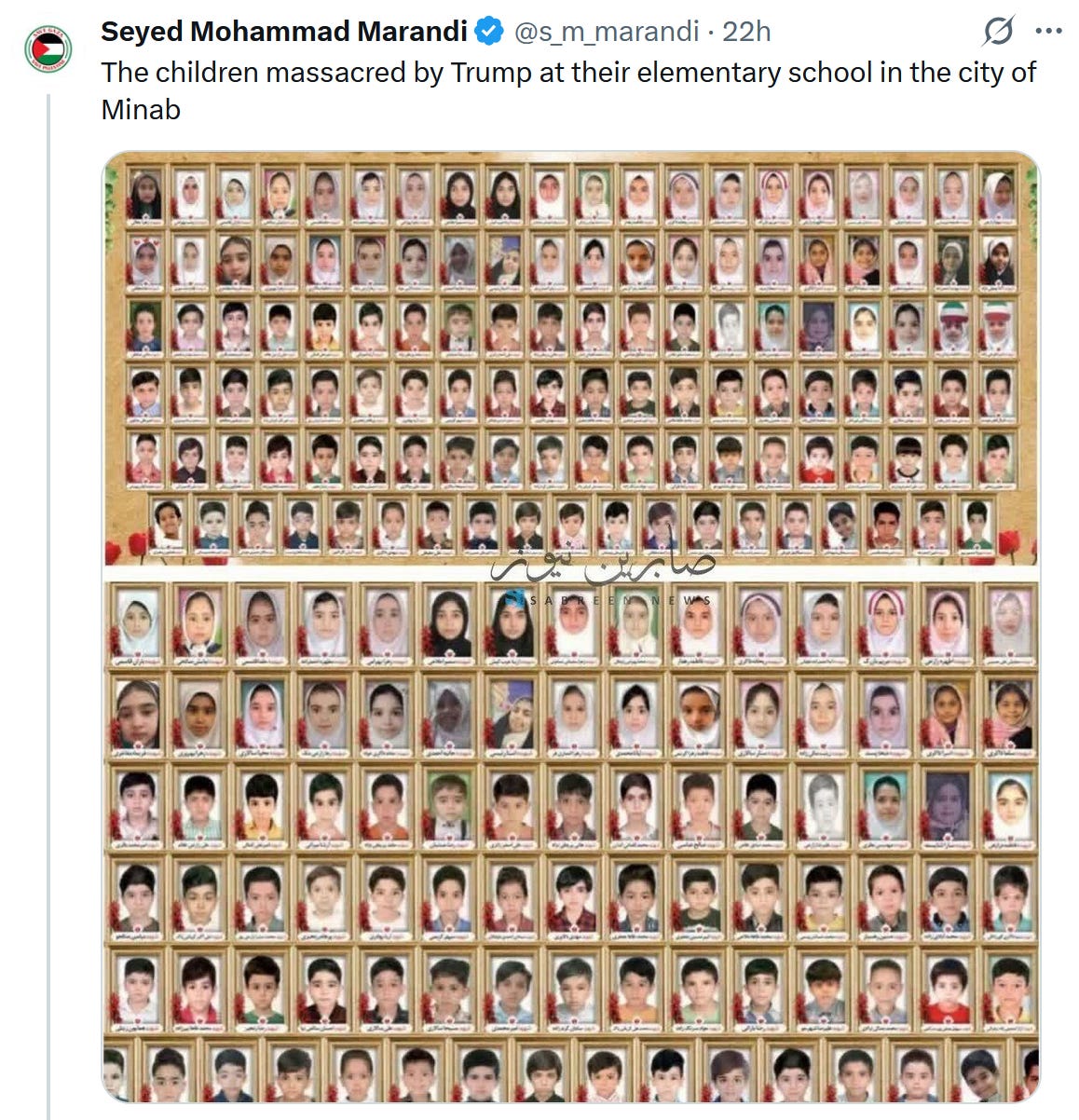
- The US bombed the school twice, 40 minutes apart, to make sure there were no survivors.
- The US military killed at least 168 children and 14 teachers.
War Secretary Hegseth published a map of the areas in Iran that were bombed by the US, and the Minab primary school was clearly in the strike zone.
This is what Hegseth meant when he bragged that the US empire is “punching them while they’re down”, with “no stupid rules of engagement”.
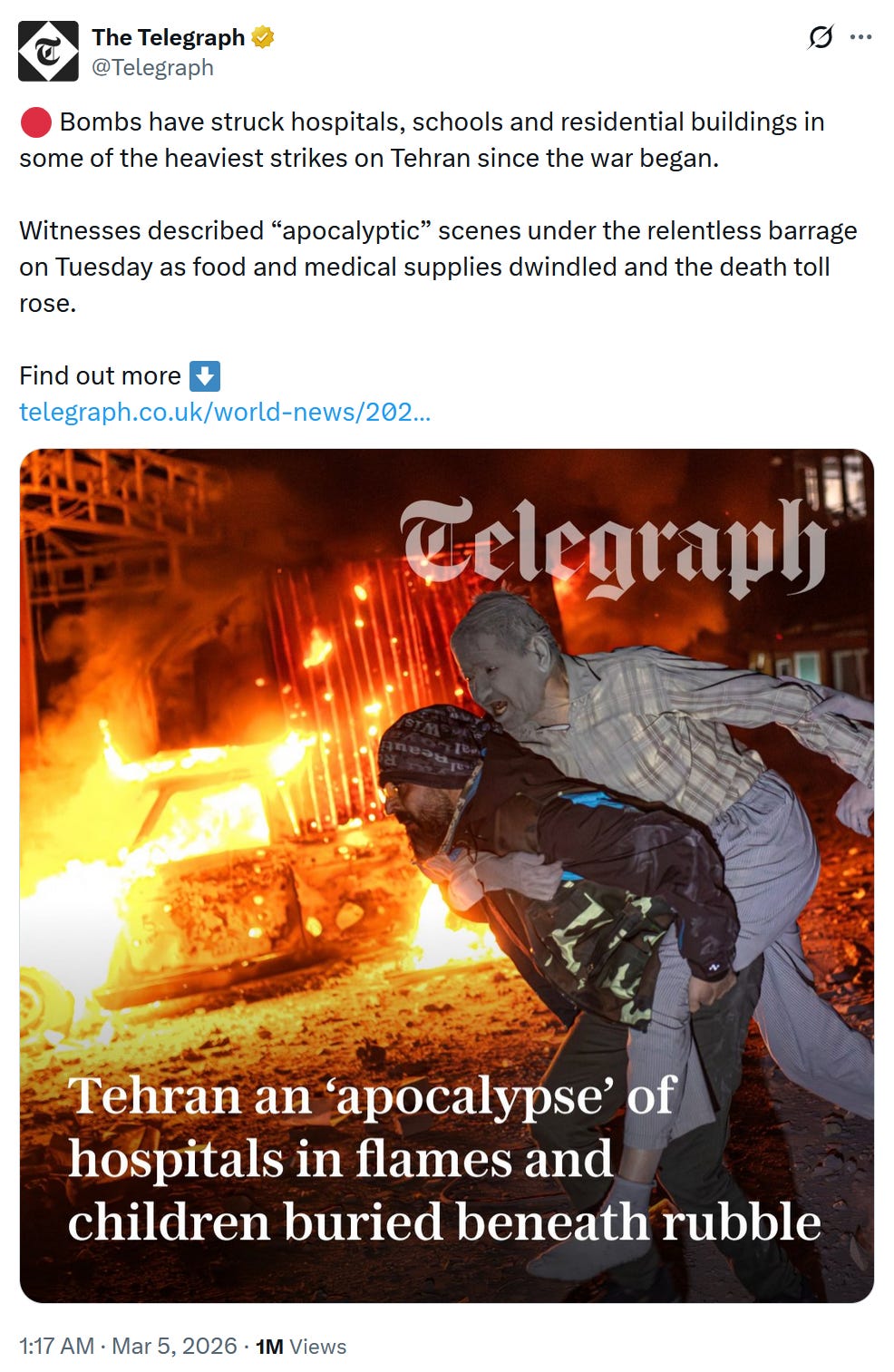
The US-Israeli slaughter is so extreme that even some right-wing media outlets in the West, like the UK’s conservative newspaper The Telegraph, were forced to admit that “Tehran [is] an ‘apocalypse’ of hospitals in flames and children buried beneath rubble”, as the US and Israel intentionally bomb civilian areas.
US and Israel want a failed state and societal collapse in Iran
What Washington and Tel Aviv want to unleash in Iran is not just regime change; it is the destruction of the state and the collapse of Iranian society.
This was openly admitted by some Israeli officials in a report in the Financial Times.
The FT cited Israeli Defense Minister Israel Katz, who declared that “every leader appointed by the Iranian terror regime . . . will be an unequivocal target for elimination”.
Tel Aviv’s plan is to kill all Iranian leaders, so the country cannot be governed and simply falls into chaos.
This was further confirmed by a former top Israeli intelligence official.
The Financial Times interviewed Danny Citrinowicz, who worked for 25 years in Israel Defense Intelligence (IDI) and was the chief of the Research and Analysis Division’s Iran branch.
Citrinowicz told the FT that what Israel wants is the “total destruction of this regime, of the pillars of this regime, of everything that holds it together”.
The former head of Israeli military intelligence’s Iran analysis said this is how Tel Aviv sees the war (emphasis added):
If we can have a coup, great. If we can have people on the streets, great. If we can have a civil war, great.
Israel couldn’t care less about the future . . . [or] the stability of Iran.
In other words, the US and Israel want to repeat in Iran the same kind of war of extermination that they carried out in Gaza, which a UN commission determined to be a campaign of genocide.
US-Israeli war on Iran blatantly violates international law
It goes without saying that the US-Israeli war of aggression against Iran flagrantly violates international law.
The United Nations education agency, UNESCO, emphasized that the bombing of Iranian schools by the US and Israel “constitutes a grave violation of the protection afforded to schools under international humanitarian law”.
Legal experts have clearly stated that the US-Israeli war violates international law. They also noted that Washington was engaged in supposed “negotiations” with Tehran, and Iran was willing to make significant concessions for a deal, when Trump launched this surprise war of aggression, sabotaging the talks.
Stanford University’s elite law school published an interview with an expert on international law, Professor Allen Weiner, who stated, “From an international law perspective, my judgment is that the attack was quite clearly illegal”.
States do have a right to self-defense under international law, Weiner noted. Iran has exercised this right.
The US and Israeli regimes claimed they launched “preemptive” attacks on Iran, but Weiner stressed that this is not valid under international law.
In order to claim self-defense, states may only strike when they have evidence that “they face an imminent threat of attack”, he argued.
This does not apply in this situation, Weiner emphasized. The Stanford law professor explained:
The notion that Iran presents a general security threat to U.S. interests does not constitute a threat of imminent attack. Nor does the possibility that Iran might at some point in the future acquire either nuclear weapons or intercontinental missiles capable of reaching the U.S. homeland amount to a threat of an imminent attack.
US-Israeli war on Iran is based on lies
All of the talking points that the Trump administration has used to try to justify this illegal war have fallen apart.
The Pentagon admitted in a closed-door briefing to Congress that Iran was not going to attack the US and Israel first, and that it only had plans to retaliate in self-defense.
Similarly, the Trump administration claimed that Iran was close to developing nuclear weapons. This was false as well.
The director general of the International Atomic Energy Agency (IAEA), Rafael Grossi, said clearly in an interview on CNN that Iran was not on the verge of having nuclear weapons.
This was another lie promoted by the US government to justify an illegal war.
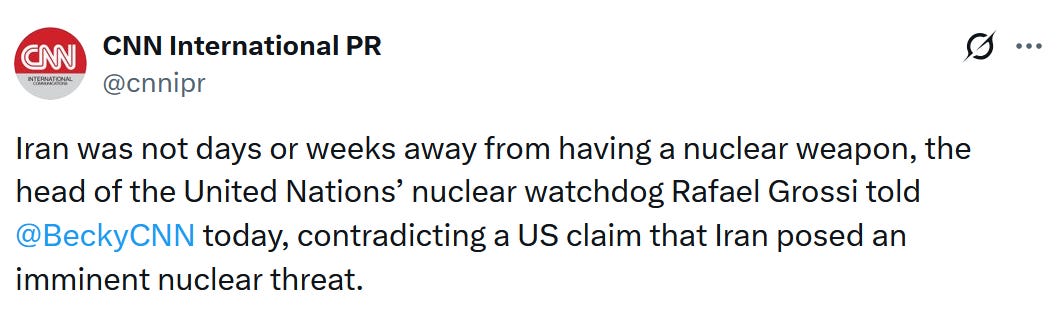
“Were the Iranians days or weeks away from building a [nuclear] bomb, from having a bomb?”, CNN host Becky Anderson asked Grossi.
“No”, he replied, bluntly.
The IAEA chief explained, “We never had information indicating that there was a structured, systematic [Iranian] program to build, to construct, a nuclear weapon”.
A WORD FROM PRESIDENT DONALD J. TRUMP
Truth Details
6485 replies
@realDonaldTrump
The United Kingdom, our once Great Ally, may be the Greatest of them all, is finally giving serious thought to sending two aircraft carriers to the Middle East.
That’s OK, Prime Minister Starmer, we don’t need them any longer — But we will remember.
We don’t need people who join Wars after we’ve already won!
President DONALD J. TRUMP
11.2k
ReTruths
43.6k
Likes
Mar 07, 2026, 10:05 PM
THE CHRIS HEDGES REPORT | CAN ISRAEL & THE U.S. SUSTAIN IRAN'S MILITARY POWER? (W/ ALASTAIR CROOKE)
The Iran War has just begun — but already, Iran’s military prowess, and America’s and Israel’s impulsive imperial hubris, is on full display.

Watch the Video Here (60 Minutes, 01 Second)
By Chris Hedges
Substack.com
7 March 2026
Although the White House X account posts video montages combining video games and Hollywood films with real footage of their activities in Iran, the actual situation on the ground is very different from an American propaganda blockbuster.
To pierce the fog of war and offer a concrete analysis of what is taking place across the Middle East, author and former British diplomat Alastair Crooke of the Substack Conflicts Forum joins host Chris Hedges on this episode of The Chris Hedges Report.
Iran’s military strength has depleted Israeli interceptor missiles, destroyed American radar systems, and prepared the Iranian leadership. Crooke explains that these losses faced by the West and Tel Aviv are shaping the evolving war.
Crooke informs Hedges that Iranians claim to possess newer missiles, which they plan to reveal and deploy later. While they haven’t done so yet, they are ready to use them when the time is appropriate. He adds that Iran is confident in their large missile stockpiles, allowing it to sustain a prolonged conflict.
Crooke also discusses the broader impact of this war on the region, especially the Gulf states that have historically been aligned with American and Israeli interests and have faced attacks since the conflict started. “The Gulf used to be seen as a safe area for businesspeople, investors, and tourists, with AI, holidays, airliners, tourism, and more... but that’s over now."
TED POSTOL: FRAUD OF MISSILE DEFENCE EXPOSED IN IRAN WAR
MIT Professor and Pentagon advisor Ted Postol discusses:
- The reasons behind the failure of missile defense systems in the conflict with Iran and
- Explains why the US and Israel are unlikely to succeed in this war.
Prof. Diesen and Prof. Postol analyze how modern warfare is evolving, emphasizing the roles of drones, advanced ballistic missiles, and countermeasures such as decoys and chaff.
Advances in affordable drone tech and advanced missile designs are reducing the effectiveness of traditional defense systems, while also raising the risk of escalation and the depletion of vital resources.
The analysis highlights the risks of concentrated infrastructure and warns that misjudgments could lead to nuclear escalation, underscoring the unpredictable, escalating nature of modern conflicts.

Watch the Video Here (62 minutes, 49 seconds)
Host Prof. Glenn Diesen
Substack.com
9 March 2026
Interview with Theodor Postol on Missiles, Missile Defense, and Escalation Risks
Postol contends that missile defenses are performing poorly and that drone and ballistic-missile capabilities—combined with external targeting support—could make the conflict increasingly destructive, with heightened risk of nuclear escalation.
Overview
In an extensive interview on the technical aspects of the war with Iran, MIT professor and missile-defense critic Theodor Postol states that the conflict is turning into an attritional struggle in which the capacity to inflict damage and endure losses outweighs public assertions of defensive dominance. As a technologist, he notes that early stages have featured notable U.S. and Israeli attacks on Iran, but he remains skeptical that these will lead to the political collapse that Israeli and U.S. leaders expect.
Postol argues that defensive systems are rapidly declining from a very low starting point, while Iran’s missile and drone capabilities—especially when combined with real-time targeting data—are putting greater pressure on Israel and U.S. facilities in the Persian Gulf. He cautions that as interceptors and radars become depleted or destroyed, the frequency and severity of attacks could rise, raising the risk of escalation.
Missile Defense: “A Very Low Number” Getting Lower
Postol notes that Israel’s and U.S.-aligned defenses have historically been only modestly effective and are now deteriorating quickly as interceptor stocks run low. He also repeats his criticism of the Patriot system, noting that in 1991 it did not intercept Scud warheads despite media reports claiming success—reports he believes were based on visible interceptor explosions rather than on genuine intercepts.
In the current conflict, he claims that Patriot PAC-3 interceptors have difficulty against maneuvering missiles like Iskander-class systems. He describes the observed intercept rates for Patriot and Iron Dome as only “a few percent at most” when interceptors are available. Additionally, he argues that video evidence is often misunderstood: a small “fireball” might just be an interceptor exploding in empty space, while a true intercept would produce a larger, brighter signature as it destroys the incoming warhead.
Drones and Real-Time Targeting: Ubiquity, Precision, and Saturation
Postol emphasizes the role of drones, noting that commercial satellite communications can enable operators to control long-range systems via near-real-time video and command links. Using the Iridium satellite constellation as an example, he explains how even modest data rates can support basic “first-person” video at low resolution—sufficient for remote operators to direct drones with approximately 'tens of meters’ accuracy.
He further claims that Russia and China are supplying Iran with high-resolution satellite intelligence, enhancing its ability to locate targets and assess battle damage. According to him, the most significant impact is cumulative: drones are used not just for direct attacks but also to disable or suppress important radars. This decreases detection chances and complicates engagement, forcing defenders to use their limited interceptors. As defenses become weaker, Postol states, bases might resort to last-resort gunfire against approaching drones.
Ballistic Missiles and Countermeasures: Maneuvering Warheads, Decoys, and Chaff
Beyond drones, Postol contends that Iran now deploys more advanced ballistic missiles than in previous exchanges. He details maneuvering reentry vehicles equipped with aerodynamic control surfaces that enable early course adjustments in the upper atmosphere, making interception more difficult. He also highlights designs that sustain thrust during descent, which can enhance impact speed and decrease aerodynamic “base drag,” thereby increasing the warhead's destructive power upon impact.
His primary criticism focuses on the sensor and discrimination challenge. He contends that missile defense is less about launching interceptors and more about accurately distinguishing warheads from decoys and clutter. He believes adversaries can easily counter this with existing, readily deployable measures. Citing examples involving Russia and North Korea—such as electronic decoys and chaff deployments—Postol argues that these tactics can jam, spoof, or saturate radars, making it difficult for defenders to target even before considering maneuvering threats.
Strategic Implications and Escalation Risk
The interview repeatedly emphasizes a key dynamic: depletion. Postol forecasts that as interceptors are launched and radars damaged, Israel’s and the U.S. positions in the Gulf will face increasing exposure. He further points out that Israel is especially susceptible to ongoing precision strikes due to its concentration of critical infrastructure and civilian populations within a few dense urban centers.
Most notably, Postol highlights the risk of nuclear escalation. He suggests Iran could rapidly develop nuclear weapons if it decided to do so and warns that Israeli decision-making might tilt toward nuclear use if conventional goals are not met. He concludes by cautioning that the conflict is moving into “unknown territory,” where misjudgments could trigger a broader regional—and possibly global—nuclear crisis.
Bottom Line
Postol’s message is clear: he argues that renowned missile-defense systems often fall short in real-world scenarios, while affordable drones, maneuvering warheads, and advanced countermeasures gradually favor ongoing offensive capabilities. Even if one doubts his estimates, the interview underscores how rapidly modern conflicts can evolve into battles of industrial strength, sensor robustness, and political willingness to accept ongoing damage.
PROF JOHN MEARSHEIMER: NEXT MOVE IN IRAN, U.S. CAUSING INSURRECTION
Despite successes like air superiority and fewer losses, the core issue remains: achieving objectives needs regime change and a new government aligned with U.S. and Israeli interests. Without a clear strategy, escalation pressures rise, risking energy markets and U.S. ammo reserves.

Watch the Video Here (54 minutes, 17 seconds)
Daniel Davis
Deep Dive
4 March 2026
Prof John Mearsheimer argues that U.S. objectives in Iran—ending nuclear enrichment, stopping ballistic missile development, and halting support for groups like Hamas, Hezbollah, and the Houthis—cannot be achieved without regime change.
They say true success would require:
- Removing the current Iranian leadership.
- Installing a new regime aligned with U.S. and Israeli interests.
However, they contend there is no coherent strategy to accomplish this. They cite President Trump’s remarks suggesting that many potential replacement leaders are dead and that even if regime change succeeds, a new leadership could be just as hostile as the current one.
They interpret this as evidence of strategic confusion and a lack of planning for post-regime outcomes. Senator Lindsey Graham is portrayed as strongly pro-war and dismissive of skepticism, emphasizing the need to eliminate Iran’s missile and nuclear capabilities and its support for regional militant groups. But the analyst argues that destroying military assets alone won’t produce lasting strategic success if the regime remains intact.
They compare the situation to the Vietnam War—where the U.S. won battles but lost strategically—to stress that tactical victories (like air superiority) don’t automatically lead to favorable political outcomes.
Regarding air power, they note that even overwhelming aerial dominance, as seen in the Gulf War, does not guarantee decisive results on the ground or regime collapse. The central concern remains:
Without a clear, viable plan for regime change and what follows, military success may not translate into long-term strategic victory.
LATEST OPEN LETTERS
-
03-02TO WORLD LEADERS
-
06-01Standing in Solidarity with the People of Venezuela
-
21-07Freedom
-
20-03Stand up to Trump
-
18-02Average Americans Response
-
23-12Tens of thousands of dead children.......this must stop
-
05-06A Call to Action: Uniting for a Lasting Peace in the Holy Land
-
28-05Concerned world citizen
-
13-02World Peace
-
05-12My scream to the world
VIRTUAL POST OFFICE
PETITIONS
LINKS
DONATION
Latest Blog Articles
-
15-10Our Friday News Analysis | What the World THINKS Now!
-
14-10Our Wednesday News Analysis | Navi Pillay, head of UN commission that accused Israel of genocide, wins Nobel Peace Prize
-
13-10Navi Pillay, head of UN commission that accused Israel of genocide, wins Nobel Peace Prize
-
13-10No state has a ‘right’ to exist – least of all an apartheid, genocidal state like Israel
-
13-10‘By the Way, the World is Not Stopping Us’: The Secret of Israel’s ‘Success’
-
12-10Our Monday News Analysis | What the World THINKS Now!
-
08-10Our Friday News Analysis | What the World THINKS Now!
-
07-10Our Wednesday News Analysis | The West wants Netanyahu gone - so Palestinians can be killed more quietly again
-
06-10The West wants Netanyahu gone - so Palestinians can be killed more quietly again
-
06-10Israel turns Gaza into largest ghetto in modern history, killing residents one after another as three-year genocide continues
-
06-10Analysis Europe's Boycott of Israel Is Rapidly Expanding – and It Won't Be Easy to Stop
Latest Comments
 One of the most important and illuminating articles that I …
Comment by Benjamin Inbaraj-
And what's wrong here?
After all, there is the homeland …
Comment by Isac Boian -
Does this reinforce or deny my argument that Israel is …
Comment by Edward Campbell -
Many 'say' they support the Palestinian cause but do little …
Comment by Philip McFedries -
The UN is strangled by the "war for profit" cabal …
Comment by Philip McFedries -
I can't read the printing on the map.
Comment by Philip McFedries -
Good news!
Comment by Philip McFedries
COMMENTS
This article has 0 comments at this time. We invoke you to participate the discussion and leave your comment below. Share your opinion and let the world know.