 NEWSLETTER
Common Grounds
Why Does Europe Invoke International Law on Iran, but Ignore Gaza? – Analysis
Source: Palestine Chronicle
By Palestine Chronicle Editors
Published March 30, 2026
European leaders invoke international law over the Iran war, exposing a stark contrast with their prolonged silence during the Gaza genocide.
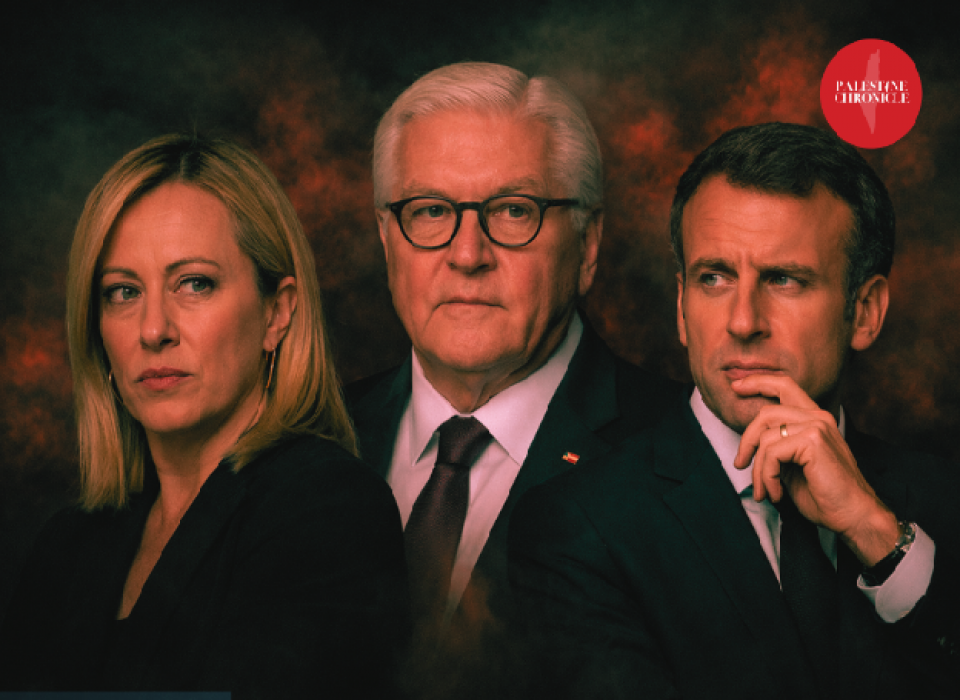
European leaders shift tone on international law over Iran, after years of shielding Israel during Gaza’s ongoing genocide. (Photo Illustration: PC)
International law is not absent from European policy.
It is activated when it aligns with strategic, economic, and political interests—and marginalized when it does not.
This does not negate the validity of legal concerns regarding the war with Iran in March 2026. Rather, it highlights the inconsistency in how those concerns are applied.
The same legal principles now cited to question the war were available throughout the genocide in Gaza from October 2023 onward.
They were not invoked with the same clarity or urgency.
A notable shift is unfolding across Europe. Governments that, for over two years since October 7, 2023, have resisted applying international law to Israel’s genocide in Gaza are now invoking that same legal framework with urgency in response to the US-Israeli war on Iran in March 2026.
This is not a marginal development. It is being articulated at the highest levels of mainstream European politics.
On March 24, 2026, German President Frank-Walter Steinmeier stated that the war on Iran is “contrary to international law,” explicitly rejecting claims of self-defense justification.
Days later, on March 29, 2026, a legal analysis by Germany’s parliamentary experts concluded that the attacks violate the UN Charter’s prohibition on the use of force due to the absence of both Security Council authorization and a valid self-defense basis.
In Spain, Prime Minister Pedro Sánchez had already taken a clear stance earlier in the month. On March 4, 2026, he described the US-Israeli strikes as “illegal,” a position he reiterated on March 25, 2026, while also refusing to allow Spanish bases to be used for military operations.
Italy’s Defense Minister Guido Crosetto similarly stated on March 5, 2026, that the attacks clearly breach international law.
Even more cautious actors are signaling discomfort. On March 2, 2026, French officials under President Emmanuel Macron stressed that such unilateral attacks should be addressed within the framework of the United Nations.
By March 26, 2026, France was emphasizing that any future military engagement in the region must be strictly defensive and anchored in international legitimacy.
At the European Union level, on March 1 and again on March 19, 2026, statements led by Kaja Kallas stressed adherence to the UN Charter, without endorsing the legality of the war.
These positions stand in sharp contrast to Europe’s posture during Israel’s ongoing genocide in Gaza.
Silence on Gaza
Since October 7, 2023, European governments have largely shielded Israel from legal accountability, consistently invoking its “right to defend itself” while avoiding or dismissing the legal implications of its actions.
This was not entirely uniform—countries such as Spain and Ireland, along with a few others, adopted more critical positions, calling for ceasefires and, at times, expressing support for accountability mechanisms.
However, the dominant posture among major European powers—including Germany, France, and Italy—remained one of political protection for Israel, even as the scale of destruction in Gaza intensified.
Throughout late 2023 and into 2024, key European states expressed reservations and, in some cases, outright opposition to international legal initiatives aimed at holding Israel accountable.
This included political resistance to South Africa’s case at the International Court of Justice, filed in December 2023, which accused Israel of genocide in Gaza.
While the court proceeded with provisional measures in early 2024, several European governments either questioned the case or avoided endorsing it.
As legal scrutiny intensified in 2024 and 2025, and discussions around potential arrest warrants at the International Criminal Court emerged—eventually targeting figures such as Benjamin Netanyahu and Yoav Gallant—European responses remained cautious, divided, and often critical of the process itself, rather than supportive of its legal implications.
For over two years, from October 2023 through early 2026, international law was treated as flexible, negotiable, or secondary—despite the scale of destruction in Gaza and the mounting legal arguments presented in international forums.
Now, it has returned as a central point of reference.
Strategic Anxiety
The difference lies in what is at stake.
The war on Iran, particularly since the escalation in early March 2026, is not perceived in Europe as a contained conflict. It carries the risk of regional escalation, direct confrontation, and the breakdown of already fragile security arrangements.
It also raises fundamental questions about the reliability of the United States as a strategic partner.
Under Donald Trump, European leaders have been forced to reassess long-standing assumptions about transatlantic leadership. Trump’s previous rhetoric throughout 2024 and 2025—including threats to NATO allies and calls to reconsider US commitments—has already shaken confidence across Europe.
The current war reinforces the perception that Washington’s actions may be driven by priorities that do not align with European interests—and that Europe could be drawn into a broader conflict without meaningful influence over its direction
.
In this context, invoking international law serves not only as a legal argument but as a means of asserting political distance.
Economic Exposure
Economic considerations are equally decisive.
A prolonged conflict with Iran threatens the stability of the Strait of Hormuz, a critical artery for global energy supplies. Since mid-March 2026, concerns over potential disruption in the Strait have intensified, with energy markets already showing signs of volatility.
European economies, already strained since 2022 by the war in Ukraine, energy crises, and supply chain disruptions, are in no position to absorb another major shock. The economic fragility that has persisted through 2024 and 2025 makes the risks associated with a wider Iran war particularly acute.
This vulnerability explains why European governments are keen to emphasize de-escalation and legal frameworks that could constrain further military expansion.
Instrumental Law
What emerges is a pattern of selective application.
International law is not absent from European policy. It is activated when it aligns with strategic, economic, and political interests—and marginalized when it does not.
This does not negate the validity of legal concerns regarding the war on Iran in March 2026. Rather, it highlights the inconsistency in how those concerns are applied.
The same legal principles now cited to question the war were available throughout the genocide in Gaza from October 2023 onward. They were not invoked with the same clarity or urgency.
Uncertain Course
Europe’s current position is neither fixed nor guaranteed.
As the war evolves beyond March 2026, so too may the language surrounding it. If strategic calculations shift—if the conflict expands in ways that demand closer alignment with Washington, or if internal pressures change—Europe’s emphasis on international law could, in fact, will soften.
This is not a departure from precedent, but a continuation of it. What is unfolding is not a sudden rediscovery of legal principles, but a recalibration of priorities.
International law, in this case, is not merely a standard. It is a tool—one that Europe has chosen, for now, to use.
The deeper question remains unresolved: whether that tool will ever be applied consistently, or only when the costs of ignoring it become too high.
The answer should be obvious.
LATEST OPEN LETTERS
-
03-02TO WORLD LEADERS
-
06-01Standing in Solidarity with the People of Venezuela
-
21-07Freedom
-
20-03Stand up to Trump
-
18-02Average Americans Response
-
23-12Tens of thousands of dead children.......this must stop
-
05-06A Call to Action: Uniting for a Lasting Peace in the Holy Land
-
28-05Concerned world citizen
-
13-02World Peace
-
05-12My scream to the world
VIRTUAL POST OFFICE
PETITIONS
LINKS
DONATION
Latest Blog Articles
-
15-10Our Friday News Analysis | What the World THINKS Now!
-
14-10Our Wednesday News Analysis | Navi Pillay, head of UN commission that accused Israel of genocide, wins Nobel Peace Prize
-
13-10Navi Pillay, head of UN commission that accused Israel of genocide, wins Nobel Peace Prize
-
13-10No state has a ‘right’ to exist – least of all an apartheid, genocidal state like Israel
-
13-10‘By the Way, the World is Not Stopping Us’: The Secret of Israel’s ‘Success’
-
12-10Our Monday News Analysis | What the World THINKS Now!
-
08-10Our Friday News Analysis | What the World THINKS Now!
-
07-10Our Wednesday News Analysis | The West wants Netanyahu gone - so Palestinians can be killed more quietly again
-
06-10The West wants Netanyahu gone - so Palestinians can be killed more quietly again
-
06-10Israel turns Gaza into largest ghetto in modern history, killing residents one after another as three-year genocide continues
-
06-10Analysis Europe's Boycott of Israel Is Rapidly Expanding – and It Won't Be Easy to Stop
Latest Comments
 One of the most important and illuminating articles that I …
Comment by Benjamin Inbaraj-
And what's wrong here?
After all, there is the homeland …
Comment by Isac Boian -
Does this reinforce or deny my argument that Israel is …
Comment by Edward Campbell -
Many 'say' they support the Palestinian cause but do little …
Comment by Philip McFedries -
The UN is strangled by the "war for profit" cabal …
Comment by Philip McFedries -
I can't read the printing on the map.
Comment by Philip McFedries -
Good news!
Comment by Philip McFedries
COMMENTS
This article has 0 comments at this time. We invoke you to participate the discussion and leave your comment below. Share your opinion and let the world know.