 NEWSLETTER
Common Grounds
U.S., Israel, Palestine: Three Dramatic Elections in One Month
Source: Haaretz
By Larry Garber
Published August 31, 2026
Will Trump endorse a candidate in Israel? Will American politicians continue to distance themselves from AIPAC? And how will Israeli restrictions impact the Palestinian election? These questions remind us that democracy transcends international borders
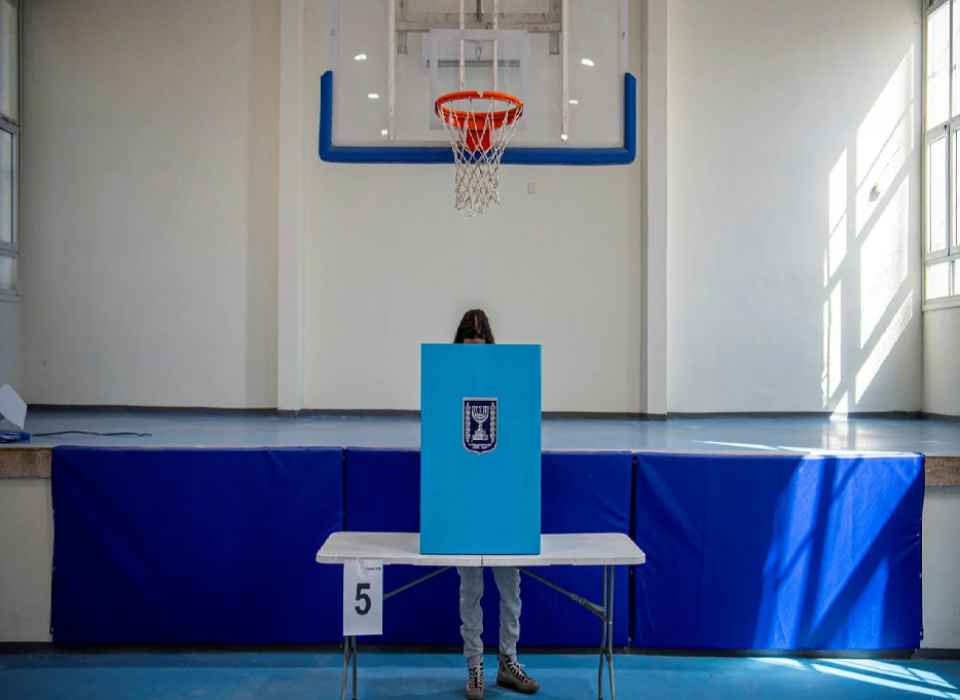
An Israeli voting in last year's local elections. Credit: Gil Eliyahu
Israelis, Americans and Palestinians are all scheduled to vote within a 32-day period between October 27 and November 28. The results of these three elections matter greatly for the three societies, and will also impact the relationships between them, in ways that will have a broader global impact in the coming years.
The U.S. midterm elections will take place on November 3, just a week after Israel's October 27 election. Drawing less attention are the elections for the Palestinian Legislative Council, which are now scheduled for November 28. The confluence of these elections provides a stark reminder that democracy, even if dominated by domestic issues, may also be impacted by external events and influences.
In Israel, Netanyahu has long touted his unique understanding of American politics and his special connection with U.S. President Donald Trump as distinguishing him from other Israeli political leaders. However, Netanyahu's stewardship of the U.S.-Israel relationship has become a major source of contention in recent months as Trump has marginalized Israeli involvement in negotiations with Iran. Netanyahu's public rejection of Trump's plan for the future of Gaza has made things even worse.
While Trump has not been shy about endorsing candidates around the globe, he has remained vague about the Israeli election, saying recently that "it's most appropriate for me to stay out of it, but I may endorse somebody." Moreover, Trump's support has not always proven decisive; Prime Minister Viktor Orban, a Trump (and Netanyahu) favorite, was soundly defeated in the Hungarian election. Still, the question of whether or not Trump will get involved in the Israeli democratic process remains a wildcard ahead of Election Day.
In the U.S., the involvement of AIPAC in Democratic primaries and some general election races has become a political flashpoint this year. While candidates once actively sought AIPAC's backing, and the campaign funding that followed its endorsement, many Democratic primary candidates are now publicly rejecting its support and criticizing what they view as the lobby's outsized influence in Congress. Even Mike Rogers, the Republican candidate for Senate in Michigan, has expressed misgivings about being seen as the AIPAC candidate.
Palestinian elections, given the less-than-ideal circumstances under which they are taking place, are inevitably affected by the actions of external actors. Voters will choose from lists comprising Palestinians residing in both Gaza and the West Bank, but Israeli-imposed movement restrictions will limit the ability of candidates to physically campaign beyond their immediate city of residence.
The Central Election Commission, which is viewed within Palestinian society as a highly credible institution, must rely on innovative mechanisms to identify those eligible to vote and to ensure that the overall integrity of the process is maintained. Those expecting a Western-style election are likely to be disappointed, but neither should the process be summarily dismissed as lacking any credibility.
The bigger question is whether these elections will restore a degree of legitimacy to Palestinian institutions and leaders, and reclaim Palestinians' agency in the determination of their fate. The Palestinian Authority is viewed by much of the public as out-of-touch, ineffective, and without popular support.
As for the technocratic National Committee for the Administration of Gaza (NCAG), even assuming their members are allowed to enter Gaza prior to the elections, the body will have limited time to demonstrate impact and has only a temporary mandate.
The most divisive question relating to the upcoming Palestinian elections is whether Hamas, which emerged as the electoral victor in the 2006 elections, should be allowed to participate and subject to what conditions.Hamas leaders have announced their intent to participate, but it remains unclear how they will finesse the June 2026 presidential decree, which requires all electoral contestants "to recognize the PLO as the sole and legitimate representative of the Palestinian People, as well as its political and national platform, and international resolutions."
The U.S. view is that the Palestinian elections are a distraction from the objective of moving forward with phase two of Trump's peace plan, which nowhere references Palestinian elections.And to the extent that Palestinian determination to hold the elections overcomes international skepticism, support for the process from other actors will likely be contingent on the Election Commission's perceived success in ensuring that Hamas affiliated candidates pledge adherence to the international agreements signed by the PLO.
Elections, at least in theory, provide a mechanism for resolving political disputes peacefully, even in an era of extreme polarization.They also offer an opportunity to reject failed policies and to inject new ideas into the fray. Whether they have transformational or even marginal consequences depends both on the leaders elected and the context in which these leaders are able to operate.
While the next 90 days deserve our considered attention, what will happen in the weeks and months to follow will determine whether prospects for peace in the Middle East have improved and whether the U.S. is capable of being a constructive partner.
Larry Garber, currently a J Street Policy Fellow, is the former USAID West Bank/Gaza Mission Director and a well-recognized comparative elections expert, who has observed elections in more than 30 countries.
LATEST OPEN LETTERS
-
03-02TO WORLD LEADERS
-
06-01Standing in Solidarity with the People of Venezuela
-
21-07Freedom
-
20-03Stand up to Trump
-
18-02Average Americans Response
-
23-12Tens of thousands of dead children.......this must stop
-
05-06A Call to Action: Uniting for a Lasting Peace in the Holy Land
-
28-05Concerned world citizen
-
13-02World Peace
-
05-12My scream to the world
VIRTUAL POST OFFICE
PETITIONS
LINKS
DONATION
Latest Blog Articles
-
13-10Navi Pillay, head of UN commission that accused Israel of genocide, wins Nobel Peace Prize
-
13-10No state has a ‘right’ to exist – least of all an apartheid, genocidal state like Israel
-
13-10‘By the Way, the World is Not Stopping Us’: The Secret of Israel’s ‘Success’
-
12-10Our Monday News Analysis | What the World THINKS Now!
-
08-10Our Friday News Analysis | What the World THINKS Now!
-
07-10Our Wednesday News Analysis | The West wants Netanyahu gone - so Palestinians can be killed more quietly again
-
06-10The West wants Netanyahu gone - so Palestinians can be killed more quietly again
-
06-10Israel turns Gaza into largest ghetto in modern history, killing residents one after another as three-year genocide continues
-
06-10Analysis Europe's Boycott of Israel Is Rapidly Expanding – and It Won't Be Easy to Stop
-
05-10Our Monday News Analysis | What the World THINKS Now!
-
01-10Our Friday News Analysis | What the World THINKS Now!
Latest Comments
 One of the most important and illuminating articles that I …
Comment by Benjamin Inbaraj-
And what's wrong here?
After all, there is the homeland …
Comment by Isac Boian -
Does this reinforce or deny my argument that Israel is …
Comment by Edward Campbell -
Many 'say' they support the Palestinian cause but do little …
Comment by Philip McFedries -
The UN is strangled by the "war for profit" cabal …
Comment by Philip McFedries -
I can't read the printing on the map.
Comment by Philip McFedries -
Good news!
Comment by Philip McFedries
COMMENTS
This article has 0 comments at this time. We invoke you to participate the discussion and leave your comment below. Share your opinion and let the world know.