 NEWSLETTER
Common Grounds
'This Is Another Nakba': How Over 100 West Bank Palestinians Had to Leave Their Homes In Just One Day
Source: Haaretz
By Matan Golan
Published January 13, 2026
Villagers dismantle houses and sell flocks under constant harassment, while volunteers stage 'protective shifts' to keep settlers' sheep away. 'Men in peak fitness need 60-year-old activists or 20-year-old children to protect them,' says observer Amir Pansky, calling it the most revolting ethnic cleansing possible.'
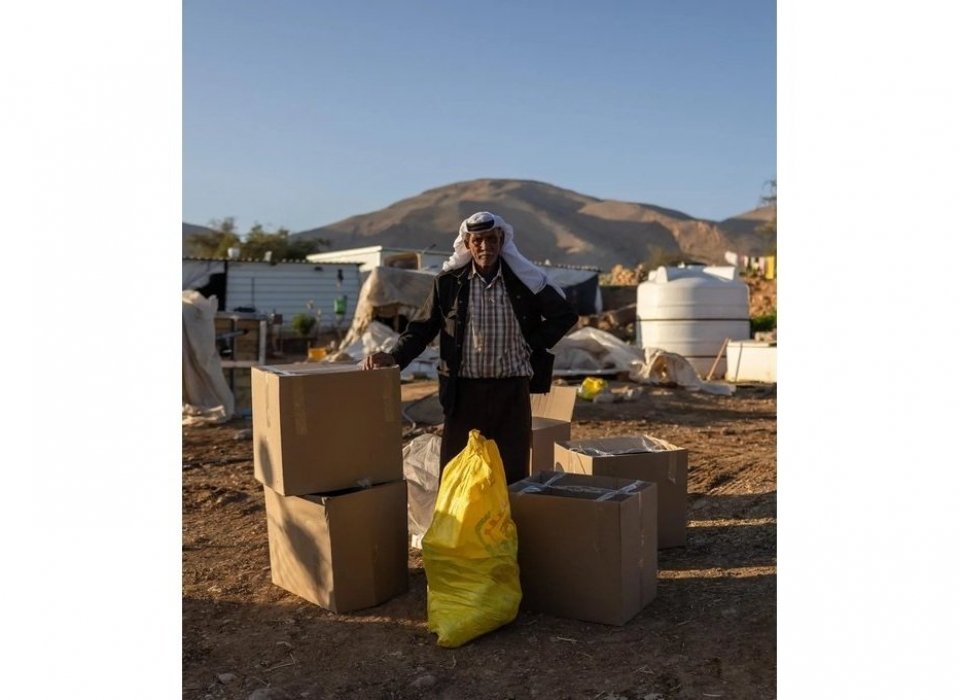
A resident of Ras Ein al-Auja with his belongings, on Sunday. Credit: Itai Ron
The sounds of metal welding in Ras Ein al-Auja continued all night long. More and more families began packing their possessionsin preparation for leaving their homes, under the worsening harassment they have undergone from the nearby settler outposts.
On Saturday afternoon, Yousef sold his flock of sheep. His neighbors dismantled the pen, while others dismantled the house. At the same time, left-wing activists were called there to provide the residents with some protection while they completed their departure.
One of the men burst into tears next to the truck loaded with his home's contents. "This is another Nakba," said his neighbor, Husseini. "Everyone is leaving for a different area. Some to Auja, some to Jericho, Taybeh or the southern part of Mount Hebron. We've lived here for 40 years, after we were forced to leave Masafer Yatta in 1967, but wherever we go they will follow us – they told us that, the settlers."
The family's flock of sheep was loaded onto a double-deck truck – the ewes below, the lambs above. "We would take the sheep far away to the mountains," Husseini said, pointing west. Since the outbreak of the war, settlers have prevented them from going out to pasture, forcing them to buy fodder for the sheep with their own money. Apart from fearing their neighbors living in the nearby outpost, Ras Ein al-Auja residents say they cannot continue living like this financially. "We have no future," said one local.
The settlers who passed by his house last week, Husseini says, shouted at him, "We've beaten you." He says that the villagers knew that the departure was coming. "It's the same group of settlers; they work according to a plan. The government is with them, as well as the army and the police. Each time they focus on a different community, force it to leave, and then take over the land it was sitting on," he added. "In the end, it doesn't matter, media or international pressure – they succeed. After cutting us off and preventing us from making a living, there is no choice left. Is this the democracy they're so proud of?"

A Palestinian girl in Ras Ein al-Auja, on Sunday. Credit: Itai Ron
The community is divided into several compounds. Settlers established a new outpost hundreds of meters from the northwestern compound in the spring of 2024, with a herd of camels and a flock of sheep. About a week and a half ago, settlers built an extension to the outpost near the villagers' homes. On Thursday, about 100 decided to leave their homes.
But not every family decided to leave. Some said that they wanted to stay and watch their neighbors pack. In the evening hours on Friday, the herds of settlers returned to roam the compounds surrounding the community.

A settler riding a donkey in Ras Ein al-Auja, making a "V" sign with his hand, on Sunday. Credit: Itai Ron
Left-wing activists provided, for the first time, around-the-clock "protection shifts" across the village, either to drive the herds of settlers away from the residential areas, while others were meant to allow men who had worked 12 hours dismantling the structures to get some sleep for the next day. After one settler's herd stopped inside the village, the activists were called in to drive the flock away. The children asked one of the activists, who is sort of treated like family by the villagers, if he had brought soccer balls in his car this time too. This time, he didn't.
"It's heart-wrenching," said Amir Pansky from Looking the Occupation in the Eye, with shining eyes. "This isn't the first expulsion I've seen, but it's the worst. These are people we have been with for three years; we know the families, the parents. It's simply completely surreal."

Palestinians leaving Ras Ein al-Auja, on Sunday. Credit: Itai Ron
Pansky said that the government could officially evacuate the village and bear the cost, but instead, it hides behind 13-year-old boys who carry out the task on its behalf. "[Palestinian] Men in their prime need 60-year-old activists or 20-year-old kids to protect them from shepherds, sent by regional councils and religious-Zionist organizations," he added. "This is the most degrading form of ethnic expulsion imaginable."
Clean laundry hangs on clotheslines and metal fences of every house – in preparation for wanderings and the unknown. A woman in a stained dress stood in the doorway of her tin house, while her daughters jumped on the worn-out sofa. "My husband goes out to work, and I stay with the little ones," she said.
"Originally, we fenced the yard to mark the boundaries of the house, but we added the gates because of the settlers. They're always roaming around here, sometimes even coming inside. We always hoped that they – the settlers – would leave, not us. It's a good area; it's hard to leave such good land," she added.

Two men herd sheep in Ras Ein al-Auja, on Sunday. Credit: Itai Ron
The western section of the community has stood abandoned since Thursday. Only a few frightened dogs wander amid the remnants of the evacuation. In the plowed field where the children used to play soccer, a single yellow ball remains.
As the sun set on Monday, settler herds crossed the village. A masked hilltop youth made a "V" sign with his fingers near the rubble of the houses, accompanied by the smug settlers, tense smiles on their faces. The driver of the Israeli army patrol vehicle signaled a three-finger gesture toward the journalists. Across the street, a little girl in a pink tracksuit examined the objects on the ground, preparing to leave the place that had been her home.
The IDF stated that "in light of the increased friction events in the area, the army will reinforce its operational presence in Ras Ein al-Auja." According to the army, "IDF forces enter the area according to calls and operational needs, to prevent clashes between populations and maintain order and security in the area."
The IDF emphasized that "the conduct of the forces as described in the report is not acceptable and is under review. IDF soldiers are required to act according to orders and regulations." They added that "the process of examining land ownership has not yet been completed."
LATEST OPEN LETTERS
-
03-02TO WORLD LEADERS
-
06-01Standing in Solidarity with the People of Venezuela
-
21-07Freedom
-
20-03Stand up to Trump
-
18-02Average Americans Response
-
23-12Tens of thousands of dead children.......this must stop
-
05-06A Call to Action: Uniting for a Lasting Peace in the Holy Land
-
28-05Concerned world citizen
-
13-02World Peace
-
05-12My scream to the world
VIRTUAL POST OFFICE
PETITIONS
LINKS
DONATION
Latest Blog Articles
-
15-10Our Friday News Analysis | What the World THINKS Now!
-
14-10Our Wednesday News Analysis | Navi Pillay, head of UN commission that accused Israel of genocide, wins Nobel Peace Prize
-
13-10Navi Pillay, head of UN commission that accused Israel of genocide, wins Nobel Peace Prize
-
13-10No state has a ‘right’ to exist – least of all an apartheid, genocidal state like Israel
-
13-10‘By the Way, the World is Not Stopping Us’: The Secret of Israel’s ‘Success’
-
12-10Our Monday News Analysis | What the World THINKS Now!
-
08-10Our Friday News Analysis | What the World THINKS Now!
-
07-10Our Wednesday News Analysis | The West wants Netanyahu gone - so Palestinians can be killed more quietly again
-
06-10The West wants Netanyahu gone - so Palestinians can be killed more quietly again
-
06-10Israel turns Gaza into largest ghetto in modern history, killing residents one after another as three-year genocide continues
-
06-10Analysis Europe's Boycott of Israel Is Rapidly Expanding – and It Won't Be Easy to Stop
Latest Comments
 One of the most important and illuminating articles that I …
Comment by Benjamin Inbaraj-
And what's wrong here?
After all, there is the homeland …
Comment by Isac Boian -
Does this reinforce or deny my argument that Israel is …
Comment by Edward Campbell -
Many 'say' they support the Palestinian cause but do little …
Comment by Philip McFedries -
The UN is strangled by the "war for profit" cabal …
Comment by Philip McFedries -
I can't read the printing on the map.
Comment by Philip McFedries -
Good news!
Comment by Philip McFedries
COMMENTS
This article has 0 comments at this time. We invoke you to participate the discussion and leave your comment below. Share your opinion and let the world know.