 NEWSLETTER
Common Grounds
The Dahiyeh Gamble: How Netanyahu’s Escalation Backfired into an Iranian Victory
Source: Palestine Chronicle
By Ramzy Baroud
Published June 8, 2026
Netanyahu’s attack on Beirut may have triggered a historic shift, linking Lebanon’s security directly to Iranian military deterrence.
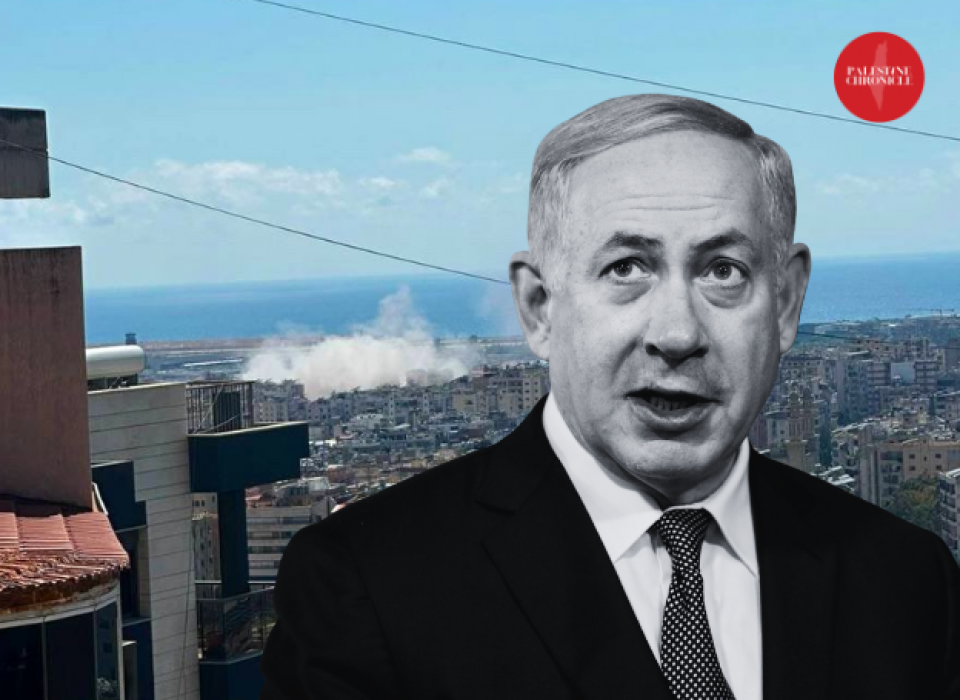
Israeli warplanes struck a residential building in Beirut's southern suburbs. (Photo: Wikimedia. Design: Palestine Chronicle)
… one conclusion is already difficult to avoid: If the current equation survives its first major test, Netanyahu’s decision to strike Dahiya on June 7 may be remembered not as an act of strength, but as one of the most consequential strategic miscalculations in Israel’s modern history.
For the first time, Israel may have been compelled to accept a new regional equation.
That equation is simple: An attack on Lebanon is an attack on Iran.
Whether Washington, Tel Aviv or Beirut likes it or not, Lebanon has become part of Iran’s effective deterrence architecture.
And the man most responsible for producing it may be Benjamin Netanyahu himself.
Had he maintained his policy of controlled escalation after April 17, the process of separating Lebanon from Iran might have continued.
Instead, his decision to bomb Dahiya on June 7 may have accomplished the opposite.
Recent statements by Iranian officials and Hamas leader Khalil al-Hayya have hinted that the framework could eventually expand beyond Lebanon.
Should Palestine become formally incorporated into the same deterrence equation, the strategic consequences would be even more profound.
According to Israeli Channel 12, citing a senior Israeli official, Israel has agreed to halt further attacks on Iran following a direct request from US President Donald Trump.
The declaration itself may appear unremarkable. It could easily be interpreted as another instance of coordination between Washington and Tel Aviv, whereby Israel agrees to American requests in exchange for political and diplomatic capital.
Yet, understood within its proper context, the announcement is extraordinary. To appreciate its significance, one must examine the timeline that led to it.
The current crisis did not begin with Iran’s latest missile strikes, nor with Israel’s bombing of Beirut’s southern suburb, Dahiya, on June 7. Rather, it began months earlier, when the United States sought to prevent the various fronts of the regional conflict from merging into a single geopolitical confrontation.
The turning point came on April 17, when Washington brokered what was presented as a ceasefire arrangement between Lebanon and Israel. The agreement followed the first round of direct Lebanese-Israeli negotiations in Washington on April 14 and was marketed as a pathway toward de-escalation and regional stability.
The sudden American interest in Lebanon was not a reflection of concern for Lebanese civilians, tens of thousands of whom had been killed or wounded. Rather, it reflected a growing realization in Washington that Iran was attempting to transform the concept of the “unity of fronts” from a military doctrine into a diplomatic strategy.
By mid-April, Tehran had begun signaling that Lebanon, Palestine, Yemen, Iraq, the Persian Gulf and Iran itself could no longer be treated as separate files. On April 17, Iranian officials linked broader regional de-escalation, including discussions surrounding the Strait of Hormuz, to Israel ending its war on Lebanon.
The declaration alarmed not only Israel and the United States but also Beirut itself.
For the Lebanese ruling class, allowing Lebanon to become formally integrated into Iran’s regional deterrence architecture would represent a major geopolitical victory for Tehran. Closely aligned with Washington, Western governments and traditional Arab allies, President Joseph Aoun and Prime Minister Nawaf Salam instead sought to establish a separate negotiating track with Israel.
The objective was straightforward: delink Lebanon from Iran.
This logic gave rise to the unprecedented direct negotiations between Beirut and Tel Aviv. The talks were presented as confidence-building measures aimed at stabilizing southern Lebanon and resolving security disputes. In reality, they were part of a broader effort to isolate Hezbollah politically and prevent Tehran from claiming diplomatic influence over the Lebanese file.
Everything that followed—from the April 17 ceasefire to its extension by Trump on April 23—was ultimately designed to shut the door in Iran’s face. The biggest obstacle to that strategy, however, was Benjamin Netanyahu himself.
Caught between competing priorities, Netanyahu attempted to strike a balance. On one hand, he wanted to keep Lebanon isolated and vulnerable. On the other, he faced relentless pressure from his far-right coalition partners and a domestic political environment increasingly addicted to perpetual confrontation.
His solution was a controlled war.
The strategy relied on the systematic destruction of southern Lebanese villages, the constant targeting of Hezbollah members, and the gradual expansion of Israeli military control, while avoiding major escalatory steps that might trigger a regional response.
The model was not new. Following previous ceasefire arrangements, Israel maintained what was officially described as a ceasefire while continuing military operations almost unilaterally.
The war did not end. It simply became one-sided.
The scale of that reality becomes apparent when examining the facts. Between the April 17 ceasefire and Israel’s attack on Dahiya on June 7, Israel carried out nearly 3,500 strikes and more than 400 demolitions inside Lebanon.
For months, Hezbollah largely refrained from major retaliation. Israeli officials, joined by many Arab media outlets, promoted the narrative that Hezbollah had been strategically crippled and that Secretary-General Naim Qassem was unable to restore the movement’s military capabilities.
The theory proved premature, and instead of collapsing, Hezbollah adapted.
Its military capabilities evolved significantly, particularly in the field of drones and reconnaissance technologies. Systems such as the Ababil platform, advanced surveillance drones, and increasingly sophisticated reconnaissance capabilities complicated Israeli operations and challenged assumptions about Hezbollah’s post-war weakness.
Israeli military officials themselves acknowledged the growing challenge posed by Hezbollah’s drone capabilities.
As Hezbollah’s military confidence returned, so too did its political confidence. At the same time, the alliance between Hezbollah and Iran tightened.
Meanwhile, Iran itself had largely rebuilt the military capabilities damaged during the US-Israeli aggression that began on February 28. The result was a dramatic reshuffling of regional calculations.
The Lebanese government, which had placed considerable faith in Washington’s promises and the direct negotiation process, suddenly found itself confronting a different reality.
Once again, it was Netanyahu who disrupted the equation.
With Israeli elections approaching and pressure mounting from his political base, Netanyahu returned to escalation. On June 7, Israeli aircraft struck Dahiya.
Given Netanyahu’s record and his repeated efforts to draw Washington into confrontation with Tehran, the objectives behind the strike appear relatively clear.
First, he sought to reassure his far-right allies that he remained committed to confronting Hezbollah.
Second, he aimed to test Iranian deterrence as Tehran had repeatedly warned that attacks on Dahiya would trigger an immediate Iranian response.
Third, if Iran did retaliate, Netanyahu likely hoped that the United States would once again become trapped in a military confrontation with Tehran.
The calculation failed: Iran responded. Within hours of the June 7 attack, multiple waves of missiles struck military and intelligence targets across northern and central Israel.
The response was immediate, direct and unmistakably non-symbolic.
Israel retaliated. Iran responded again. Simultaneously, Hezbollah intensified attacks on Israeli military positions in northern occupied Palestine.
For a brief moment, the region appeared to be moving rapidly toward a wider war. It was at this point, on June 7 and into June 8, that Trump intervened.
The American president had little interest in returning to a confrontation that neither the US military establishment, the American public nor much of his own administration appeared willing to fight.
The result was the reported phone call. Soon afterward came the statement to Channel 12.
On June 8, a senior Israeli official indicated that Israel would not respond further. If that position holds, the implications may be historic.
For the first time, Israel may have been compelled to accept a new regional equation.
That equation is simple: An attack on Lebanon is an attack on Iran.
Lebanon, whether Washington, Tel Aviv or Beirut likes it or not, has become part of Iran’s effective deterrence architecture. Ironically, this is precisely the outcome that months of diplomacy were intended to prevent.
And the man most responsible for producing it may be Benjamin Netanyahu himself.
Had he maintained his policy of controlled escalation after April 17, the process of separating Lebanon from Iran might have continued. Instead, his decision to bomb Dahiya on June 7 may have accomplished the opposite.
Recent statements by Iranian officials and Hamas leader Khalil al-Hayya have hinted that the framework could eventually expand beyond Lebanon.
Should Palestine become formally incorporated into the same deterrence equation, the strategic consequences would be even more profound.
Whether that happens remains uncertain. But one conclusion is already difficult to avoid:
If the current equation survives its first major test, Netanyahu’s decision to strike Dahiya on June 7 may be remembered not as an act of strength, but as one of the most consequential strategic miscalculations in Israel’s modern history.
– Dr. Ramzy Baroud is a journalist, author and the Editor of The Palestine Chronicle. He is the author of eight books. His latest book, ‘Before the Flood,’ was published by Seven Stories Press. His other books include ‘Our Vision for Liberation’, ‘My Father was a Freedom Fighter’ and ‘The Last Earth’. Baroud is a Non-resident Senior Research Fellow at the Center for Islam and Global Affairs (CIGA). His website is www.ramzybaroud.net
LATEST OPEN LETTERS
-
03-02TO WORLD LEADERS
-
06-01Standing in Solidarity with the People of Venezuela
-
21-07Freedom
-
20-03Stand up to Trump
-
18-02Average Americans Response
-
23-12Tens of thousands of dead children.......this must stop
-
05-06A Call to Action: Uniting for a Lasting Peace in the Holy Land
-
28-05Concerned world citizen
-
13-02World Peace
-
05-12My scream to the world
VIRTUAL POST OFFICE
PETITIONS
LINKS
DONATION
Latest Blog Articles
-
15-10Our Friday News Analysis | What the World THINKS Now!
-
14-10Our Wednesday News Analysis | Navi Pillay, head of UN commission that accused Israel of genocide, wins Nobel Peace Prize
-
13-10Navi Pillay, head of UN commission that accused Israel of genocide, wins Nobel Peace Prize
-
13-10No state has a ‘right’ to exist – least of all an apartheid, genocidal state like Israel
-
13-10‘By the Way, the World is Not Stopping Us’: The Secret of Israel’s ‘Success’
-
12-10Our Monday News Analysis | What the World THINKS Now!
-
08-10Our Friday News Analysis | What the World THINKS Now!
-
07-10Our Wednesday News Analysis | The West wants Netanyahu gone - so Palestinians can be killed more quietly again
-
06-10The West wants Netanyahu gone - so Palestinians can be killed more quietly again
-
06-10Israel turns Gaza into largest ghetto in modern history, killing residents one after another as three-year genocide continues
-
06-10Analysis Europe's Boycott of Israel Is Rapidly Expanding – and It Won't Be Easy to Stop
Latest Comments
 One of the most important and illuminating articles that I …
Comment by Benjamin Inbaraj-
And what's wrong here?
After all, there is the homeland …
Comment by Isac Boian -
Does this reinforce or deny my argument that Israel is …
Comment by Edward Campbell -
Many 'say' they support the Palestinian cause but do little …
Comment by Philip McFedries -
The UN is strangled by the "war for profit" cabal …
Comment by Philip McFedries -
I can't read the printing on the map.
Comment by Philip McFedries -
Good news!
Comment by Philip McFedries
COMMENTS
This article has 0 comments at this time. We invoke you to participate the discussion and leave your comment below. Share your opinion and let the world know.