 NEWSLETTER
Common Grounds
Palestinian Children’s Day: Stolen Childhood, Unbroken Will
Source: Palestine Chronicle
By Palestine Chronicle Editors
Published April 6, 2026
International Day of the Palestinian Child reveals genocide, imprisonment, and systemic denial, yet children persist through education, culture, and resistance.
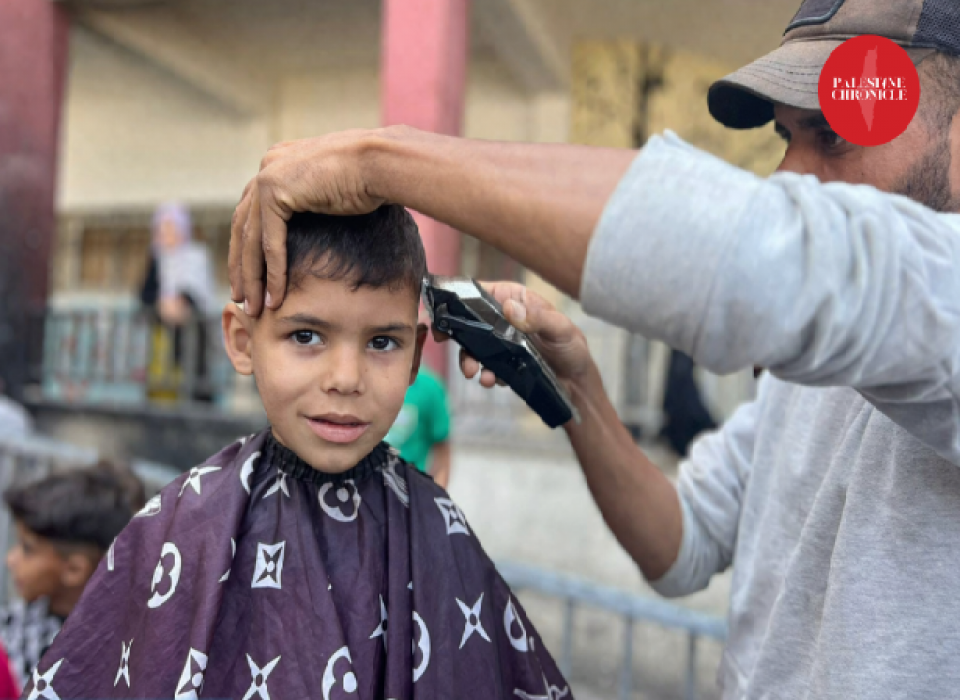
Palestinian barbers give free haircuts to children ahead of Eid al-Fitr, offering moments of normalcy amid genocide (Photo: Mahmoud Ajjour, The Palestine Chronicle)
... education continues under constant interruption.
Children navigate checkpoints, delays, and the threat of violence simply to reach school.
Some wait for hours each day for gates to open, while others are forced to take longer, more dangerous routes.
Yet they persist.
… for Palestinians, education is not merely a social good. It is a form of continuity—
a refusal to allow war and occupation to define the limits of their future.
On April 5, Palestinians mark Palestinian Children’s Day, a day that has grown increasingly urgent with each passing year.
The day is not a ceremonial occasion, nor a symbolic gesture. It is a political and human reality shaped by occupation, and, in the current moment, by genocide in Gaza.
To speak of Palestinian childhood today is to speak of a condition defined by violence, disruption, and systematic targeting. Yet it is also to speak of persistence—of a generation that continues to assert its right to exist, to learn, and to remain.
What is Palestinian Children’s Day?
The Palestinian Children’s Day emerged in the 1990s through Palestinian institutions and civil society organizations seeking to document violations against children living under Israeli occupation.
"Oh God, please take me"
— Save Gaza (@Alee93ale) March 27, 2026
Palestinian woman is suicidal after her tent and her children's tent were completely flooded
There is great tragedy in Gaza right now that needs international pressure. Silence is a crime.
We will all suffer on Judgement Day for this. pic.twitter.com/T66GLwmKcD
While not officially recognized by the United Nations, it has become widely observed across Palestine and among international solidarity networks.
The day serves as an annual moment of reckoning. It centers not abstract notions of childhood, but the lived experiences of Palestinian children under military occupation, blockade, and displacement.
Over time, it has also evolved into a platform for legal and political advocacy, grounded in international law and human rights frameworks.
Death, Injury, and Arrest
The scale of violence against Palestinian children since October 2023 has been unprecedented.
According to UNICEF, the Palestinian Health Ministry, and other organizations, more than 21,000 Palestinian children have been killed in Gaza, with over 44,000 injured.
The above figures are not incidental. They indicate that children are central victims of the genocide, bearing the consequences of sustained bombardment, siege, and infrastructural collapse.
Beyond those killed or wounded, countless children have been displaced multiple times, often separated from family members, and forced to survive in conditions lacking food, water, and medical care. The destruction of homes and neighborhoods has rendered entire childhoods unmoored from any sense of stability.
In the occupied West Bank, the Israeli violence takes a different, though equally systematic, form. Palestinian prisoner institutions report that approximately 350 children are currently held in Israeli prisons. Since the beginning of the war, more than 1,700 children have been arrested in the occupied West Bank alone.
These arrests are rarely spontaneous. They are carried out through coordinated night raids, often involving forced entry into homes, the use of explosives, and the presence of heavily armed soldiers. Children are taken from their families, handcuffed, and transported through military checkpoints, where many are subjected to physical and psychological abuse.
Inside detention, Palestinian institutions describe a system characterized by enforced disappearance, denial of visits, and severe restrictions on communication.
This is not an incidental pattern of abuse, but part of a structural system of repression.
A System, Not an Exception
The targeting of Palestinian children cannot be understood as a series of isolated incidents. Palestinian institutions have consistently emphasized that the detention of children is a longstanding, systematic policy.
Over the years, tens of thousands of Palestinian children have been subjected to arrest and military prosecution. Unlike Israeli children, who are tried under civilian law, Palestinian minors are prosecuted in military courts, where due process protections are severely limited.
This dual legal system reflects a broader framework in which Palestinian childhood itself is treated as a site of control. The aim is not only punitive, but preventative: to discipline and contain an entire generation.
Perception and Dehumanization
This reality is reinforced by a political and ideological discourse among Israeli officials and public figures that has, at times, explicitly dehumanized Palestinians, including children.
Statements by Israeli leaders and public figures over the years have framed Palestinians collectively as a threat, blurring distinctions between children and adults, civilians and combatants.
Such rhetoric contributes to an environment in which the killing, detention, or mistreatment of children is normalized or justified within a broader security narrative.
The result is not only physical harm, but the erosion of the basic moral and legal distinctions that are meant to protect children in times of conflict.
Where Is International Law?
Under international law, children are entitled to special protection.
The Convention on the Rights of the Child and the Fourth Geneva Convention establish clear obligations to protect children from violence, arbitrary detention, and collective punishment.
Yet the gap between legal principle and political reality remains vast.
International organizations have documented violations extensively. UN reports have verified thousands of grave violations against Palestinian children, including killing, maiming, detention, and attacks on schools and hospitals. However, these findings have rarely translated into meaningful accountability.
For Palestinian children, international protection exists largely on paper.
Education Under Siege
If imprisonment represents one form of disruption, the destruction of education represents another—one that extends far beyond the present moment.
In Gaza, the education system has effectively collapsed. The majority of schools have been destroyed, damaged, or repurposed as shelters for displaced families. For many children, formal education has ceased entirely.
In the West Bank, education continues under constant interruption. Children navigate checkpoints, delays, and the threat of violence simply to reach school. Some wait for hours each day for gates to open, while others are forced to take longer, more dangerous routes.
Yet they persist.
This persistence underscores a central truth: for Palestinians, education is not merely a social good. It is a form of continuity—a refusal to allow war and occupation to define the limits of their future.
Resilience and the Refusal to Disappear
Even amid the devastation of Gaza, children continue to assert their presence in ways that challenge the logic of destruction.
Images and videos show children reciting poetry, performing traditional dabka dances, and engaging in creative expression amid ruins and displacement camps. These acts are not incidental. They are expressions of identity, continuity, and collective memory.
In the West Bank, children standing at checkpoints with schoolbags in hand embody a quieter, but equally powerful, form of resistance. Their insistence on reaching school, despite obstacles and risk, reflects a broader culture of steadfastness.
This is not resilience in the abstract. It is a daily practice.
On Palestinian Children’s Day, the contradiction is unmistakable. Palestinian children are subjected to one of the most severe systems of violence and control in the world, marked by genocide, imprisonment, and systemic deprivation.
Yet they remain.
They learn. They create. They endure.
And in doing so, they assert a future that no system of oppression has yet been able to erase.
LATEST OPEN LETTERS
-
03-02TO WORLD LEADERS
-
06-01Standing in Solidarity with the People of Venezuela
-
21-07Freedom
-
20-03Stand up to Trump
-
18-02Average Americans Response
-
23-12Tens of thousands of dead children.......this must stop
-
05-06A Call to Action: Uniting for a Lasting Peace in the Holy Land
-
28-05Concerned world citizen
-
13-02World Peace
-
05-12My scream to the world
VIRTUAL POST OFFICE
PETITIONS
LINKS
DONATION
Latest Blog Articles
-
15-10Our Friday News Analysis | What the World THINKS Now!
-
14-10Our Wednesday News Analysis | Navi Pillay, head of UN commission that accused Israel of genocide, wins Nobel Peace Prize
-
13-10Navi Pillay, head of UN commission that accused Israel of genocide, wins Nobel Peace Prize
-
13-10No state has a ‘right’ to exist – least of all an apartheid, genocidal state like Israel
-
13-10‘By the Way, the World is Not Stopping Us’: The Secret of Israel’s ‘Success’
-
12-10Our Monday News Analysis | What the World THINKS Now!
-
08-10Our Friday News Analysis | What the World THINKS Now!
-
07-10Our Wednesday News Analysis | The West wants Netanyahu gone - so Palestinians can be killed more quietly again
-
06-10The West wants Netanyahu gone - so Palestinians can be killed more quietly again
-
06-10Israel turns Gaza into largest ghetto in modern history, killing residents one after another as three-year genocide continues
-
06-10Analysis Europe's Boycott of Israel Is Rapidly Expanding – and It Won't Be Easy to Stop
Latest Comments
 One of the most important and illuminating articles that I …
Comment by Benjamin Inbaraj-
And what's wrong here?
After all, there is the homeland …
Comment by Isac Boian -
Does this reinforce or deny my argument that Israel is …
Comment by Edward Campbell -
Many 'say' they support the Palestinian cause but do little …
Comment by Philip McFedries -
The UN is strangled by the "war for profit" cabal …
Comment by Philip McFedries -
I can't read the printing on the map.
Comment by Philip McFedries -
Good news!
Comment by Philip McFedries
COMMENTS
This article has 0 comments at this time. We invoke you to participate the discussion and leave your comment below. Share your opinion and let the world know.