 NEWSLETTER
Common Grounds
From Palestine to Iran: This is Not a Religious War — It is a War on Religion
Source: Palestine Chronicle
By Ramzy Baroud & Romana Rubeo
Published April 21, 2026
The greatest mistake one can make in trying to understand the violence consuming Palestine and the region is to call it a religious war. It is not.
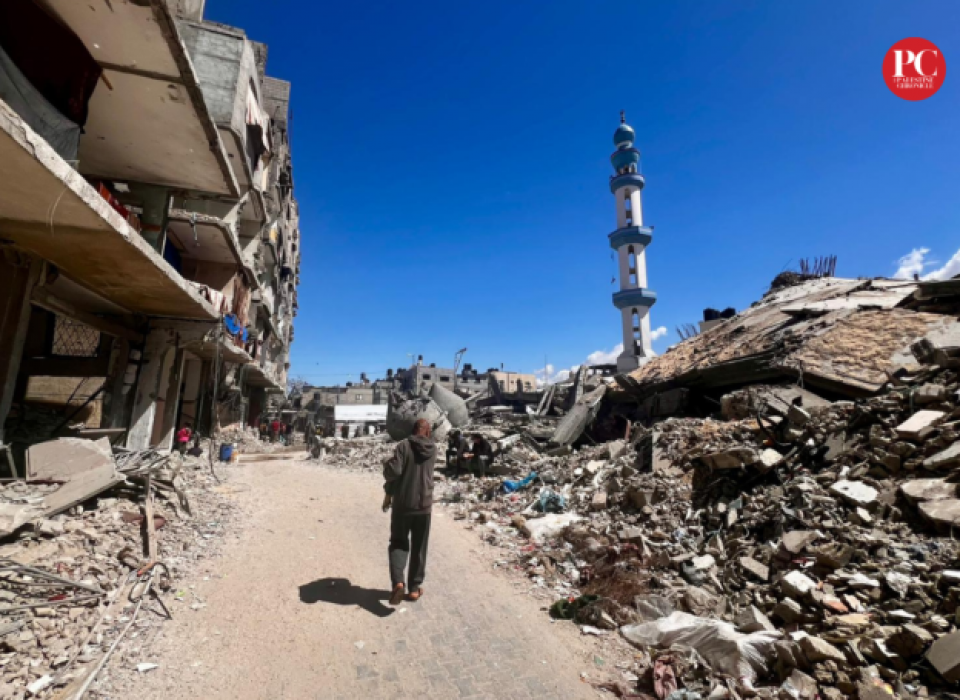
Palestinians return to the mosque to pray on the ruins of the Farouk Mosque. (Photo: Mahmoud Ajjour, The Palestine Chronicle)
A religious war suggests opposing camps driven by competing theologies, each claiming God as its exclusive mandate. That is not what is taking place. Palestinians, Lebanese, and Iranians, whether Muslim or Christian, Sunni or Shia, are not mobilized in some grand sectarian crusade. They are resisting siege, occupation, bombardment, humiliation, and erasure.
What we are witnessing instead is something darker: a war on religion itself.
This war manifests in many forms. It appears in the destruction of mosques in Gaza, in the tightening grip over Al-Aqsa Mosque, in the harassment of Palestinian Christians in Jerusalem, in attacks on churches and shrines, in the mockery of sacred language, and in the growing contempt shown toward spiritual symbols and religious authority across the region. It is not theology that unites these acts, but power. It is domination stripped of restraint.
In Gaza, the Israeli part of this war is by now undeniable.
The destruction has not only been military. It has been civilizational. It has targeted the social, historical, and spiritual architecture of Palestinian life.
Gaza’s government media office said 835 mosques had been completely destroyed and 180 more partially damaged. Churches had also been struck, and 40 of Gaza’s 60 cemeteries had been destroyed.
This is not merely a matter of damaged buildings. A mosque is not reducible to stone, concrete, or minaret. A church is not only an old wall or a fragile roof. These are repositories of memory. They hold grief, continuity, ritual, and belonging. To destroy them on this scale is to assault not only a people’s present, but also their ancestry and their future.
In Gaza, where people now pray amid rubble and in bombed-out structures, religion itself has been forced into survival mode. Even worship has been made to kneel before annihilation.
Yet the Israeli war on Palestinian religion did not begin in Gaza, and it will not end there.
For decades, Jerusalem has served as a laboratory for this assault.
At Al-Aqsa Mosque, Palestinians have repeatedly been beaten, restricted, expelled, and humiliated under the language of “security.” Israeli forces have stormed the compound during Ramadan, firing stun grenades, assaulting worshippers, and turning one of Islam’s holiest sites into a space of fear rather than devotion.
In recent years, access has been tightly controlled through age restrictions, military permits, and checkpoints that prevent thousands of Palestinians from the West Bank from reaching Jerusalem at all. Even for those who do arrive, entry is often arbitrary, delayed, or denied altogether.
The result is not simply restricted movement, but a deeper assault on dignity: prayer reduced to permission, worship subjected to force, and a sacred space transformed into a site of constant surveillance and coercion.
Palestinian Christians know this reality no less intimately. For years, they have faced mounting pressure not only as Palestinians under occupation, but as custodians of a Christian presence in East Jerusalem that Israel has steadily made more precarious.
The Rossing Center documented 111 cases of harassment and violence against Christians in Israel and East Jerusalem in 2024, including 46 physical attacks and 35 attacks on church property.
Among the ugliest manifestations are the repeated incidents of extremists spitting at clergy, pilgrims, and Christian women in the Old City. Reuters reported in 2023 that Israeli police arrested suspects after growing complaints of precisely such acts.
Spitting is often dismissed by outsiders as a small indignity. It is not. It is a ritual of dehumanization. It is a public declaration that the other is impure, unwanted, and beneath dignity. When such acts become common enough to require police statements and special investigations, we are no longer speaking of isolated prejudice. We are speaking of a political culture in which contempt for Palestinian Christian presence has become normalized.
Recent events have only made this more explicit. On Palm Sunday this year, Israeli police barred Cardinal Pierbattista Pizzaballa from entering the Church of the Holy Sepulchre, disrupting a centuries-old Christian observance before the decision was reversed after public outcry.
The symbolism was staggering. If even the highest Catholic authority in Jerusalem can be denied access to one of Christianity’s holiest sites, then no Christian in Palestine is meant to feel secure in the permanence of his or her faith, ritual, or place.
Then came one of the most grotesque scenes of all: the cutting off of the head of a Jesus statue in South Lebanon.
Reuters verified the authenticity of the image showing an Israeli soldier striking a statue of Jesus in Debel, a Christian village in southern Lebanon. Church leaders called it a “serious affront” to the Christian faith.
That language is accurate, but restrained. Such an act is not random vandalism. It is desecration in its most literal form. A statue of Christ is not worshipped as an object, but it is revered as a sacred representation. To mutilate it in a Christian town under military occupation is to send a chilling message: not even your most cherished symbols are beyond our reach.
That offense is not only religious. It is civilizational.
For Arab Christians, especially in Palestine and Lebanon, faith is not an imported or marginal identity. It is indigenous, ancient, and woven into the very history of the land. To attack their churches, insult their clergy, restrict their ceremonies, or destroy their sacred symbols is not merely to offend belief. It is to assault the very idea that they belong to the East at all.
The American role in this war on religion is different in history, but not in effect.
Donald Trump’s language and symbolism have repeatedly revealed a political culture that instrumentalizes religion while dishonoring everything religion is supposed to protect: humility, dignity, compassion, restraint, and reverence for life.
On April 5, in an Easter Sunday post threatening Iran, Trump ended his message with the phrase “Praise be to Allah.” It was not a gesture of respect. It was mockery—Islamic language turned into a taunt while military threats were being issued. And this was not an isolated vulgarity.
Trump also circulated an AI-generated image of himself dressed as a Jesus-like figure, provoking outrage among many Catholics, and then publicly attacked Pope Leo, calling him “terrible” and “weak” after the pontiff criticized war.
None of this is trivial. It reflects a political performance in which religious language is emptied of moral meaning and turned into ego, theater, and coercion.
Trump may present himself as a Christian leader, but the Christianity projected in these gestures is not one of mercy or justice. It is imperial, theatrical, violent, and profoundly anti-Christian in spirit.
That culture is echoed in the figures around him.
One could argue, of course, that all of this belongs to a much older Islamophobic discourse that has plagued the West for decades. That is true, but insufficient.
Because the contempt no longer falls only on Muslims. The degradation of Christian clergy in Jerusalem, the restrictions on Christian holy days, the hostility toward Pope Leo, and the desecration of Christ’s image in Lebanon suggest something broader and more dangerous.
This is not simply anti-Muslim politics in a familiar form. It is an assault on the sacred whenever the sacred stands in the way of militarism, supremacy, or domination.
This is why calling it a religious war is so misleading.
The peoples under attack are not fighting because they seek to impose religion. They are fighting, enduring, and surviving because they are being invaded, besieged, erased, and denied the most basic conditions of dignity—including the dignity of worship.
The more accurate description is a war on religion. Once a war reaches this stage, it loses even the last remnants of logic.
It becomes absolute—extremist, unrestrained, untethered from any moral limit. A war of this nature can only sustain itself through desecration and the systematic erasure of the other.
That is what makes it so profoundly dangerous—not only for Palestinians, Lebanese, and Iranians, but because it destroys the very moral boundaries that religion, at its best, is meant to preserve: the sanctity of life, the dignity of human beings, and the limits that should restrain violence.
– Dr. Ramzy Baroud is a journalist, author and the Editor of The Palestine Chronicle. He is the author of eight books. His latest book, ‘Before the Flood,’ was published by Seven Stories Press.
– Romana Rubeo is an Italian writer and the managing editor of The Palestine Chronicle. Her articles appeared in many online newspapers and academic journals.
LATEST OPEN LETTERS
-
03-02TO WORLD LEADERS
-
06-01Standing in Solidarity with the People of Venezuela
-
21-07Freedom
-
20-03Stand up to Trump
-
18-02Average Americans Response
-
23-12Tens of thousands of dead children.......this must stop
-
05-06A Call to Action: Uniting for a Lasting Peace in the Holy Land
-
28-05Concerned world citizen
-
13-02World Peace
-
05-12My scream to the world
VIRTUAL POST OFFICE
PETITIONS
LINKS
DONATION
Latest Blog Articles
-
15-10Our Friday News Analysis | What the World THINKS Now!
-
14-10Our Wednesday News Analysis | Navi Pillay, head of UN commission that accused Israel of genocide, wins Nobel Peace Prize
-
13-10Navi Pillay, head of UN commission that accused Israel of genocide, wins Nobel Peace Prize
-
13-10No state has a ‘right’ to exist – least of all an apartheid, genocidal state like Israel
-
13-10‘By the Way, the World is Not Stopping Us’: The Secret of Israel’s ‘Success’
-
12-10Our Monday News Analysis | What the World THINKS Now!
-
08-10Our Friday News Analysis | What the World THINKS Now!
-
07-10Our Wednesday News Analysis | The West wants Netanyahu gone - so Palestinians can be killed more quietly again
-
06-10The West wants Netanyahu gone - so Palestinians can be killed more quietly again
-
06-10Israel turns Gaza into largest ghetto in modern history, killing residents one after another as three-year genocide continues
-
06-10Analysis Europe's Boycott of Israel Is Rapidly Expanding – and It Won't Be Easy to Stop
Latest Comments
 One of the most important and illuminating articles that I …
Comment by Benjamin Inbaraj-
And what's wrong here?
After all, there is the homeland …
Comment by Isac Boian -
Does this reinforce or deny my argument that Israel is …
Comment by Edward Campbell -
Many 'say' they support the Palestinian cause but do little …
Comment by Philip McFedries -
The UN is strangled by the "war for profit" cabal …
Comment by Philip McFedries -
I can't read the printing on the map.
Comment by Philip McFedries -
Good news!
Comment by Philip McFedries
COMMENTS
This article has 0 comments at this time. We invoke you to participate the discussion and leave your comment below. Share your opinion and let the world know.